


 For all latest news, follow the Daily Sun's Google News channel.


The questions Gandhi left behind
Special Correspondent, Dhaka
Published: 06 Oct 2026, 08:43 AM
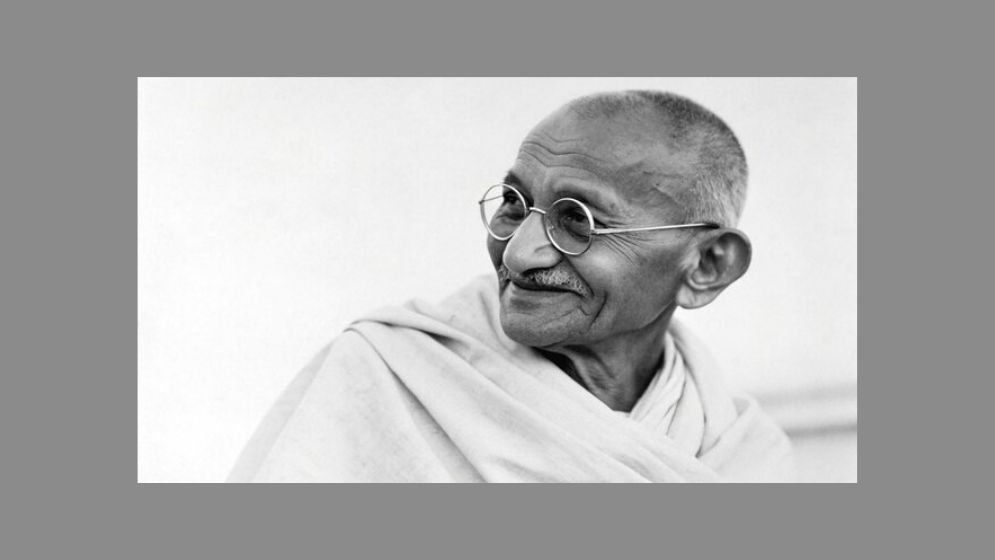
Photo: Collected
We usually remember Mahatma Gandhi through a handful of familiar images: a walking stick in his hand, a simple dhoti, his head slightly bowed as he walked; sitting on a fast; or leading India’s struggle for independence. Every year, on his birth anniversary, he is remembered, his message of non-violence is discussed and his political role is revisited.
For Bangladesh, one of the most significant chapters of
Gandhi’s life is Noakhali.
In November 1946, at the age of 77, Gandhi travelled to
Noakhali after communal violence had devastated the area. He left for Noakhali
on 6 November and reached Chaumuhani the following day. He then travelled
through affected areas, spoke to people and witnessed the consequences of the
violence firsthand.
His decision to go to Noakhali carried considerable political significance. At a time when the administration and political leadership were struggling to protect people amid intense communal tension, Gandhi treated his physical presence among those affected as a political responsibility.
For him, being directly beside people had become more important than holding a
large political meeting or delivering a major speech.
Truth, non-violence and swaraj were central to Gandhi’s political thought. Swaraj, for him, meant more than the end of British rule. It was connected with human dignity, the right of people to make decisions about their own lives and participation in local society.
Through the idea of Gram
Swaraj, he imagined a society in which people would participate in decisions
affecting their lives and play a role in managing their economic and social
affairs at the local level.
His Noakhali journey gave that idea a practical dimension.
The then Premier of Bengal, Huseyn Shaheed Suhrawardy, had arranged special travel facilities for Gandhi and his associates. Gandhi declined them. According to contemporary accounts, he said such arrangements were for “big people”.
At Goalundo, he explained that he was going to Noakhali
to console people affected by the riots and wipe the tears of the oppressed.
On 13 November, Gandhi asked members of his entourage to go
and live in affected villages. He also spoke of remaining there as a kind of
hostage for the safety of the Hindu minority. His aim was to help create a
sense of security among people who had been exposed to communal violence.
On 2 January, 1947, at Chandipur, Gandhi decided that he
would no longer wear shoes while walking on the soil of Noakhali. He
subsequently walked barefoot through villages in Noakhali and the then Tippera
district.
This decision can be seen as a personal symbol, but its
political meaning was larger. Gandhi was trying to reach people who had
suffered violence and rebuild a measure of trust and security among communities
living with fear.
His contact with Suhrawardy was also important.
Suhrawardy was the Premier of undivided Bengal and one of
the leading figures of the Muslim League. His role in the communal politics of
1946 remains a subject of historical debate. Yet Gandhi maintained
communication with him. Their political differences did not prevent dialogue.
That tendency—to keep a channel of communication open
despite serious political disagreement—was an important feature of Gandhi’s
politics.
In August 1947, when communal violence broke out again in
Calcutta, Gandhi postponed his plan to return to Noakhali. Instead, he decided
to remain in the city with Suhrawardy. On 13 August, they moved into Hyderi
Mansion in Beliaghata, where the surrounding area had been deeply affected by
communal violence.
Gandhi remained there until 7 September.
When violence intensified in Calcutta on 31 August, his plan
to go to Noakhali was abandoned. On 1 September, he began a fast. After 73
hours, he ended it on 4 September. That night, people came to him carrying
weapons, surrendered them and pledged to stop the violence.
The episode later became known as the “Calcutta miracle”.
Gandhi’s politics during these years remains relevant
because non-violence, for him, was not merely a moral slogan. It involved
standing beside people facing injustice and violence.
His political life also raises a difficult question: how can
political disagreements remain within the space of dialogue without turning
opponents into enemies?
That question is not irrelevant to Bangladesh today.
Mob violence, attacks on minorities, intolerance towards
dissent and violence within families all raise the problem of how violence
gradually becomes accepted as normal behaviour.
The 2024 Violence Against Women Survey conducted by the Bangladesh Bureau of Statistics and the United Nations Population Fund provides disturbing evidence.
Under the survey’s Bangladesh-context definition, 76% of women had experienced at least one form of intimate-partner violence in their lifetime, while 49% had experienced such violence in the previous 12 months.
Among women who had experienced physical or sexual violence by their husbands,
64% had never told anyone.
The situation involving children is also deeply concerning.
According to the 2025 Bangladesh Multiple Indicator Cluster Survey, 85.7% of
children aged 1–14 had experienced physical punishment or psychological
aggression by adult household members during the month preceding the survey.
These figures bring us to a basic question: how does
violence gradually become normal behaviour in a society?
There is no need to reproduce Gandhi’s past exactly. His
time, politics and society were very different from ours. But questions about
human safety, dignity and tolerance towards those who think differently remain.
Gandhi’s Noakhali experience also reminds us that
non-violence does not mean asking victims to endure violence silently. It
requires confronting violence, protecting vulnerable people and refusing to
accept force as a legitimate way of settling differences.
Gandhi’s efforts did not prevent Partition. His work in
Noakhali did not end communal hatred. On 30 January, 1948, he was assassinated
by a gunman, less than six months after independence.
Yet the value of a political effort cannot always be
measured by whether it achieved its immediate objective.
Gandhi went to Noakhali when fear had become part of
everyday life. He walked through affected villages, spoke with people and tried
to restore a sense of security at a time when that task seemed almost
impossible.
That is perhaps why the image of Gandhi walking barefoot
through Noakhali remains more relevant to Bangladesh than the familiar
commemorative portrait.
On 2 October, 2026, the 157th birth anniversary of Mahatma
Gandhi was observed. More than a political programme, the most important legacy
of that 77-year-old man who went to Noakhali may be a moral position: when
violence takes hold, do not remain safely at a distance from the people who are
suffering.
Gandhi therefore leaves us with several questions.
When fear takes over, whose side will we stand on?
When political differences deepen, will we keep the door to
dialogue open?
And when people cannot protect their own safety, who will
take responsibility for protecting them?
The answers were not easy then.
They are not easy now.