



 For all latest news, follow the Daily Sun's Google News channel.


Youth display potential of digital legal aid in Bangladesh
Participants developed ideas across six thematic areas
Daily Sun Report, Dhaka
Published: 28 Sep 2026, 10:07 PM
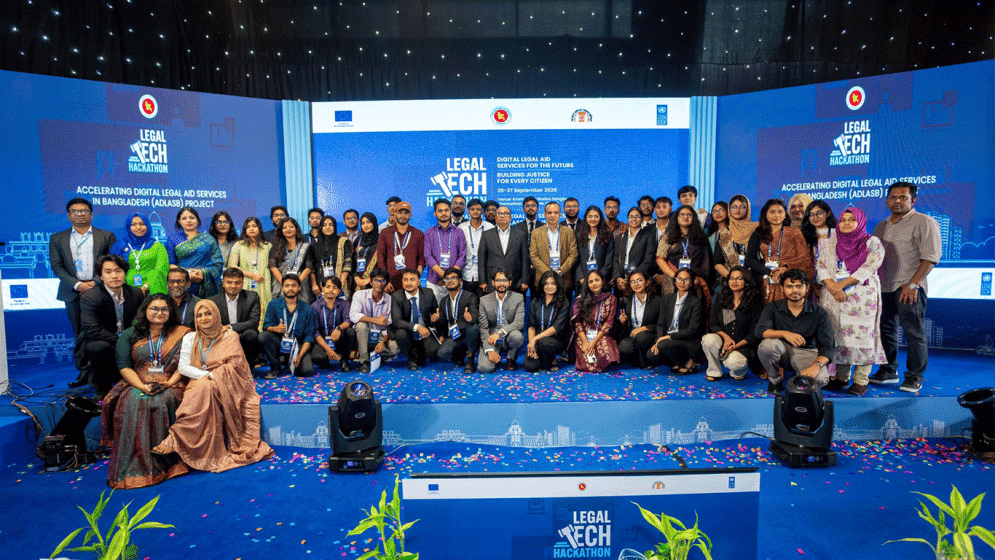
Photo: Courtesy
Young innovators from across Bangladesh demonstrated how technology, creativity and public-service thinking can help transform access to justice at the “Legal-Tech Hackathon 2026: Digital Legal Aid for Future” which concluded on Sunday in the capital.
The two-day national hackathon brought together
students from law, computer science and information technology, business,
governance, public administration and the social sciences to develop practical
digital solutions to some of the challenges people face in accessing legal aid,
said a press release.
The hackathon was organised under the Accelerating
Digital Legal Aid Services in Bangladesh (ADLASB) project, funded by the
European Union, implemented by the Directorate of Bangladesh Legal Aid (DBLA)
under the Law and Justice Division of the Ministry of Law, Justice and
Parliamentary Affairs, and technically supported by the United Nations
Development Programme (UNDP).
The project is supporting Bangladesh’s transition
towards a more accessible, efficient and people-centred digital legal aid
system, initially across eight pilot districts.
The competition attracted around 1,250 students
forming nearly 250 teams from across Bangladesh, reflecting strong interest
among young people in contributing directly to the country’s justice-sector
transformation.
Participants developed ideas across six thematic
areas, including improving access to legal aid, responsible applications of
artificial intelligence, digital case management, online dispute resolution,
inclusive service delivery, and AI-supported call-centre services.
Following an initial selection process, mentoring
and expert engagement, the finalist teams refined their concepts and presented
their solutions before a multidisciplinary jury during the grand finale.
Beyond identifying winning ideas, the hackathon
created a platform for young people to engage directly with real institutional
challenges and explore how innovation could contribute to the ongoing
development of Bangladesh’s digital legal aid services.
Md Monjurul Hossain, director general of Directorate
of Bangladesh Legal Aid (DBLA), Law and Justice Division, Ministry of Law,
Justice and Parliamentary Affairs, attended the closing ceremony as chief guest.
Highlighting the importance of ensuring that
digitalisation delivers tangible benefits for justice seekers, he said, “Going
digital is not just about turning paper forms into computer files. Technology
must make justice simpler, faster, and accessible to everyone.”
Anowarul Haque, assistant resident representative of
Democratic Governance Cluster at UNDP Bangladesh, highlighted the broader
significance of investing in the ideas and capabilities of young people.
“Bangladesh's future will be shaped by people who
can bring together knowledge with imagination, technology with empathy, and
innovation with a sense of public responsibility. What we have seen during this
hackathon gives us every reason to believe that those people are already here,”
he said.
At the conclusion of the grand finale, Res Judicata
Digitalis from the University of Dhaka was awarded first place, followed by CoU
JusticeLab from Comilla University as first runner-up and Law Debuggers, an
inter-university team, as second runner-up.
The winning teams were recognised not only for
technological innovation, but also for the practicality, inclusiveness and
potential public value of their solutions. Their proposals demonstrated how
youth-led innovation can contribute to making legal aid services more
responsive, accessible and user-centred.
The hackathon forms part of the wider justice reform effort under ADLASB to place people at the centre of Bangladesh’s digital legal aid transformation, combining institutional reform, technology and innovation to help ensure that legal assistance is easier to reach for those who need it most.