


 For all latest news, follow the Daily Sun's Google News channel.


Call to reduce fossil fuel dependence to protect fisheries
Daily Sun Report, Dhaka
Published: 24 Sep 2026, 04:49 PM
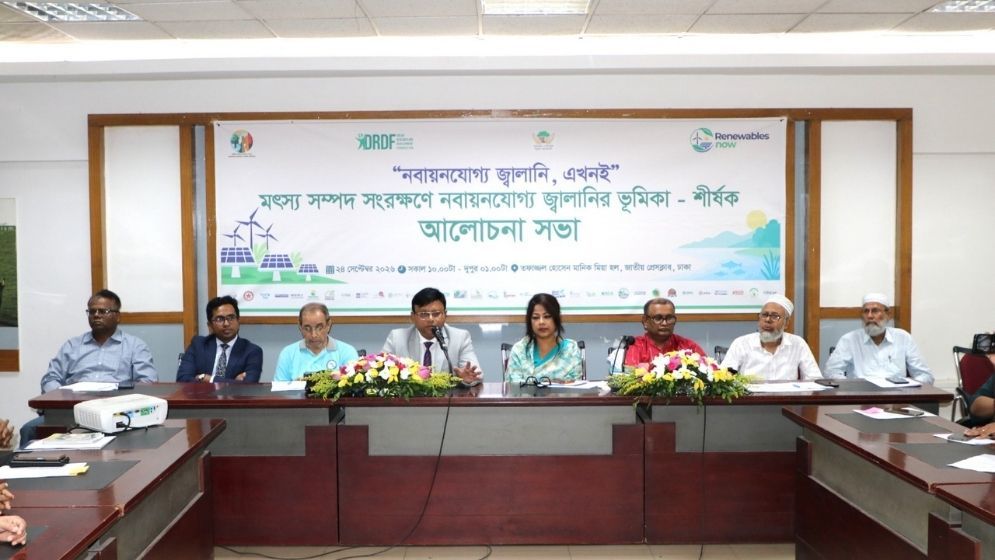
Photo: Courtesy
Lawmakers, fisheries experts and environmental activists have called for reducing dependence on fossil fuels and expanding renewable energy use to protect fisheries resources, aquatic biodiversity and coastal livelihoods.
They
also stressed the need to assess the environmental impacts of fossil-fuel-based
power plants on fish sanctuaries and breeding grounds and promote solar and
other renewable energy technologies across the fisheries sector.
The
call came at a discussion titled “Renewables Now to Protect Fisheries” at the
National Press Club in Dhaka on Thursday.
The
event was organised under the “Renewables Now” campaign by Dhoritri Rokhhay
Amra (DHORA), Dream Research and Development Foundation (DRDF), Sundarban and
Coastal Protection Movement and 34 other civil society and social
organisations.
Nikhil
Chandra Bhadra, coordinator of the Sundarban and Coastal Protection Movement,
chaired the discussion.
Engineer
Md Ashraf Uddin Bokul, chairman of the Parliamentary Standing Committee on the
Ministry of Defence, attended as the chief guest, while Bithika Binte Hossain,
MP, was the special guest. DHORA member Iqbal Faruk delivered the welcome
address.
Speakers
included Dr Md Anisur Rahman, former chief scientific officer of the Bangladesh
Fisheries Research Institute; Mostafa Kamal Majumdar, president of the
Bangladesh Environment Journalists Forum; Abdul Qayum, former district
fisheries officer; and Rafiqul Islam Azad, former president of the Dhaka
Reporters Unity.
Iqbal
Faruk said ash, heated water and pollutants from coal-fired power plants are
entering rivers and disrupting the growth and survival of fish, while heavy
metals are also accumulating in fish.
“To
protect fisheries resources, we must move away from fossil fuels, phase out
coal-fired power plants and install solar power facilities on their existing
sites,” he said.
Mir
Mohammad Ali, president of DRDF and an assistant professor at Sher-e-Bangla
Agricultural University, said excessive dependence on fossil fuels was creating
risks for fisheries resources.
Fly
ash and heated water from coal-fired power plants contribute to river
pollution, reduce dissolved oxygen levels and harm fish, he said, calling for a
rapid transition to renewable energy and a planned phase-out of coal-fired
power plants.
Ashraf
Uddin Bokul said exemptions from duties and VAT had been provided for importing
renewable energy equipment to help meet at least 20% of national electricity
demand from renewable sources by 2030.
He
said rooftop solar and solar irrigation were being encouraged, while
initiatives were underway to allocate government-owned land for renewable
energy projects and develop battery storage facilities.
Bithika
Binte Hossain said tackling the impacts of climate change required collective
efforts alongside the expansion of renewable energy.
She
stressed the need for public cooperation in implementing government plans and
called on young people to play an active role in the efforts.
Nikhil
Chandra Bhadra said the discussion should lead to collective action involving
the government, experts, fishers, civil society and citizens to promote
renewable energy and protect fisheries resources and the environment.
Veteran
journalist Mostafa Kamal Majumdar said efforts to expand renewable energy had
been continuing for years and called for a specific action plan to implement
measures already taken.
He
also suggested establishing a Solar Energy Corporation, similar to institutions
in developed countries, if necessary.
Dr
Md Anisur Rahman said even small changes in water temperature, pollution
levels, dissolved oxygen, pH and other water-quality parameters could
significantly harm hilsa and other fish species.
Such
changes could disrupt aquatic ecosystems and food chains, he said, stressing
that strong action on renewable energy must be accompanied by effective
implementation of existing recommendations.
The
discussion ended with a call for immediate and coordinated action to accelerate
the transition to renewable energy and protect Bangladesh’s fisheries, aquatic
ecosystems and coastal livelihoods.