



 For all latest news, follow the Daily Sun's Google News channel.


Govt not responsible for current energy crisis: Titumir
PM’s finance adviser blames previous government’s import-dependent energy policy; calls for research into its costs and structural reforms to revive investment and production
Daily Sun Report, Dhaka
Published: 02 Sep 2026, 11:09 PM
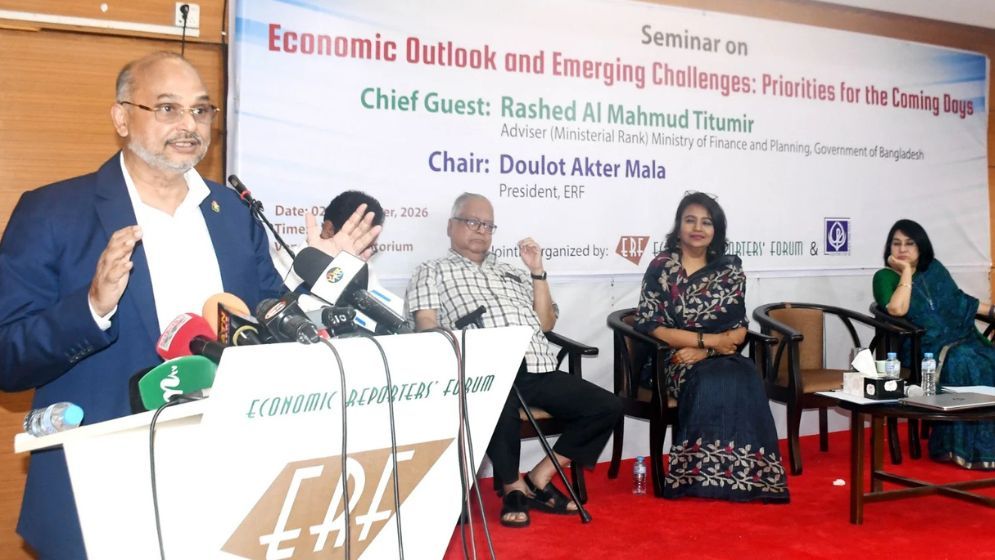
Photo: BSS
Prime Minister’s Adviser on Finance and Planning Rashed Al Mahmud Titumir said the current government bears no responsibility for the ongoing electricity and fuel crisis, attributing the situation to the previous authoritarian government’s flawed, import-dependent energy policy.
He made the remarks on Wednesday at a seminar titled “Economic Outlook and Emerging Challenges: Priorities for the Coming Days”, organised by the Economic Reporters’ Forum (ERF), with the Centre for Policy Dialogue (CPD) as co-organiser.
The seminar was held at the ERF auditorium in the capital, with Titumir as the chief guest.
National Professor Mahbub Ullah, CPD Distinguished Fellow Fahmida Khatun and FBCCI Administrator Fazlul Hoque also spoke at the event.
ERF President Doulot Akter Mala chaired the session, while ERF General Secretary Abul Kashem moderated it.
In his address, Titumir said young people should be made aware of the massive debt burden left by the previous government as a result of its policies in the power and energy sectors.
He called for research into the “cost of inaction” or “cost of wrongdoing” associated with those policies, urging universities, research organisations and professional associations to conduct comprehensive studies on the issue.
Titumir also said floating LNG terminals would be established as necessary to help address the energy crisis.
Asked how the government would finance the proposed new pay structure, he said revenue collection would be strengthened by increasing income tax and VAT collection.
“We will sit with journalists and discuss the revenue collection figures for the first quarter of the current fiscal year,” he said. “We are taking various measures to increase income tax and VAT collection. Each month, we are focusing on a different sector. We have also taken several initiatives to prevent tax evasion.”
Speaking at the seminar, National Professor Mahbub Ullah said Bangladesh must move away from an economy based on plunder and return to one focused on development and production.
CPD Distinguished Fellow Fahmida Khatun presented an assessment of the country’s economic situation, saying the new government had begun taking steps to implement its election manifesto.
“It cannot be said that there has been either a clear improvement or deterioration over the past six months,” she said. “Inflation has declined somewhat, but although the rate of inflation has fallen, the overall price level remains high. As a result, people’s purchasing power has declined. Wages have not increased proportionately, leading to a decline in real incomes.”
Fahmida said there had been some improvement in indicators such as foreign exchange reserves and inflation, while concerns remained over production, investment, employment and energy.
She stressed the need for deep structural reforms to address the country’s persistent economic challenges.
“Uncertainty, the energy crisis, and instability in the banking sector have discouraged investment,” she said.
FBCCI Administrator Fazlul Hoque said export growth was a notable achievement despite the ongoing energy crisis.
He said exporters had been forced to bear additional costs to maintain production and meet export commitments, including expenses for diesel, generators and overtime.
He called for the urgent reactivation of coal- and oil-fired power plants to help ease the current crisis.
“This would reduce some of the pressure on gas supplies, allowing more gas to be diverted to the industrial sector,” he said.