


 For all latest news, follow the Daily Sun's Google News channel.


Govt to set up specialised research centre to assess semiconductor industry potential
Such initiatives could help develop high-tech engineering expertise domestically, reduce brain drain and contribute to Bangladesh’s technological self-reliance
Daily Sun Report, Dhaka
Published: 10 Aug 2026, 04:03 PM

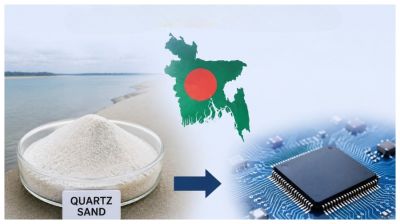
The government is planning to establish a specialised research facility to assess the feasibility of producing semiconductor-grade raw materials from the country’s river sand, potentially opening a new avenue for the development of the domestic high-tech industry.
The proposed Sand Processing and Research Centre
(SPRC) is envisioned as a key hub for developing a semiconductor materials
ecosystem in Bangladesh, according to a recent review study by Dr Md Sohel
Rana, deputy director of the Bangladesh Geological Survey.
According to the study, the SPRC would go beyond
functioning as a conventional laboratory. It would feature pilot-scale mineral
beneficiation, chemical purification and advanced materials-characterisation
facilities.
The centre would initially assess the technical and
commercial feasibility of producing high-purity silica and metallurgical-grade
silicon from sand collected from the Brahmaputra-Jamuna, Padma and Teesta
rivers.
The study noted that Bangladesh’s river sand may
contain silica with purity levels of up to 99.5%. However, semiconductor
manufacturing requires much higher levels of purity, including control of
ultra-trace impurities. The proposed centre would focus on research and
technologies needed to achieve such standards.
Sohel Rana said the centre could create new research
and employment opportunities for Bangladeshi scientists and engineers while
strengthening links between universities and industry.
He said skilled human resources and innovation would
be critical to developing the semiconductor sector. Through the SPRC, young
engineers could gain hands-on experience in high-purity mineral analysis, VLSI
design and mineral-processing technologies.
Such initiatives could help develop high-tech
engineering expertise domestically, reduce brain drain and contribute to
Bangladesh’s technological self-reliance, the study said.
The proposed centre would also seek joint research
opportunities with global semiconductor companies and facilitate the transfer
of advanced refining technologies to Bangladesh. Under the proposed roadmap,
its technological capabilities would be developed in phases between 2026 and
2050, with the long-term goal of integrating locally sourced raw materials into
the global semiconductor supply chain.
“Bangladesh is currently going through a period of
transition. We have vast quantities of quartz-rich sand originating from the
Himalayas, which is a strategic resource,” Sohel said. “However, there is no
alternative to specialised research centres like the SPRC if we want to make
this resource suitable for chip manufacturing.”
He said directly entering chip fabrication would be
highly capital-intensive and risky. Therefore, the study recommends
establishing the SPRC as an initial step to ensure raw-material purity and
develop downstream silica-based industries such as optical fibre and speciality
glass manufacturing.
According to the proposed national roadmap, the
first five years would focus on mineral mapping and operating a pilot facility.
However, the study identified high investment
requirements and limited access to advanced technologies as major challenges to
implementing the project.