


 For all latest news, follow the Daily Sun's Google News channel.


Who owns Bangladesh's identity? The battle for its secular soul
Special Correspondent
Published: 21 Jul 2026, 06:17 PM
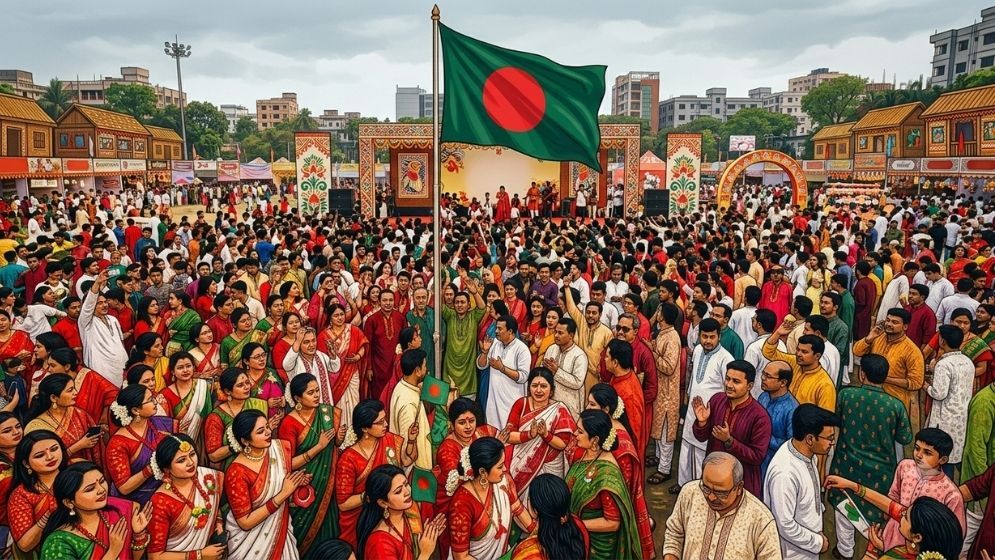
Representational image
Every FIFA World Cup has traditionally transformed Bangladesh into a celebration of shared joy. Streets filled with the flags of Argentina, Brazil, Spain or Germany have long reflected not political loyalties but a love of sport that transcends class, religion, and ideology. This year, however, the mood felt different. In some places, football flags gave way to religious ones, while organised groups in parts of the country openly campaigned against football, particularly girls' participation. These may appear to be isolated incidents, but together they raise a larger question: Is Bangladesh's secular cultural identity coming under increasing pressure?
The country's prolonged political uncertainty
since the 2024 transition has created fertile ground for identity politics.
Religion and nationalism have increasingly dominated public discourse, while
cultural issues have become political battlegrounds. Anti-India rhetoric has
also become a powerful political tool. While criticism of India's policies is a
legitimate part of democratic debate, sweeping anti-India narratives have, at
times, spilled over into hostility towards Bangladesh's Hindu minority, with some
groups portraying Bengali cultural traditions as inherently "Hindu"
and therefore incompatible with Muslim identity. Such narratives risk deepening
communal divisions and weakening the inclusive civic culture that has long
distinguished Bangladesh.
Though during the interim government the
major national celebrations, including Pahela Boishakh and sponsored cultural
programmes were organised, yet the real concern lies elsewhere. Critics argue
that while official celebrations continued, the state often appeared less
effective in protecting Bangladesh's pluralistic cultural space from
intimidation, vandalism, and ideological campaigns targeting secular
institutions.
That concern has been amplified by attacks on
symbols of Bangladesh's history and culture. During the political unrest,
Liberation War memorials, murals, museums, and historically significant
buildings associated with the country's independence were vandalized or
damaged. Such incidents are not merely acts of destruction; they represent an
assault on the historical memory of a nation founded through immense sacrifice.
The pressure has also extended to cultural
institutions. Chhayanaut and Udichi—two organisations that have spent decades
nurturing Bengali music, literature, and progressive cultural traditions, and
which have previously been targets of extremist violence—again faced vandalism,
intimidation, and sustained campaigns seeking to discredit their work. These
developments have renewed concerns about the shrinking space for artistic expression
and secular cultural practice.
Equally troubling are repeated attempts to
restrict women's participation in public life. Organised opposition to girls'
football tournaments and online campaigns policing women's dress and behaviour
reflect a broader effort to redefine public life through a more conservative
social vision. Meanwhile, attacks on Sufi shrines and folk religious traditions
threaten forms of Islam that have historically embodied Bangladesh's spirit of
tolerance, inclusivity, and coexistence.
None of this suggests that Bangladesh is
abandoning its secular foundations. But it does underscore the need for
vigilance. The responsibility does not rest with the government alone.
Political parties, universities, intellectuals, artists, journalists, and civil
society all have a role in defending the country's pluralistic traditions.
Protecting secularism should never be viewed as defending one political party
over another; it is about preserving the constitutional values upon which the
Republic was founded.
Bangladesh emerged in 1971 through a struggle
rooted in linguistic nationalism, cultural pluralism, and equal citizenship.
Those ideals remain the nation's greatest strength. The battle for Bangladesh's
future is no longer fought on the battlefield but in classrooms, cultural
institutions, public squares, and digital platforms. If the country fails to
protect its shared cultural heritage from polarisation and intolerance, it
risks losing not only monuments and traditions but also the inclusive national
identity that gave meaning to its independence.