


 For all latest news, follow the Daily Sun's Google News channel.


Bangladesh pushes digital overhaul of land services to combat corruption
Daily Sun Report, Dhaka
Published: 30 Jun 2026, 01:41 PM
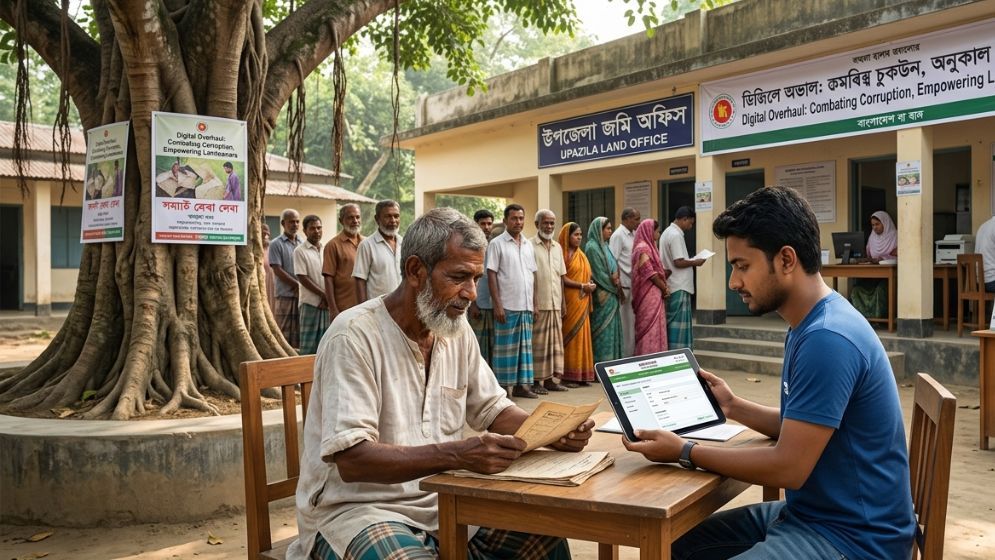
The government is accelerating the digital overhaul of land services in an effort to curb corruption, reduce delays and improve public access to services.
However, despite the rollout of new technologies, experts and recent data suggest that deep-rooted irregularities continue to undermine the sector.
Land-related services in Bangladesh have long been associated with bureaucratic delays, unofficial payments and the influence of middlemen.
In response, the Ministry of Land has introduced a range of digital initiatives, including mobile applications, geo-fencing technology and online service platforms, aimed at minimising direct contact between citizens and officials.
State Minister for Land and Chittagong Hill Tracts Affairs Mir Mohammed Helal Uddin said the government's priority is to make land services more efficient, transparent and accessible through digitalisation.
"Our objective is to reduce human interaction in service delivery. The more services people can access digitally, the fewer opportunities there will be for corruption and harassment," he said.
At the centre of the initiative is the Bhumi App, which has been downloaded more than 100,000 times. The application enables users to pay land development tax, apply for and monitor e-mutation requests, verify land records, obtain digital copies of khatians and mouza maps, submit complaints online, calculate inheritance shares and manage a unified landowner profile linked to national identity information.
To support citizens with limited digital skills, the government has authorised 893 land service centres nationwide, where users can receive assistance for a nominal fee.
The ministry has also launched awareness campaigns through local administrations, schools and religious institutions, while distributing instructional materials and videos to encourage greater use of online land services, particularly in rural communities.
Despite these efforts, many people continue to depend on brokers to navigate the system.
Dhaka resident Rafikul Islam, who recently used the digital platform, said the online services had significantly simplified the process.
"I completed several procedures online and received assistance from a service centre when necessary. Compared with the conventional system, it saved both time and effort," he said.
However, Zakir Hossain from Shailkupa upazila in Jhenaidah said limited internet access and low digital literacy remain major obstacles outside urban areas.
"Many people still believe brokers can get files processed more quickly. Technology is helpful, but effective implementation and public awareness are equally important," he said.
Officials concede that technology alone cannot eliminate practices that have become entrenched over decades.
As part of wider reforms, the ministry is preparing to introduce Bhumi Drishti, a geo-fencing-based attendance monitoring system for land offices. Once field trials are completed, the platform will create virtual boundaries around offices, allowing supervisors to track officials' attendance in real time through a central dashboard.
"If an official leaves the designated office boundary during working hours, the system will immediately record the movement on the dashboard," the state minister said.
Helal Uddin also highlighted a structural issue within the sector, noting that land administration and land registration fall under separate ministries. While land administration is overseen by the Ministry of Land, sub-registrar offices are administered by the Ministry of Law.
According to the minister, many irregularities begin during the registration process, including forged deeds and documentation-related disputes.
To address these problems, the government is expanding digital cadastral surveys, developing a central land information repository and integrating land registration with land information systems to improve record accuracy and reduce disputes.
The authorities are also linking land acquisition compensation payments to the government's Integrated Budget and Accounting System (iBAS++) so funds can be transferred directly to beneficiaries, reducing manual intervention and opportunities for malpractice.
Despite these reforms, corruption in the land sector remains widespread.
According to the latest survey by Transparency International Bangladesh (TIB), 66.2% of households receiving land-related services experienced some form of corruption, up from 51% in 2023. Nearly 47.6% reported paying bribes, with the average unofficial payment reaching Tk11,310 per household.
The survey estimated that bribery linked to land services amounted to approximately Tk30.81 billion nationwide, the highest among all public service sectors examined.
Land disputes also continue to place a heavy burden on the country's judicial system. Bangladesh currently has more than 4.7 million pending court cases, with the Association for Land Reform and Development identifying land conflicts as one of the principal drivers of the civil case backlog.