


 For all latest news, follow the Daily Sun's Google News channel.


Experts call for stronger govt, civil society collaboration to transform primary education
Bobby Hajjaj emphasised the government's commitment to improving learning outcomes through stronger collaboration with NGOs and other stakeholders
Daily Sun Report, Dhaka
Published: 29 Jun 2026, 05:44 PM
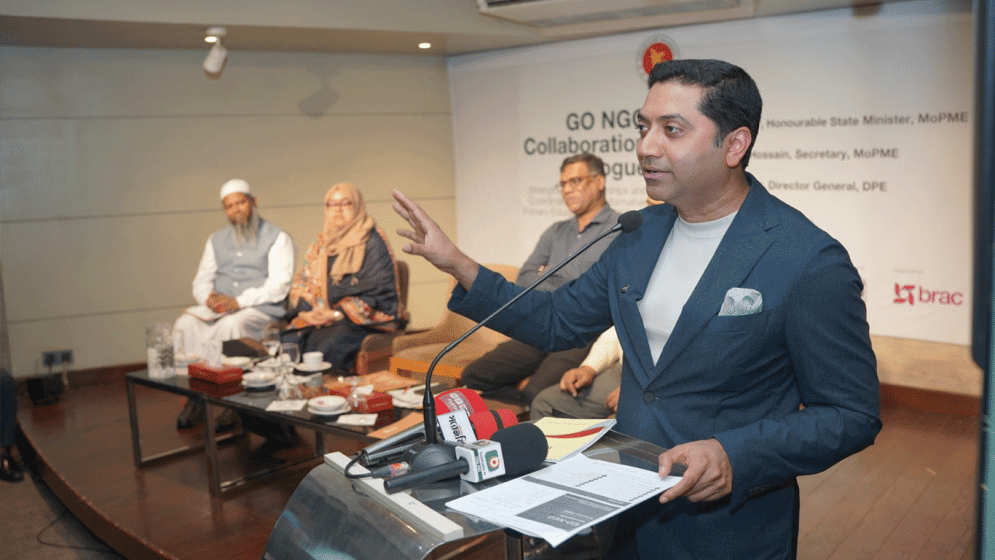
State Minister for Primary and Mass Education Bobby Hajjaj speaking at an event organised by Brac in the capital on Monday. Photo: Courtesy
Experts have stressed the importance of strengthening collaboration between the government and non-government organisations to achieve the goals of the Fifth Primary Education Development Programme (PEDP-5).
The call was made at the “GO–NGO Collaboration
Dialogue: Strengthening Partnerships and Coordination for Transformative
Primary Education under PEDP-5”, organised jointly by the Directorate of
Primary Education (DPE) and BRAC on Monday at BRAC Centre in Dhaka, said a press
release.
During the event, the experts focused on some key
priorities which include: developing a structured GO–NGO collaboration
framework; accelerating foundational literacy and numeracy outcomes; expanding
support for inclusive, climate-resilient and digital learning; strengthening
education services in hard-to-reach areas; integrating NGO data into national
systems; and enhancing disaster preparedness, health, nutrition and WASH
initiatives in primary schools.
The chief guest at the event was Bobby Hajjaj, state
minister for Primary and Mass Education. Shahina Ferdousi, director general of
Directorate of Primary Education, chaired the event, while Farid Ahmed,
director general of National Academy for Primary Education (NAPE) and chairman
of Diploma in Primary Education (DPEd) Board, and Md Abdur Rahim, additional
director general of Directorate of Primary Education, attended as special
guests.
Mohammad Atiqur Rahaman, additional director general
(PEDP4) of Directorate of Primary Education, provided the keynote presentation
and KAM Morshed, senior director of advocacy, communications and engagement at
BRAC, moderated the question-and-answer session after the keynote address.
Safi Rahman Khan, director of education, skills
development and migration at BRAC, provided the welcome address.
In his address as chief guest, Bobby Hajjaj
emphasised the government's commitment to improving learning outcomes through
stronger collaboration with NGOs and other stakeholders. He identified five key
areas requiring joint action under PEDP-5 including curriculum, teachers,
administration, infrastructure, and technology.
He noted that the programme would be implemented
through a range of targeted projects to advance these priorities.
He observed that while Bangladesh had made
significant progress in primary education, considerable work remained to ensure
quality learning for all children. Stressing that learning outcomes must remain
at the centre of reform efforts, he highlighted the importance of delivering
quality education at scale while making the system increasingly inclusive.
He also underscored the value of NGO partnerships in
responding to emerging challenges, noting that NGOs' flexibility and community
reach complement the government's broader institutional capacity.
The state minister further highlighted the need for
scalable, sustainable approaches capable of delivering long-term improvements
across the primary education system.
Speaking as chair of the event, Shahina Ferdousi
described NGOs as key partners in extending the reach of education services at
the grassroots level. She noted that collaboration with NGOs is integral to
policy development, implementation, monitoring, and evaluation.
Speaking as a special guest, Farid Ahmed emphasised
that stronger government–NGO collaboration offers valuable opportunities to
share knowledge, experience and best practices across the education sector. He
noted that while NGOs have long contributed to improving education at the
grassroots level, the success of all interventions ultimately depends on their
impact in the classroom.
Speaking as a special guest, Md Abdur Rahim said
that every parent hopes to see their child complete primary education
successfully and progress confidently to secondary school. He emphasised the
importance of working together to realise this shared aspiration and called for
continued collaboration and support from all stakeholders to ensure better
educational outcomes for every child.
Syed Rashed Al-Zayed, senior economist at the World
Bank, and Dr Mostafizur Rahman, deputy director of Campaign for Popular
Education (CAMPE), shared their views, while the vote of thanks was provided by
Md Ataur Rahman, deputy-project director (PEDP4) of Directorate of Primary
Education.
A session on collaborative planning and consensus
building was moderated by Md Moazzem Hossain, programme head of development at
BRAC Education Programme. Ahsania Mission, B-SCAN, Educo Bangladesh, Actionaid
Bangladesh, World Vision, Save the Children, BIED, and other organisations
participated in the session.