


 For all latest news, follow the Daily Sun's Google News channel.


Experts hope women’s political empowerment to accelerate national development
Separate panel discussions were also held on women's representation in local government
Daily Sun Report, Dhaka
Published: 27 Jun 2026, 09:23 PM
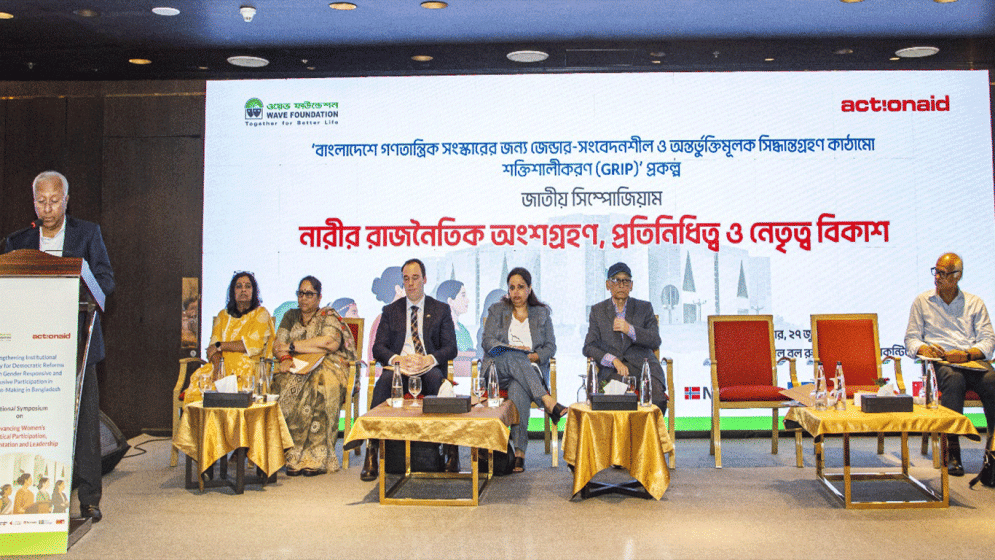
Experts at a discussion on women's political representation on Saturday. Photo: Daily Sun
Speakers at a national symposium have said that ensuring women's political empowerment will further accelerate women's development in Bangladesh.
They emphasised that greater political
participation, representation, and leadership for women can be achieved through
political commitment, effective democratic reforms, and internal changes within
political parties.
These remarks were made on Saturday at a day-long national symposium titled "Women’s political participation, representation and leadership development," organised by WAVE Foundation and ActionAid Bangladesh at Hotel InterContinental in the capital.
The symposium, chaired by WAVE Foundation Executive
Director Mohsin Ali, was attended by members of parliament Rasheda Begum Hira,
Nusrat Tabassum, and Sanjida Islam Tulee as special guests.
Other participants included Bangladesh Election
Commission Senior Secretary Akhtar Ahmed, Deputy Secretary Shah Alam, UN Women
Representative Gitanjali Singh, Australian High Commission First Secretary
(Political) Harry Thompson, Canadian High Commission Second Secretary
(Development, Gender Equality) Stéphanie St-Laurent Brassard, representatives
of various political parties, members of civil society, and media
professionals.
In his closing remarks as the chief guest, Election
Commissioner Md Anwarul Islam Sarkar said that coordinated efforts by the
Election Commission, political parties, civil society, the media, and local
communities are essential for promoting women's political participation and
leadership.
He noted that such initiatives would play a vital
role in advancing democratic reforms and strengthening decision-making
institutions.
In his welcome address, WAVE Foundation Executive
Director Mohsin Ali stressed the need to raise public awareness and amplify the
voices of women politicians to promote women's political participation and
leadership.
He said this would encourage greater involvement of
women in democratic reforms and the electoral process.
UN Women Representative Gitanjali Singh said that
inclusive democracy is not merely a women's issue but an essential condition for
democracy itself. She emphasised that women must be recognised not only as
voters but also as candidates, leaders, and decision-makers.
Australian High Commission representative Harry
Thompson said political parties should view women not simply as beneficiaries
of opportunities but as a significant political force.
Canadian High Commission representative Stéphanie
St-Laurent Brassard noted that women's political participation also contributes
positively to economic growth and social development.
A research paper presented at the symposium
highlighted the need for political parties to implement the Representation of
the People Order (RPO) and adopt gender-sensitive democratic reforms.
Separate panel discussions were also held on women's
representation in local government, leadership development, and political
violence against women.
Based on the day's discussions, a draft
"Charter of Demands for Women's Political Empowerment" was presented.
The proposed recommendations included internal
reforms within political parties, mandatory nomination of a specified number of
women candidates in national and local government elections, achieving 50-50
representation in the long term, conducting regular gender audits of political
parties, establishing complaint resolution mechanisms to address political
violence against women, and increasing women's representation in local
government through direct elections.
The organisers said that the opinions and
recommendations gathered during the symposium would be finalised and submitted
to policymakers.
WAVE Foundation is implementing the project titled
"Strengthening Gender-Sensitive and Inclusive Decision-Making Structures
for Democratic Reform in Bangladesh" in partnership with ActionAid
Bangladesh.
The project, carried out with the support of the
Bangladesh Election Commission, aims to make democratic institutions more
inclusive and ensure equal participation of women and men in local and national
electoral processes.