


 For all latest news, follow the Daily Sun's Google News channel.


Mega plan underway to strengthen Dhaka’s earthquake preparedness: Secy
Daily Sun Report, Dhaka
Published: 24 Jun 2026, 05:46 PM
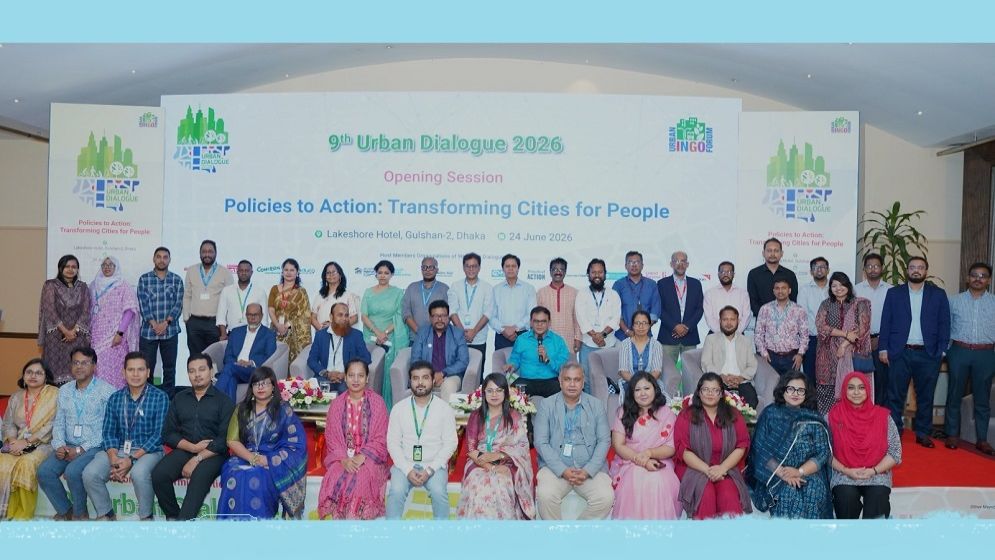
Photo: Courtesy
The government has embarked on a mega-plan to strengthen
Bangladesh’s disaster preparedness and transform Dhaka into a
disaster-resilient city, with a special focus on earthquake response, said Md
Saidur Rahman Khan, Secretary at the Ministry of Disaster Management and
Relief.
He made the remark at the 9th urban dialogue, organised by
the Urban INGO Forum Bangladesh, in the capital on Wednesday.
He said the primary objective of these initiatives is to
build a disaster-resilient urban community through effective policy
implementation and enhanced public awareness.
According to the plan, the government has identified 450
assembly points across Dhaka where residents can gather and receive emergency
assistance after a major earthquake. The locations are being verified by the
Geological Survey to ensure they are not situated on active fault lines.
To strengthen rescue operations, authorities have prepared
an inventory of more than 50 categories of heavy equipment from the Armed
Forces, Fire Service, Red Crescent and private organisations.
Plans are underway to establish a National Emergency
Operations Centre (NEOC) and introduce an Incident Command System (ICS) to
improve coordination during disasters.
The government also plans to incorporate disaster preparedness
into the national curriculum through teacher training and awareness programmes.
Authorities said a comprehensive mega-plan is being
implemented to make Dhaka a disaster-resilient city, alongside initiatives to
excavate 20,000 kilometres of canals and plant 250 million trees over the next
five years.
Dr Adil Muhammad Khan, professor of Urban and Regional
Planning at Jahangirnagar University and executive director of the Institute
for Planning and Development (IPD), delivered the keynote presentation titled
“Policies to Action: Transforming Cities for People".
He stressed that the human dimension must be prioritised in
city planning and decision-making, noting that an inclusive city cannot be
built solely through buildings, roads or vehicle-centred development.
“The bigger question is not how much money we spend every
year, but how many more people we are able to bring under essential services,”
he said.
"If we work towards a 10- to 15-year vision with people
at the centre of our planning, we can change the negative perceptions
surrounding our cities,” he added.
The session was chaired by Manish Kumar Agrawal, country
director of Concern Worldwide Bangladesh, while Muhammad Mahfuzur Rahaman, national
director of Habitat for Humanity International Bangladesh and Secretariat of
the Urban INGO Forum, delivered the welcome address.
The vote of thanks was offered by Chandan Z. Gomes, Senior
Director of Operations of World Vision Bangladesh.