


 For all latest news, follow the Daily Sun's Google News channel.


BNP govt will begin work on Teesta Barrage too: PM
BSS, Gazipur
Published: 20 May 2026, 06:22 PM
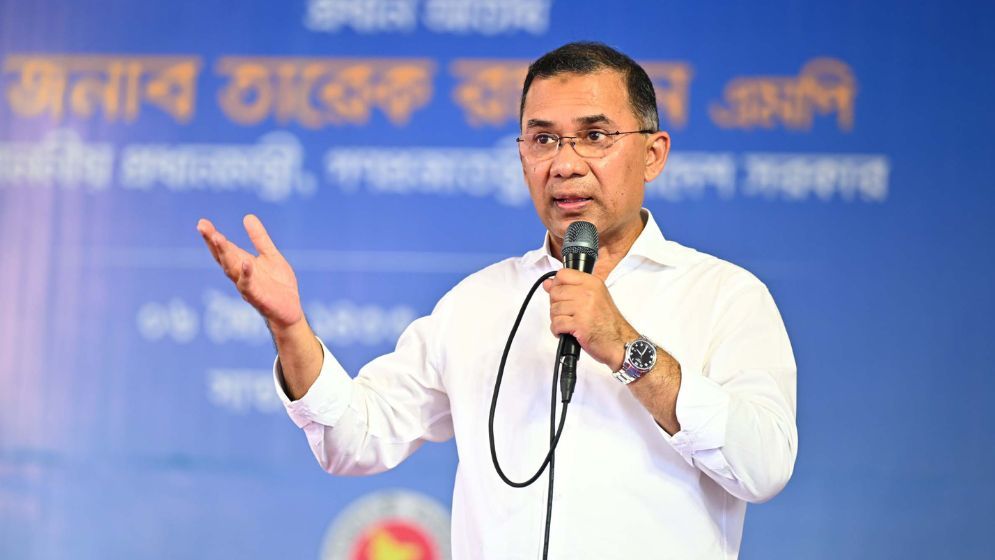
Photo: PID
Prime Minister and BNP Chairman Tarique Rahman said on Wednesday that the BNP government would start work on the Padma Barrage and Teesta Barrage projects.
“I want to clearly state that this BNP government will begin work on the Padma Barrage and, Inshallah, also on the Teesta Barrage. Under the leadership of today’s disaster management and relief minister, the BNP carried out various programmes regarding the Teesta issue. Therefore, if anyone has worked, delivered, and prepared the ground, it is the BNP,” he said.
The prime minister made the remarks while addressing a civic gathering after laying the foundation stone of the National Disaster Management Research and Training Institute building here this afternoon.
Stating that the government has already decided to construct the Padma Barrage in the country’s northern and southern regions, especially on the Padma River in Rajshahi, he said, “Over the border, barrages are being built and water is being diverted in different ways, while we receive less water during the dry season.”
“We want to construct this barrage so that people and farmers in our country can get water on time during both monsoon and dry seasons.”
Tarique warned about another issue caused by the Farakka Barrage, saying: “Another serious issue is that seawater is entering the southern region because of the Farakka Barrage. As a result, salinity is increasing in areas, including the Sundarbans. Many plants are being damaged, while various animals are becoming extinct.”
He said, “Therefore, we must construct the barrage and preserve excess monsoon water for use during the dry season.”
Referring to climate change, the prime minister said, “The winter is now less intense even in January. I clearly remember that when we were students, we wore sweaters during rehearsals for cultural events on the occasion of Independence Day on 26 March.”
Speaking about environmental degradation and urbanisation, he said, “Very likely, 20 to 25 years ago, the place where we are standing today was underwater. Certainly, there must have many trees around this area. Now there are not many trees today. There are a lot of buildings.”
Referring to a video documentary screened at the event, he said, “In this video, we saw a small scene. The video might have shown the place where the Rohingyas live in Cox's Bazar. There are about 13 lakh Rohingyas.
“I visited Teknaf in Cox’s Bazar in 2005 or 2006. At that time, the area was full of trees. Now shelters for Rohingyas have been built there, meaning thousands of trees have been cut down,” he added.
Tarique also referred to a proposed road project in Cox’s Bazar, saying, “I recently saw a newspaper report stating that around 3,000 trees would need to be cut down because of the road design from Cox’s Bazar, along the beach, to Ukhiya.
“After seeing the report, I called the minister concerned over the phone and instructed him to discuss the matter with engineers and carry out the work without cutting trees.”
Highlighting groundwater depletion, he said, “In Gulshan and Cantonment areas in Dhaka, water used to be available just 20 to 25 feet underground. Now people reportedly need to go down 600 to 700 feet to get water. This issue is not directly, but indirectly related to agricultural work.”
The prime minister said, “Our farmers are drawing water through deep tube wells to produce crops for 20 crore people. As a result, it is slowly becoming empty from below. Naturally, when the bottom becomes empty, it will collapse from above.”
Highlighting the BNP’s electoral pledge of excavating canals, he said, “Alhamdulillah, after forming the government, we have already started the canal excavation programme. It is deeply connected with people’s lives, agriculture, and even earthquake-related risks.”
Noting that even a small disaster causes severe damage in Bangladesh, Tarique said, “Our crops are destroyed and livestock suffer losses due to even the slightest disaster. Therefore, there are two main objectives of today’s programme – to conduct research on changing weather patterns and train people on disaster preparedness and response after establishing the institute.
“We cannot stop natural disasters. We do not have the power to control them. However, we can inform the people and make them aware of the disasters. Today’s programme should become a pledge that we will not only raise awareness among people but also become aware ourselves,” he added.
“Our country has limited resources. If we can protect and properly utilise them for the country and its people, we can gradually grow into a developed country. But if resources are destroyed, public suffering will increase,” he said.
Disaster Management and Relief Minister Asadul Habib Dulu, State Minister M Iqbal Hossain and Director General of the Department of Disaster Management Razwanur Rahman spoke at the event.
A documentary produced by the Department of Disaster Management was screened at the beginning of the event, and a commemorative crest was presented to the prime minister.
Prime Minister’s Defence Adviser Brig Gen (retd) AKM Shamsul Islam, lawmakers, and senior government officials were present at the event.