


 For all latest news, follow the Daily Sun's Google News channel.


Community schools seen as solution to garment workers’ children’s education gap
Daily Sun Report, Dhaka
Published: 19 May 2026, 07:16 PM
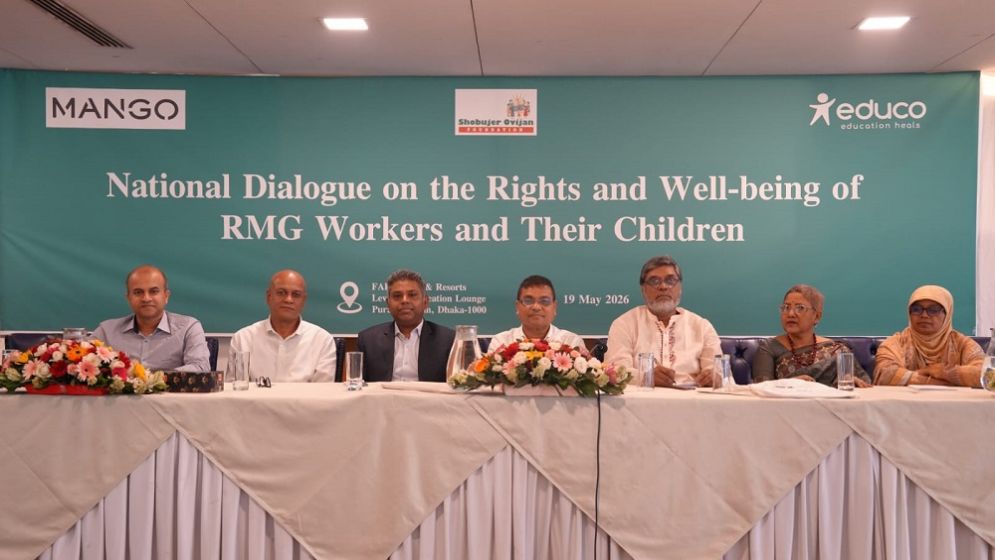
Photo: Courtesy
Community Based Learning Centers (CBLCs) are showing
significant progress in addressing the education gap of garment workers,
according to the SMILE project endline evaluation brief.
The findings were presented in a national dialogue titled
“Rights and Well-being of RMG Workers and Their Children” at a hotel in the
capital on Tuesday.
The project was implemented by EDUCO Bangladesh, with
funding from MANGO and in collaboration with the Shobujer Ovijan Foundation
(SOF), at 19 factories in the Savar Upazila and Gazipur Sadar area of Dhaka.
Educo Bangladesh Project Manager Rafeza Akter presented the
overall activities and objectives of the SMILE Project.
The presentation on the project’s impact and achievements
was delivered by Irfath Ara Iva, CEO of H&H Research and Consultancy.
Country Director of EDUCO in Bangladesh, Abdul Hamid, said
female workers are contributing largely in the garment sector; however, their
children are significantly neglected in education, including care and security.
We introduce a rightly based model, which is helpful for
these purposes. The investment in the care of children is a strategical
investment that plays a major role in our sustainable economy, he added.
According to project findings, children enrolled in CBLCs
demonstrated noticeable improvements in: Basic literacy and numeracy skills,
Classroom participation and confidence, Psychosocial well-being and emotional
stability and regular engagement in learning activities.
The learning centers also created a safe and structured
environment, helping children stay connected to education even when formal
schooling support is limited.
The SMILE Project shows broader workplace improvements that
indirectly support children’s education outcomes. Worker satisfaction increased
from 43.4% to 84.8%, while collaboration between workers and factory management
rose sharply from 60% to 95%.
Mohammad Mozammel Haque, Joint Secretary of the Ministry of
Labor and Employment as a chief guest in this event.
He said that they have realized the need for daycare centers
and community-based facilities.
He added that if the government’s capacity increases,
necessary attention will definitely be given to this issue and existing
challenges will be addressed.
He also noted that those who are financially capable can
also come forward to support such initiatives.
He said that if sufficient resources were available, steps
would have been taken more quickly to establish such centers.
He explained that these facilities not only contribute to
the development of children but also increase productivity in factories by
improving workers’ satisfaction.
He further stated that due to a lack of adequate
opportunities, the children of garment workers are unable to reach their
desired potential. He called on everyone to come forward in support of these
initiatives.
Female garment workers are being marginalized and dropping
out of the workforce, calling for urgent attention from all stakeholders, said
Naimul Ahsan Jewel, General Secretary of Jatiya Sramik Jote Bangladesh and
member of NCCWE.
At the event, the success stories of the SMILE Project
titled “Voice of Change” and the “Educo Annual Report” were officially unveiled.
Special guests at the event included Imran Kader Turjo,
Director of BKMEA; and Md. Mahfuzur Rahman Bhuiya, Joint Inspector General of
the Department of Inspection for Factories and Establishments.
Under the “Strengthening Meaningful Participation of Factory
Workers and Their Children in Leveraging a Decent Environment to Enjoy Their
Rights and Well-being in Bangladesh (SMILE) project, 12 Day Care Centers (DCCs)
and 5 Community-Based Learning Centers (CBLCs) are being operated. Through
these, 120 children aged 0–5 years are receiving daycare services, and 3,000
children aged 5–12 years are engaged in community-based learning activities. In
addition, 10,000 factory workers (8,000 women and 2,000 men), 300 factory
management representatives, and 35 teachers and caregivers are directly
benefiting from the project. Furthermore, approximately 43,000 people are
indirectly benefiting from the initiative.