


 For all latest news, follow the Daily Sun's Google News channel.


Planners demand opening BRT corridor as removing and opening cost equally
Daily Sun Report, Dhaka
Published: 19 May 2026, 10:59 AM
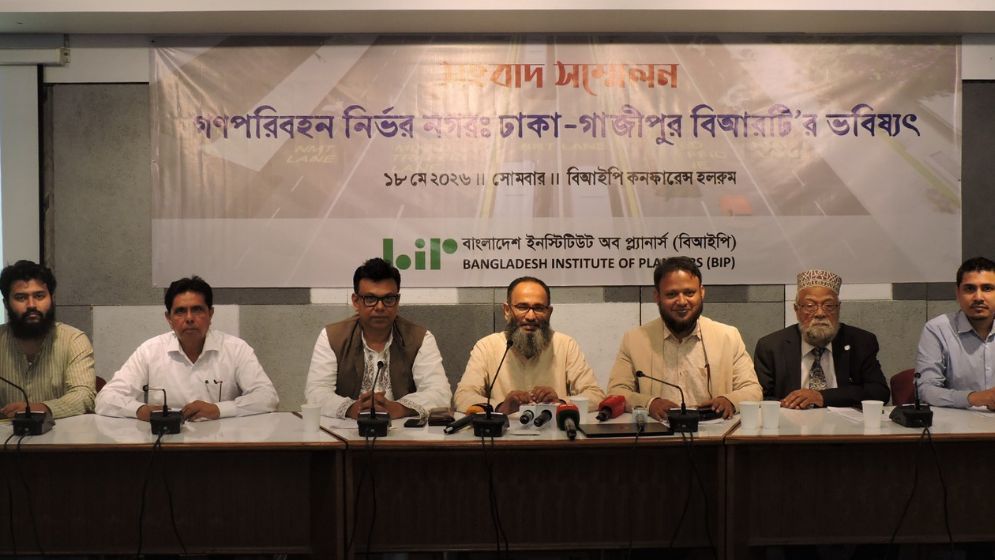
Photo: Daily Sun
Urban planners urged the government to open the 21 kilometers Gazipur-Airport Bus Route Transit Corridor before dismantling the infrastructures based on the suggestions from consultants, as they said that the government needs an equal amount of money to dismantle and open the system.
They came up with the recommendations in a press conference titled ‘Public Transport Dependent Dhaka: Future of Gazipur-Dhaka BRT at the head office of the Bangladesh Institute of Planners at Banglamotor in the capital on Monday (18 May).
Presenting a paper, the BIP’s general secretary, Dr Musleh Uddin Hasan said that the government has invested more Tk4,000 crore and now there is a discussion for dismantling the system based on reports from the consultants but it is possible to reap benefits from the system by reversing the thought.
He said, “The project started in 2012 and was supposed to be completed in 2016, but it has not been completed to date. Still, the money the project has for it is enough for basic BRT service introduction. The government may need additional Tk200-300 crore for purchasing buses and Tk1,000 for electric buses. But if the BRT corridor is cancelled and open for all transports and it has to remove the existing stations, ramps, and escalators and compensation to the contractors, which will cost it Tk1,000-1,200 crore.”
He said that the BRT system proved effective in many cities that are populous cities, and it is suitable for Bangladeshi cities.
He laid out several proposals in the conference, including opening the corridor within six months, reconstructing and strengthening the BRT company management board with appropriate professionals, and taking on one more BRT project in the Dhaka-Narayanganj and Gazipur urban regions.
The BRT corridor project, which was initiated in 2012 to make public transport faster and popular in urban areas and implemented by the Roads and Highways, the Bangladesh Bridge Authority, and the Local Government Engineering Department, faltered as many important components like purchasing buses for the corridor and construction of a bus depot, could not be completed.
The interim government had the project reviewed by the two committees, and the reports of the committee were reviewed by a group of experts led by BUET Prof Shamsul Huq, who made some recommendations.
One of the recommendations says, “Considering the above-mentioned changed circumstances, field observations, and the limited utility of the proposed BRT system, together with its potential operational impacts leading to degradation of the Level of Service (LOS) of this national highway, it would be prudent to abandon the BRT operation. Accordingly, any further investment aimed at making the BRT system operational, including procurement of buses, would not be justified.”
The recommendation also says, “Any attempt to operate the system either by private operators or BRTC would not be advisable, as such an arrangement is unlikely to bring tangible benefits and may instead lead to further inconvenience for road users.”
Another recommendation says, “The halted BRT project should therefore be formally closed, after completing the required remaining structural components that would be compatible with the proposed plan. The settlement of outstanding contractual matters with the contractors can be made in accordance with the contractual agreements.”
Sources at the BIP said the future of the under-construction BRT is going to be one of the agenda in the cabinet meeting very soon and it is likely that the government will uphold the recommendation by the experts and based on the apprehension, the planners have arranged a briefing to present their views.
Former president of the BIP Adil Mohammed Khan said, “A group of professionals recommended the BRT project a decade ago but now the same people said that it will be a burden for the government and inconvenient for the road users. This is really sarcastic.”
Speaking on the occasion, the Vice-President BIP Shaikh Muhammad Mehedi Ahsan said that the project failed due to the faulty feasibility study, which lacked in checking technical viability.
It is worth mentioning that China Gezhouba Group Co. Ltd. (CGGC) and Jiangsu Provincial Transportation Engineering Group Co. Ltd were the construction contractors.
During the construction period, it was pointed out that there were some flaws in the designs of the infrastructure, which were done by a group of consultants.
The government formed a committee to discern the responsibilities of the firms. The project’s consulting firms included SMEC International and Brisbane City Enterprise from Australia, SYSTRA SA from France, and ACE Consultants Limited from Bangladesh. Their responsibilities included project management, coordination, and capacity development, as well as supervision and management of engineering, procurement, and construction activities.
In addition, CEPT University and the Bureau of Research, Testing and Consultation (BRTC), BUET were jointly assigned the responsibility of developing the operational and business model for the BRT corridor. However, CEPT University and BUET later withdrew from the project.