


 For all latest news, follow the Daily Sun's Google News channel.


Three-day air pollution campaign begins in Dhaka
The event’s chief guest was freedom fighter Abul Hossain
Daily Sun Report, Dhaka
Published: 16 May 2026, 05:10 PM
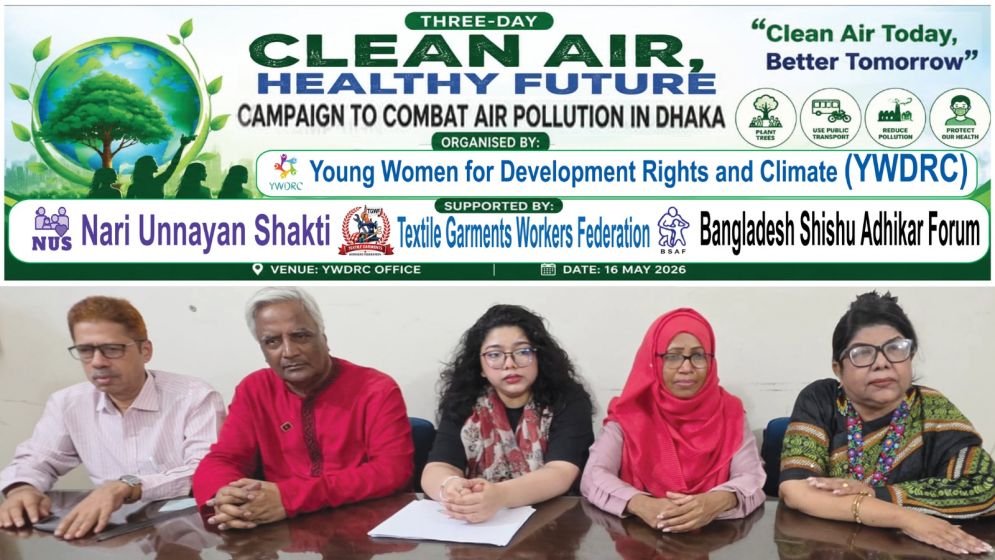
Photo: Courtesy
A three-day campaign titled “Clean Air, Healthy Future” was inaugurated in Dhaka on Friday to raise public awareness and press for urgent action against worsening air pollution in Bangladesh.
The campaign, organised by Young Women for
Development Rights and Climate (YWDRC), began in the Khilgaon area, with the
inaugural programme held at the organisation’s office in Banasree, Rampura,
said a press release.
The initiative received support from Nari Unnayan
Shakti, Bangladesh Shishu Adhikar Forum, and the Textile Garments Workers
Federation.
YWDRC Executive Chairperson Nusrat Sultana Afroj
chaired the event and presented the keynote paper. Citing World Health
Organization (WHO) data, she said nearly 99% of the global population currently
lives in polluted air environments.
Referring to a study conducted by Dhaka Medical
College Hospital (DMCH) between 2020 and 2024, she said respiratory-related
hospital admissions increase by more than 3.8% for every 10-point rise in the
Air Quality Index (AQI). Increased PM2.5 concentrations also significantly
raise hospital admissions, particularly among vulnerable groups.
Speakers at the programme warned that children under
five and elderly people are among the worst affected by air pollution,
suffering from asthma, pneumonia, cardiovascular diseases, stroke, lung cancer,
allergies, and impaired lung development.
The event’s chief guest was freedom fighter Abul
Hossain, president of the Textile Garments Workers Federation. Special guests
included Dr Afroja Pravin, executive director of Nari Unnayan Shakti;
Khairuzzamal Kamal, vice-president of Bangladesh Shishu Adhikar Forum; Abdul
Momen, executive member of the Forum for Culture and Human Development; and
Selina Khatun, publicity secretary of the Domestic Worker Employers
Association.
Speakers stressed the need for immediate government
action and adequate budget allocation to tackle air pollution, which they
described as a major public health and environmental crisis.
During the programme, organisers and participating
civil society groups placed a 13-point demand before the government. The
demands included formulating a national clean air action plan, shutting down
illegal and highly polluting brick kilns, enforcing environmental laws in
industries, modernising public transport, banning open waste burning, expanding
urban forestry, introducing real-time air quality monitoring systems, and
increasing investment in renewable energy.
The campaign organisers also called for stronger
environmental education in schools and greater involvement of NGOs and youth
groups in environmental protection initiatives.