


 For all latest news, follow the Daily Sun's Google News channel.


Potato farmers in Joypurhat face heavy losses amid storage crisis
Saud Abdullah, Kalai
Published: 15 May 2026, 12:00 AM
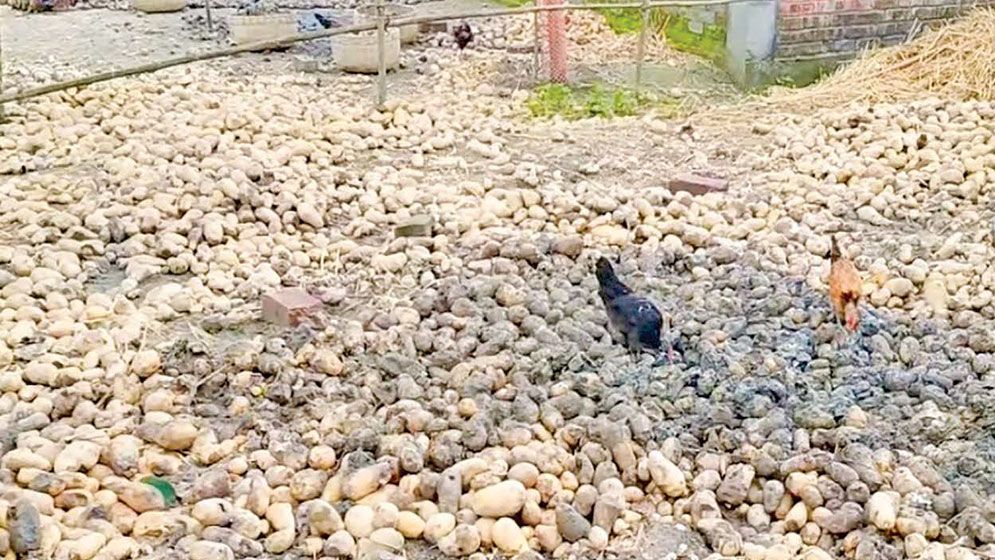
Despite a bumper potato harvest in Joypurhat this season, farmers across the district are facing severe financial losses due to low market prices, shortage of cold storage facilities, rising storage costs and extensive potato decay.
Farmers said the cost of producing potatoes this year ranged between Tk15 and Tk20 per kilogram, while the market price has dropped to only Tk8 to Tk9 per kilogram. After adding cold storage expenses, the total cost rises to Tk20–25 per kilogram, forcing farmers to incur losses of around Tk7 to Tk8 per kilogram.
According to the Joypurhat Department of Agricultural Marketing, potatoes were cultivated on around 39,300 to 40,000 hectares of land in the district during the 2026 season, producing nearly 1 million tonnes. However, the combined storage capacity of the district’s 21 private cold storages is only 216,300 tonnes, enough to preserve just around 22% of total production.
As a result, huge quantities of potatoes are being stored in farmers’ homes, temporary sheds and open fields, where many are rotting due to excessive heat, humidity and recent heavy rainfall. The situation is particularly difficult in Kalai upazila, where piles of potatoes were seen dumped beside roads, fields and homesteads. In several areas, the stench of rotten potatoes has spread through local communities.
Md Amirul Islam, a farmer from Sardarpara in Kalai municipality, said he cultivated potatoes on 20 bighas of land at a cost of around Tk54,000 per bigha. He said the current market price is not enough to recover even half of his production cost.
Another farmer, Abdul Hamid of Aklapara village in Udaypur union, said he cultivated potatoes on seven bighas of land but could not store all his produce due to a shortage of cold storage space. Much of the potatoes stored at home are now rotting, causing heavy losses.
Frequent power outages have further complicated the situation. Cold storage operators said continuous load shedding has forced them to rely heavily on generators, sharply increasing operational costs.
Punat Cold Storage Manager Biplob Ghosh said the facility now consumes 75 to 80 litres of diesel per hour to maintain cooling during power cuts. He added that mechanical faults are also increasing because of irregular electricity supply.
Palli Cold Storage owner Md Mosharraf Hossain Bhutto said monthly diesel expenses have risen from around Tk10,000–15,000 to Tk30,000–40,000 due to prolonged generator use. Potato trader Mithu Fakir said prices have fallen sharply because of excessive supply in the market and the shortage of storage facilities, which forced many farmers to sell potatoes at once. He also blamed reduced export opportunities and the fuel crisis for the poor market situation.
Kalai Upazila Agriculture Officer Md Harunur Rashid said many farmers are storing potatoes at home without scientific preservation methods, accelerating spoilage and quality deterioration.
Deputy Director of the District Agricultural Extension Department AKM Sadiqul Islam said the district’s cold storage capacity is far below production demand. He stressed the need for more modern cold storages and alternative preservation systems.
District Agricultural Marketing Officer agriculturist Md Mehedi Hasan said the storage crisis occurs every year due to inadequate cold storage capacity. He suggested increasing government potato procurement, expanding export opportunities and creating new markets to reduce farmers’ losses.