


 For all latest news, follow the Daily Sun's Google News channel.


Tk50,000 crore lost every year to traffic jam in capital
Daily Sun Report, Dhaka
Published: 01 May 2026, 08:06 PM
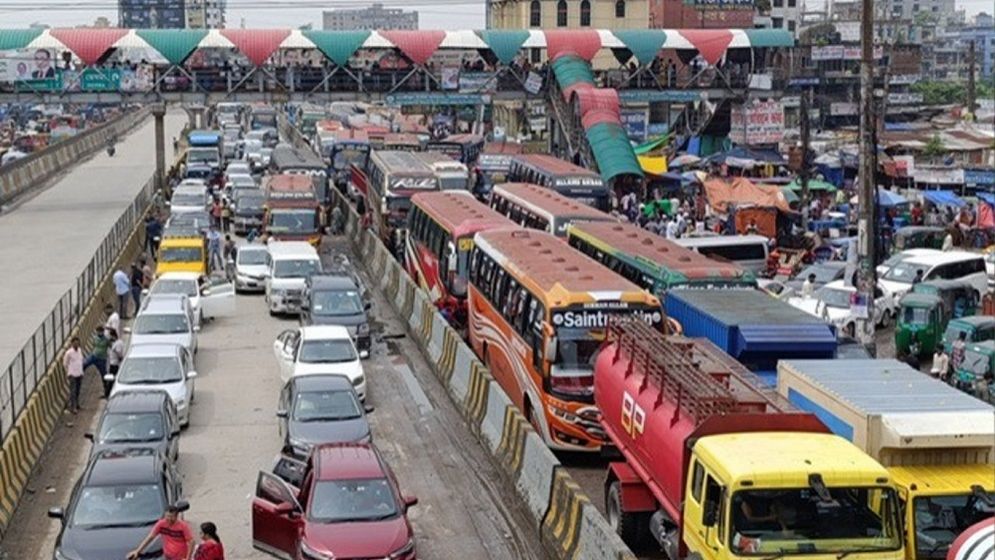
File Photo: Collected
The country is incurring at least Tk50,000 crore losses
every year due to the acute road traffic gridlocks seen every day in the capital, and the
authorities’ consistent failure in addressing the crisis.
The failure can be largely attributed to the lack of
coordination among different government agencies tasked with curbing traffic
jams on Dhaka city roads.
In 2012, the then government formed the Dhaka Transport
Cooperation Authority (DTCA) with aim to coordinate among different agencies.
However, as it was short of enforcement powers, real progress was never
achieved.
DTCA provides services to the two city corporations,
Bangladesh Road Transport Corporation (BRTC), Dhaka Mass Transit Company Ltd
(DMTCL), Bangladesh Road Transport Authority (BRTA) and traffic police – but
cannot ensure effective coordination among them. More alarmingly, DTCA cannot
maintain any channel of coordination with traffic police. DTCA officials have
put the blame on traffic police.
Government buses are operated by BRTC, while private buses
are controlled by various owners’ and workers’ associations.
Dhrub Alam, director of bus route rationalisation project at
DTCA, said, “Although we are responsible for coordinating Dhaka’s transport
system, due to lack of adequate cooperation from other agencies, we are unable
to implement projects and programs effectively.”
The lack of coordination among agencies is most evident in
the determination of bus routes. Currently, around 9,000 buses operate on more
than 291 routes in Dhaka. To address this disorder, the Dhaka Transport
Coordination Authority (DTCA) is attempting to implement the “Bus Route
Rationalization” project, which aims to bring over a hundred private bus
companies under a limited number of companies and operate them on designated
routes.
Under this plan, DTCA has reduced and fixed the number of
routes to 42. However, at the same time, the traffic police have developed
their own separate bus route plan, which conflicts with DTCA’s plan. Moreover,
although the law requires coordination with DTCA in determining routes, there
have been instances where other committees and agencies have also approved
routes independently. As a result, multiple plans exist for the same routes,
creating complications in implementation.
Masihur Rahman, Chief Executive Director of the Dhaka
Transport Coordination Authority (DTCA), told Kaler Kantho, “It is supposed to
be our responsibility to take initiatives on bus route plans, but the police
are doing it. We have raised this issue in ministry meetings, saying that if
they want to make plans, they can do so, but they should at least take our
advice. It would be better if they allowed us to design the plans and then
carried them out in implementation.”
Traffic congestion in Dhaka causes an annual loss of at
least Tk50,000 crore. Based on this, in a decade Dhaka’s traffic jams have
caused losses exceeding Tk5 lakh crore to the state. On 14 March, Inspector
General of Police Ali Hossain Fakir said at a meeting in Gazipur, “Due to
traffic congestion alone, the capital loses Tk140 crore taka daily; this
amounts to Tk50,000 crore annually.”
On 26 June last year, at a seminar of the Policy Research
Institute (PRI), former Chief Adviser’s Special Assistant Sheikh Moinuddin
said, “Traffic congestion in the capital causes annual losses of Tk37,000
crore, enough to build two MRT lines per year. At the same time, five million
working hours are lost annually.”
This crisis requires a coordinated transport management
system.
According to data from the Accident Research Institute (ARI)
of Bangladesh University of Engineering and Technology (BUET) from about four
years ago, traffic congestion in Dhaka causes economic losses of
Tk37,000-Tk55,000 crore annually ($3.5 billion to $5 billion), equivalent to
losing 5% to 10% of GDP.
Beyond financial loss, traffic congestion poses serious
health risks, according to a World Bank report. The global institution
estimates that in 2019, environmental pollution—especially vehicle-related air
pollution—was responsible for 78,000 to 88,000 premature deaths in Bangladesh,
equivalent to about 4% of GDP loss.