


 For all latest news, follow the Daily Sun's Google News channel.


IMF takes tough stance
It has warned that it may withdraw budget support if there are deviations from commitments made by the previous government.
Daily Sun Report, Dhaka
Published: 22 Apr 2026, 08:34 AM

Photo : Collected
The International Monetary Fund (IMF) has said that it will not make any new decisions regarding the stalled loan installments unless reform programmes are implemented thoroughly.
However, it has kept the door open for discussions on new loan programs beyond the ongoing ones. The IMF is reportedly dissatisfied with the progress of reforms in revenue, banking, and the overall financial sector undertaken during the previous Awami League and interim governments.
In particular, the organization has taken a serious view of the failure to strengthen the autonomy of Bangladesh Bank and the leniency shown in recovering non-performing loans. The process of dissolving the National Board of Revenue has also slowed down. As a result, the country’s tax-to-GDP ratio is not increasing—in fact, it is declining. Although the IMF has long advised reducing subsidies from the budget, these have continued to rise every year.
Under stricter compliance conditions, the IMF has promised $1.5 billion in budget support. However, it has also warned that it may withdraw this support at any time if the conditions are not met, according to sources in the Finance Division.
Meanwhile, less than a day after the IMF withheld a tranche of the ongoing $5.5 billion loan program, the government raised fuel prices to a record level. Gas prices have also been increased. However, Finance Minister Amir Khasru Mahmud Chowdhury stated that the fuel price hike was not due to IMF pressure but was driven by global factors.
The impact of higher fuel prices is already being felt across the transport sector, including bus and truck fares, leading to rising commodity prices. An increase in electricity prices is also underway.
Sources said the IMF has adopted a tougher stance on implementing structural reforms amid ongoing pressure on Bangladesh’s economy. This position was communicated to the finance minister during several meetings held on the sidelines of the recently concluded IMF-World Bank Spring Meetings in Washington. The information was confirmed by members of the finance minister’s delegation.
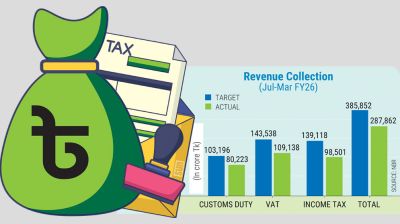
During the meetings, the finance minister presented an overview of the country’s economic situation. In response, the IMF reiterated concerns over weaknesses in revenue collection, monetary policy, exchange rates, and the banking sector. The tax-to-GDP ratio remains between 7–8 percent, which is very low compared to development needs.
The IMF emphasized expanding the tax net, ensuring transparency in the VAT system, and increasing income tax collection. It also advised maintaining a tight monetary policy to control inflation, including raising policy interest rates to regulate money supply and ensuring good governance in the banking sector.
The organization believes that without a fully market-based exchange rate, pressure on foreign currency reserves will not ease. It has urged full implementation of such a system in the upcoming budget.
The IMF also recommended reducing subsidies in the energy sector and gradually introducing market-based pricing, along with minimizing financial losses of state-owned enterprises. It strongly criticized the high rate of non-performing loans and the leniency in loan rescheduling, warning that such practices could further undermine transparency in the financial sector.
Speaking on the issue, former World Bank Dhaka office chief economist Dr. Zahid Hossain said the budget support would help ease pressure on foreign exchange reserves and assist in managing the budget deficit.
However, he cautioned that full benefits of the support would depend on the swift implementation of structural reforms. He noted that failure to meet IMF conditions could result in the withdrawal of budget support at any time, meaning the government must strictly adhere to the agreed conditions.