


 For all latest news, follow the Daily Sun's Google News channel.


No ‘silent expulsion’ in public exams: Education minister
BSS, Dhaka
Published: 18 Apr 2026, 05:00 PM
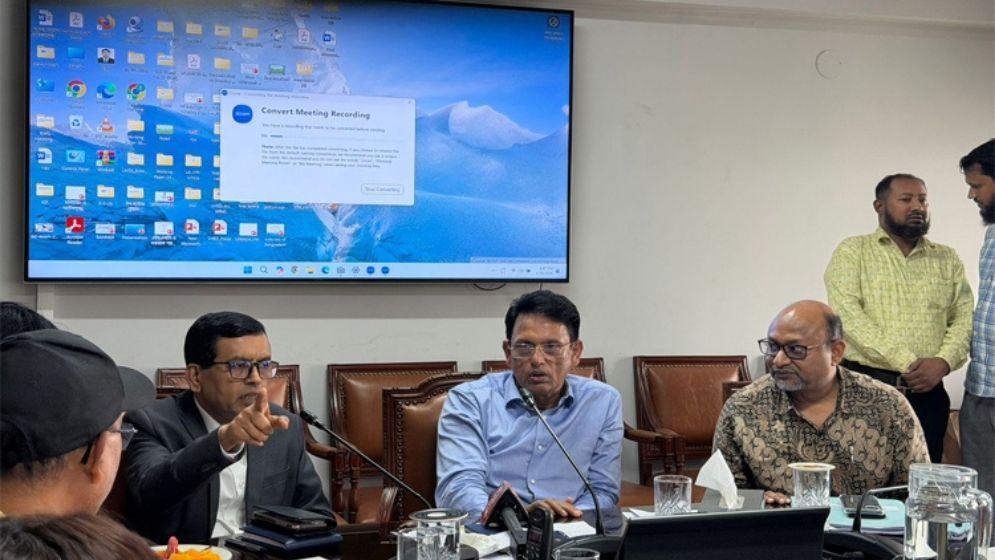
Photo: BSS
Education Minister ANM Ehsanul Hoque Milon on Saturday said there will be no provision for “silent expulsion” in the upcoming public examinations.
“Expelling any
student without proper legal procedure is not lawful. I instructed the
concerned authorities to abolish the controversial Clause 29 immediately of the
old education board policy,” he said.
Milon said this
to BSS after a meeting with the stakeholders to ensure the smooth holding of
the upcoming Secondary School Certificate (SSC), Higher Secondary Certificate
(HSC), and equivalent examinations, 2026.
Expressing
surprise and dissatisfaction over the provision, the minister said, “There can
be no such term as ‘silent expulsion.’ When we conducted examinations under the
Public Examinations Act of 1980, there was no such rule. This is completely
against the law.
He said if
someone is to be punished, it must be done through due process or a transparent
procedure. Whether a student has cheated or not must be proven in the
examination hall itself, he said adding expelling someone silently while they
are at home is in no way acceptable.
“We are confident
that there is no possibility of disorder at examination centers now. Therefore,
I have instructed that this clause in the policy be amended immediately,” he
said.
Regarding the
recent concerns and anxiety among students on social media about “silent
expulsion,” the minister said that the policy related to the Secondary School
Certificate examination was formulated in 1961. The confusion may have arisen
from an outdated and inconsistent version of that policy, he said.
The minister also
informed that the Inter-Education Board Coordination Committee will soon issue
a clarification notice on the matter.
Speaking about
the decisions taken in the meeting, he said, “The HSC and equivalent
examinations will begin on 2 July and will be completed within the following
five weeks. All preparations have also been completed to ensure a smooth
environment for the SSC and equivalent examinations starting on 21 April.”
Reassuring students,
Milon said, “The stricter laws this time are not for students, but for teachers
and center secretaries—to ensure they properly carry out their
responsibilities. We are not chasing students; rather, we are focusing on
improving the quality of education and ensuring accountability and competence
among teachers.”
Highlighting
government initiatives to improve education quality, he said that for the first
time in the country’s history, written examinations have been conducted through
Non-Government Teachers Registration and Certification Authority (NTRCA) for
the recruitment of head teachers and principals, which will play an important
role in enhancing the education system.
The meeting was
attended by senior officials of the ministry of education, chairmen of various
education boards, and also, via Zoom, the deputy commissioners, police superintendents,
upazila nirbahi officers, education board officials, and teacher
representatives from across the country.