


 For all latest news, follow the Daily Sun's Google News channel.


Experts urge for effective programmes, budget allocation to reduce street children
The event saw the participation from parents of disadvantaged children
Daily Sun Report, Dhaka
Published: 12 Apr 2026, 06:21 PM
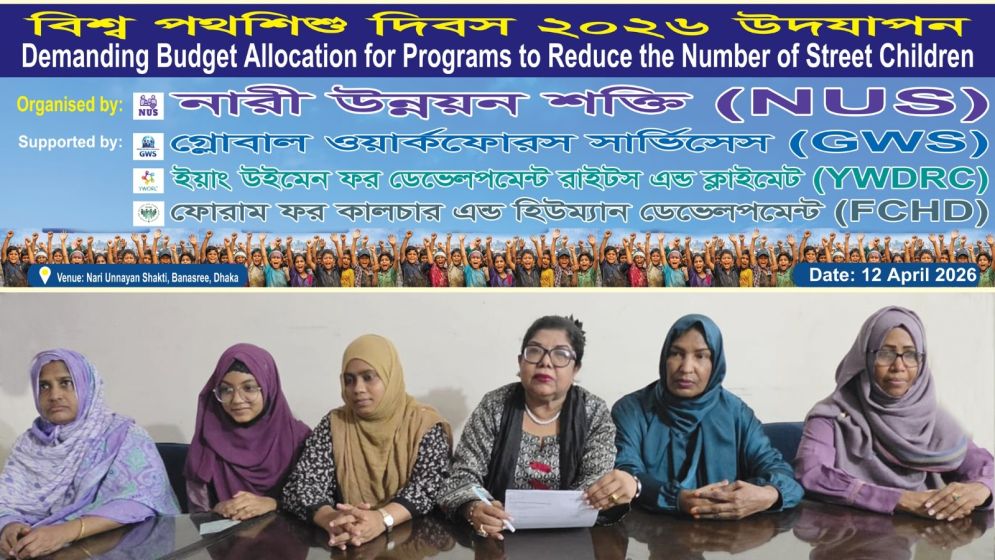
Photo: Courtesy
A group of experts have urged the government to adopt realistic and effective programmes to reduce the number of street children and to ensure adequate budget allocation in this sector.
The demands were raised during an important
discussion meeting held in the capital’s Banasree on the occasion of World
Street Children’s Day 2026 on Sunday.
The event saw the participation from parents of
disadvantaged children. The keynote paper was presented by Dr Afroja Parvin,
executive director of Nari Unnayan Shakti (NUS).
According to the data presented, a recent report
states that approximately 3.4 million children in Bangladesh are living in the streets,
many of whom spend their lives in extreme uncertainty and vulnerability.
Additionally, there are about 56.9 million children
(aged 0–17) in the country, a large proportion of whom are at risk of poverty,
violence, child labour, and child marriage. Among them, around 11.3% are
engaged in child labour.
Speakers highlighted the multidimensional challenges
faced by street children, including lack of safe shelter and housing, exclusion
from education, inadequate healthcare and nutrition, risks of physical and
sexual abuse, vulnerability to drug addiction and crime, and social
discrimination and neglect.
Dr Sultan Muhammad Razzak, executive director of
Forum for Culture and Human Development (FCHD), said that the street children's
problem cannot be solved through temporary assistance alone. Rather, it
requires long-term planning and strong government budgetary commitments.
Nusrat Sultana Afroj, executive chairperson of Young
Woman for Development Rights and Climate, said that dedicated protection
frameworks and skill development programmes are essential to help street
children reintegrate into mainstream society.
Lamia Hasan, representative of Global Workforce
Services, said that without skill development, vocational training, and
employment opportunities, a sustainable solution to the street children issue
is not possible.
Shahanara Begum, executive member of FCHD, stressed
the importance of increasing social awareness and strengthening family-based
support programmes.
Other speakers included Bilkis Akter, executive
member of NUS, Selina Khatun, media & publicity secretary of Domestic
Worker Employers Association Bangladesh, and Monowara Begum, representative of
disadvantaged women, among others.
The speakers collectively placed several demands before
the government, including: increased budget allocation for street children, adoption
of integrated rehabilitation programmes at the national level, ensuring free
access to education and healthcare, effective measures to eliminate child labour,
creation of opportunities for skill development and employment and strengthening
of law enforcement for the protection of street children.
The speakers strongly emphasised that street
children are not a burden on society, but rather a potential human resource.
With proper planning, adequate budget, and sincere initiatives, their lives can
be transformed. Therefore, taking effective action now is the need of the time.