


 For all latest news, follow the Daily Sun's Google News channel.


Bogura-6, Sherpur-3 polls mostly peaceful with minor irregularities: AFED
Vote counting began promptly in most polling stations after the close of voting
Daily Sun Report, Dhaka
Published: 11 Apr 2026, 04:10 PM
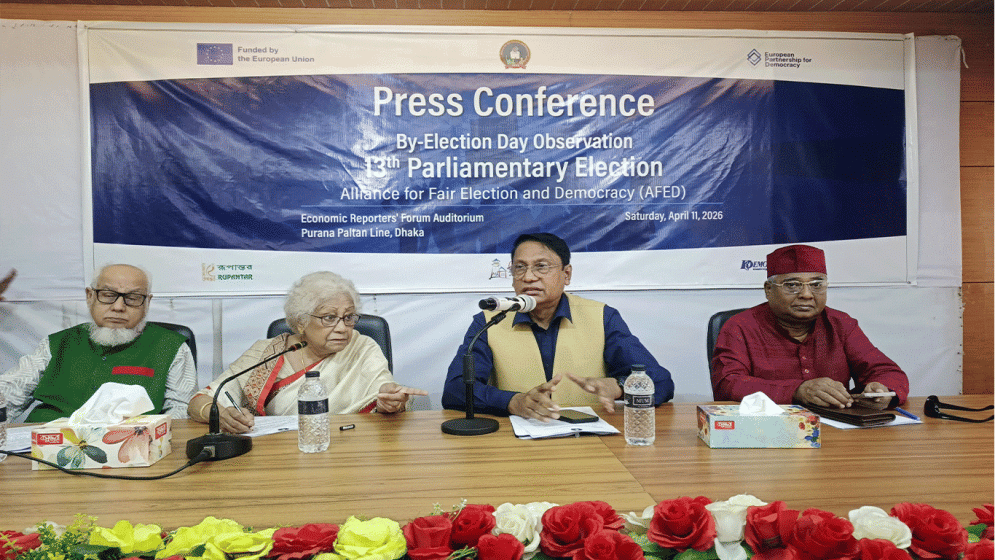
Photo: Courtesy
An election observation mission has found that the 9 April by-polls in Bogura-6 and the Sherpur-3 election were conducted in a generally peaceful and orderly manner, though several administrative and procedural shortcomings were identified.
At a press conference held in the capital on Saturday, members of the Alliance for Fair Election and
Democracy (AFED) said voters were largely able to cast their ballots without
disruption, but emphasised the need for improvements to strengthen public confidence
in the electoral process.
The by-polls in Bogura-6 was held after vacancies
arose in the constituency when the elected candidate retained another seat,
while Sherpur-3 fell vacant following the death of a candidate ahead of the
polls.
AFED spokesperson Harun-Or-Rashid said, “We observed
a generally calm and orderly process, with voters able to participate,” while
noting that certain gaps remain that could be addressed to improve future
elections.
Polling process and accessibility issues
According to observers, polling stations generally
followed standard opening procedures, including showing empty ballot boxes
before sealing and ensuring the availability of required materials. Party
agents from contesting candidates were present during the opening in most
cases.
However, accessibility remained a concern, with 32%
of polling stations not adequately accommodating persons with disabilities,
potentially limiting their ability to participate independently.
Voting was mostly calm and orderly, with queues well
managed in nearly all observed cases. Security personnel were visibly present
throughout the day. Still, in 12% of polling stations, voter identity
verification procedures were not consistently followed.
Observers also reported signs of proxy voting in
about 11% of polling stations, where ballots appeared to have been cast by
individuals other than the registered voters. While the voting environment was
largely peaceful, one incident of physical violence inside a polling station
was recorded.
Campaign violations and voter influence
AFED noted violations of campaign silence rules,
with campaign materials visible near nearly half of the polling centers
observed. In several instances, individuals not affiliated with election
authorities were seen directing voter movement or instructing voters on how to
cast their ballots.
Additionally, organised transportation of voters was
observed in 50% of locations, where groups arrived together in the same
vehicles.
Despite these issues, priority voting arrangements
were made for elderly voters, pregnant women, and persons with disabilities in
all observed polling stations. Minority voters were generally treated equally,
although a few deviations were noted.
Low turnout and boycott announcement
Voter turnout in both elections was lower compared
to the 12 February national elections, with observers reporting moderate participation
in 64% of polling stations and low turnout in 31%. Many observers noted
extended periods with little or no voter presence.
During the polls, Bangladesh Jamaat-e-Islami
candidate Md Masudur Rahman announced a boycott of the Sherpur-3 election,
alleging widespread irregularities, ballot stuffing, and the forced removal of
polling agents.
The announcement, made at a press conference in
Sreebordi upazila, did not appear to significantly affect voter turnout.
Counting and postal voting
Vote counting began promptly in most polling
stations after the close of voting, although some experienced minor delays and
a few reportedly started early. AFED observers said ballots were generally
assessed accurately, with only a small number of complaints raised.
Election results were publicly posted at polling
stations in nearly all cases, and no significant interference or intimidation
was observed during counting, although in a few instances candidate agents
could only partially observe the process.
AFED also monitored postal voting managed by the
Bangladesh Election Commission. While the counting process was found to be
transparent, participation remained low. In Bogura-6, only about one-third of
issued postal ballots were returned, with a small number rejected due to
procedural errors such as missing declaration forms.
Incidents and recommendations
Observers recorded six incidents across both
constituencies, including a violent clash between supporters in Sherpur-3 that
left five people injured. Other irregularities included ballots being sealed
before distribution and results sheets signed before counting in isolated
cases. Authorities responded promptly to all incidents, AFED said.
Based on its findings, AFED recommended that the
Election Commission enhance training for polling officials, ensure full
accessibility at polling centres, and enforce campaign silence rules more
strictly. It also urged expansion and improvement of postal voting to include
more eligible groups such as election observers, media personnel, and persons
with disabilities.
Concluding the briefing, Harun-Or-Rashid said the
by-elections “proceeded smoothly overall,” adding that AFED’s detailed
recommendations will be included in a broader scale on the February
parliamentary elections and national referendum, scheduled for publication in
May.
AFED, a coalition of 30 civil society organisations, deployed 53 observers—30 in Bogura-6 and 23 in Sherpur-3—covering 103 polling centres. Its observation activities are supported by funding from the European Union.
Taleya Rehman, chairperson of Democracywatch and
AFED board member, Binoy Krishna Mollick, executive director, Right Jessore,
AHM Nouman, chairperson, DORP, Md Harun-or-Rashid, chief executive and AFED
member secretary, were present at the press conference.