


 For all latest news, follow the Daily Sun's Google News channel.


YWDRC demand rapid implementation of 5th phase to eliminate hazardous child labour
Daily Sun Report, Dhaka
Published: 09 Apr 2026, 07:53 PM
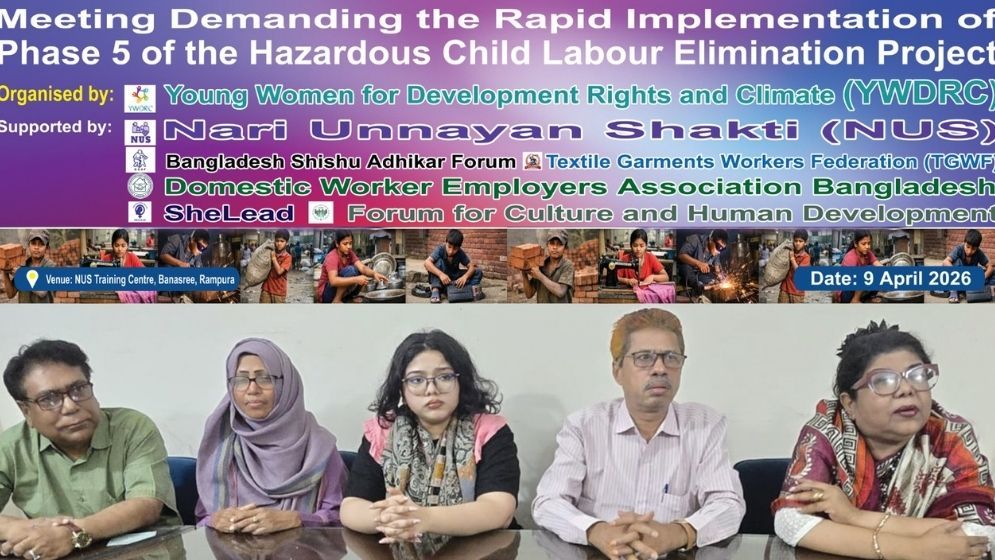
Photo: Courtesy
Speakers at a meeting held at the NUS Training Center in the capital’s Banasree demanded the swift implementation of the fifth phase of the “Hazardous Child Labour Elimination Project” to tackle the growing problem of hazardous child labour in Bangladesh.
They
said that hazardous child labour remains a serious social and human rights
issue, with the latest survey by the Bangladesh Bureau of Statistics and the
ILO estimating around 3.54 million child workers in the country, of whom
approximately 1.28 million are engaged in hazardous work.
This
means nearly one in three child labourers is exposed to dangerous conditions,
posing severe threats to their health, education, and future.
The
session, organised by Young Women for Development Rights and Climate (YWDRC)
with support from Nari Unnayan Shakti (NUS), Bangladesh Shishu Adhikar Forum
(BSAF), Textile Garments Workers Federation (TGWF), Domestic Worker Employers
Association Bangladesh (DWEAB), She-Lead, and Forum for Culture and Human
Development (FCHD), brought together experts, activists, and stakeholders.
Speakers
said that without immediate and effective measures, an entire generation’s
future would be at risk. They demanded that the government approve and
implement the fifth phase of the hazardous child labour elimination project
without delay, and take steps to identify children engaged in dangerous work,
rehabilitate them, and include them in education and skills development
programmes.
They
also stressed the need for stricter enforcement of labour laws, effective
monitoring of hazardous work sectors, and punitive measures against violations.
Expanding social protection programmes for poor and vulnerable families was
highlighted as essential to prevent children from being forced into labour.
Nusrat
Sultana Afroz, Executive Chairperson of YWDRC, said immediate action is crucial
to ensure children’s rights and secure their future.
Dr
Afroza Parvin, Executive Director of NUS, called for government coordination
and sufficient budget allocation, noting that without these, eliminating
hazardous child labour would remain impossible.
Dr
Sultan Mohammad Razzak of BSAF emphasised addressing legal enforcement gaps,
while Abdul Momin of FCHD stressed creating opportunities for education and
skill development as sustainable solutions.
Selina
Khatun, publicity secretary of DWEAB, warned that rising unemployment in the
country has further increased child labour beyond official survey figures.
Other
speakers included Shahida Wahab of She-Lead, Bir Muktijoddha Abul Hossain of
TGWF, and several other leaders and activists.
The
participants said that previous government initiatives had suffered from slow
implementation and inadequate monitoring. They demanded a coordinated approach
involving relevant ministries, local government, civil society, and labour
organisations.
Concluding
the session, speakers urged immediate, coordinated, and effective measures to
eliminate hazardous child labour, stressing that ensuring a safe and secure
childhood is a constitutional responsibility of the state.