



 For all latest news, follow the Daily Sun's Google News channel.


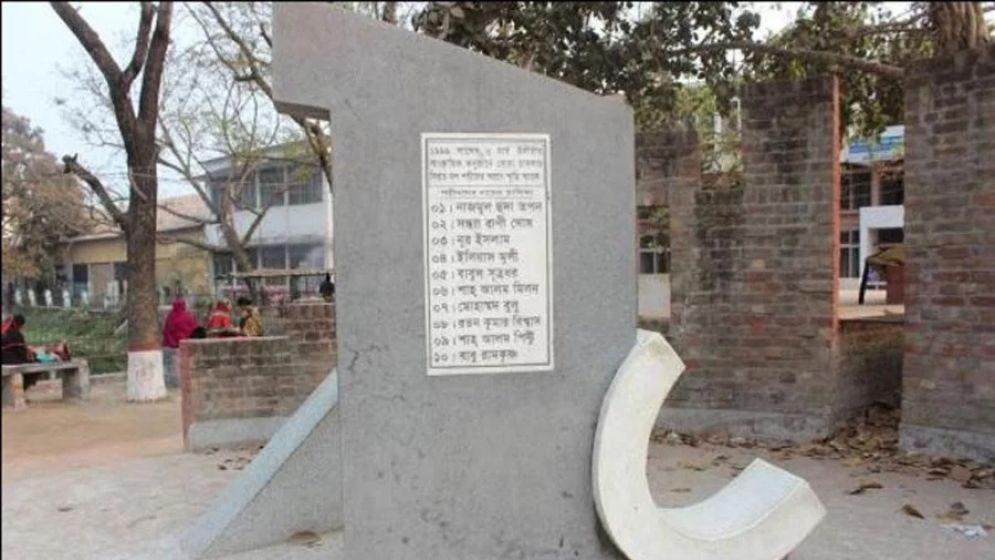
A memorial—Ram-Ratan-Shah Alam Square—was established on the main road of Jashore town with municipal funding on 6 March 2008. File Photo: Collected
Even after 27 years, justice has remained out of reach for
the victims of the harrowing Udichi massacre in Jashore.
Believed to be the country’s first militant attack the
incident shocked the nation, but has yet to see justice, as legal and
administrative weaknesses have led to the acquittal of all accused.
Despite attempts to revive the case in higher courts, the
proceedings have remained stagnant for the past 16 years. Families of the
victims, survivors, and cultural activists have expressed frustration over the
prolonged delay in justice.
Today (6 March), the 27th anniversary of the tragedy, Udichi
planned a series of events, including offering of tributes at the Shaheed
Minar, discussion and memorial meeting at Udichi office in Jashore and Kushtia,
and a torch-lighting ceremony at the memorial site.
The memorial—Ram-Ratan-Shah Alam Square—was established on
the main road of Jashore town with municipal funding on 6 March 2008.
‘All suspects acquitted’
According to sources, on 6 March 1999, two powerful bombs
exploded at the 12th National Conference of Bangladesh Udichi Shilpigosthi at
Jashore Town Hall field. The explosions claimed the lives of 10 individuals,
including performers, and injured more than 250 innocent attendees. The
deceased were identified as Nazmul Huda Tapan, Sandhya Rani Ghosh, Noor Islam,
Elias Munshi, Babul Sutradhar, Shah Alam Milon, Mohammad Bulu, Ratan Kumar
Biswas, Shah Alam Pintu, and Babu Ramkrishna.
Among them, Shah Alam Milon, Ratan Kumar Biswas, and Babu
Ramkrishna hailed from Kushtia.
Court sources indicate that due to flaws in the Criminal
Investigation Department’s (CID) charge sheet, all accused were acquitted by
the court on 30 May 2006. Later, the government appealed the verdict in the
higher court, leading to a revival of the case. However, no further hearings
have taken place, leaving the case entangled in legal complexities.
Following the arrest of militant leader Mufti Hannan, he
reportedly confessed to police about orchestrating the Udichi bombing. Despite
this, the case has seen little progress.
On 8 June 2010, a hearing was held on the appeal petition in
the Udichi case. After the hearing, a judicial bench comprising Justice
Siddiqur Rahman Miah and Justice Krishna Debnath ordered a notice to be issued
to seek statements from the accused. The related documents from the High Court
reached the Chief Judicial Magistrate Court in Jashore on 26 July 2010.
Following the High Court’s directive, the acquitted accused surrendered before
the Chief Judicial Magistrate Court and secured bail. However, no further
appeal hearings have taken place since then, leaving the case entangled in
legal complexities.
When contacted to speak on the matter, Public Prosecutor of
Jashore court Syed Saberul Haque stated that the then-Awami League government
politically targeted former minister Tariqul Islam in the Udichi case. He
claimed that Tariqul was among the first to arrive at the scene, ensuring
medical treatment for the injured and organizing blood donations through mosque
announcements. He further claimed that political interference obstructed a fair
trial.
Outcry of the survivors and families of deceased
Survivors of the attack continue to demand justice.
Nahid, who lost both legs in the bombing, expressed his
agony, saying, “I am living with unbearable pain. We demand justice for the
perpetrators.”
Similarly, Sukanta Das, who lost a leg, stated, “Years keep
passing, yet the culprits have not been brought to justice.”
He observed that the government must act with sincerity.
The families of the deceased have echoed similar demands.
In Kushtia’s Milpara area, family of victim Ramkrishna
reiterated their call for justice. Similar demands were voiced by the families
of Ratan Biswas from Amala Paraa and Shah Alam from Chaul's Border area.