


 For all latest news, follow the Daily Sun's Google News channel.


Justice, democracy true honour to martyrs’ sacrifice: Tarique
'Our responsibility, as those who are still alive, is to build the Bangladesh envisioned by the martyrs,' he says
Daily Sun Report, Dhaka
Published: 09 Feb 2026, 08:15 PM
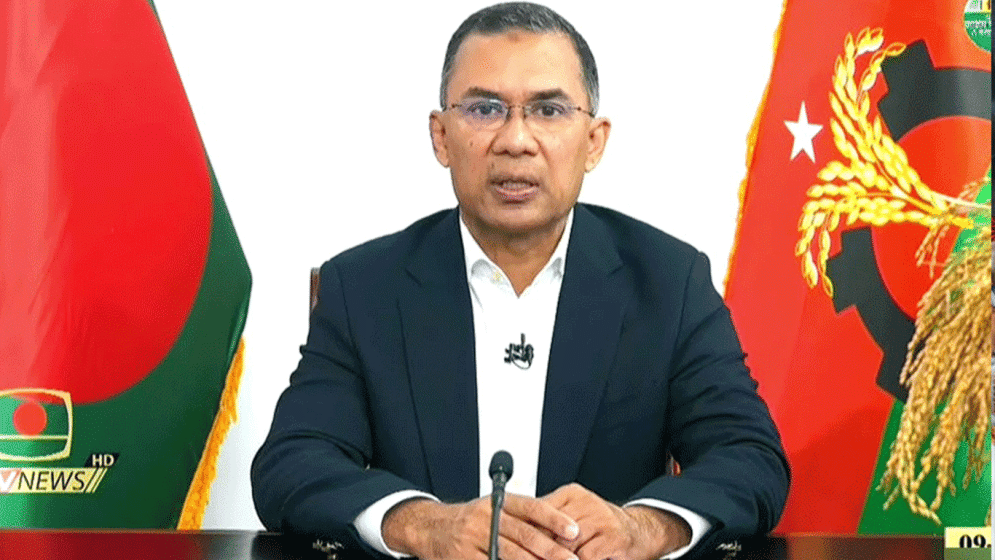
Photo: Collected
BNP Chairman Tarique Rahman on Monday said that the sacrifices of those who laid down their lives in various mass movements throughout Bangladesh’s history must never be allowed to go in vain, stressing that the establishment of a justice-based and democratic state is the only true way to honour the martyrs.
He made the remarks in a televised address to the
nation at around 7:15pm on Monday, delivered on the occasion of the 13th
National Parliamentary Election and Referendum 2026.
The speech was broadcast live on Bangladesh
Television (BTV).
Referring to key moments in the country’s history, Tarique said that from the 1971 Liberation War to the anti-hegemony movement of 7 November 1975, the mass uprising against autocracy in 1990, the Shapla Chattar killings, and most recently the 2024 struggle to protect independence, countless people have sacrificed their lives for the nation.
Full text of the speecch is given as below for our readers:
After a long series of movements and struggles—at
the cost of thousands of lives—the nation has now arrived at a historic moment
to return state ownership to its rightful owners: the people. On 12 February,
the long-cherished national election desired by democracy-loving citizens is
set to take place.
Dear citizens of the country,
At this auspicious moment of restoring the people’s
rights in the state, politics, and governance, I begin by offering gratitude to
Almighty Allah and wish to address you with a few words. This democratic moment
did not arrive overnight. For more than one and a half decades, the Bangladesh
Nationalist Party (BNP), along with all pro-democracy political parties and
democracy-loving citizens, had to engage in relentless movements and struggles.
During this anti-fascist movement, thousands of
people were disappeared, killed, and abducted. Brutal detention centers known
as “Aynaghar” became living graves for human beings. In the historic mass
uprising of students and citizens in 2024 alone, more than 1,400 people were
killed and at least 3,000 were injured.
I pray for the forgiveness of all those who have
been martyred at various times—from the War of Liberation to the present day—in
the struggle to establish democracy and human rights. I express deep sympathy
for the injured and heartfelt condolences to the bereaved families.
Dear citizens,
From the War of Independence in 1971, to the
anti-imperialist movement of 7 November 1975, the anti-autocracy movement of
the 1990s, the massacre at Shapla Chattar, and most recently the 2024 struggle
to protect independence—at every turning point in history, millions have
sacrificed their lives.
With the death of one person, an entire family’s
dreams, hopes, and aspirations die. Why did these people sacrifice their lives
so willingly? What did they seek? No compensation can equal a human life. Shall
these sacrifices go in vain? No—never.
Those of us who are still alive by Allah’s mercy
must build the Bangladesh that the martyrs dreamed of: a just, humane, secure,
and democratic Bangladesh. Only through such a state can we attempt to repay
the debt of those who gave their lives for the country.
Dear citizens,
Bangladesh is a country of nearly 200 million
people. More than half of the labour force is women. There are over 40 million
youths, 50 million children, more than four million persons with disabilities,
and countless farmers, workers, and labourers. If the aspirations of these
groups are ignored, the state itself will eventually weaken. A state cannot be
strong if its citizens are weak.
Without ensuring political and economic empowerment
of the people, democracy, development, and decentralization cannot be sustainable.
The restoration of voting rights—from local representatives to Members of
Parliament—through the election on 12 February is a major opportunity for
citizens to reclaim their lost political power.
Dear citizens,
With this understanding, BNP has already announced
its election manifesto to ensure political and economic empowerment of the
people. Our plans aim to build a self-reliant Bangladesh, targeting every
sector and profession. The manifesto is designed to restore the social,
economic, and political rights of the present generation and secure a humane
Bangladesh for future generations.
Employment—both at home and abroad—especially for
youth, the unemployed, and women, is BNP’s top priority.
To address unemployment, comprehensive reforms of
banking, insurance, capital markets, and regional economies have been planned.
Through increased domestic and foreign investment in industry and commerce, the
target is to create 10 million jobs at home and abroad.
Nationwide technical and practical education will
transform the unemployed into skilled manpower. Free skills development,
freelancing, and outsourcing training will be provided at colleges, madrasas,
and universities. Local cottage industries and SMEs will receive easy,
low-interest loans. Investment will be promoted in e-commerce exports,
cybersecurity, outsourcing, data processing, artificial intelligence,
semiconductors, and the IT sector—creating 200,000 direct and 800,000 indirect
jobs annually.
Dear citizens,
According to various statistics, Bangladesh
currently has over 2.7 million unemployed, including nearly 900,000 graduates.
About 22% of youth are not engaged in education, employment, or training. If
BNP forms the government, educated unemployed youth will receive special
allowances for 6 months to 1 year, or until employment is secured.
Dear citizens,
More than half of the nation’s workforce is women.
No progress is possible without bringing women into the mainstream of politics
and the economy. BNP has decided to issue a Family Card to every
household—registered in the name of the female head of the family. Initially,
economically vulnerable families will receive 2,500 taka per month or
equivalent food assistance. This card symbolises women’s economic empowerment.
Women’s free education up to postgraduate level will
continue. Women’s participation in policymaking will increase. Special support
will be provided for women entrepreneurs. Women-only electric transport,
daycare centers, breastfeeding corners, hygienic public toilets, and strict
laws against violence, cyberbullying, rape, and harassment will be enforced.
Dear citizens,
Although economic sectors have expanded, Bangladesh
remains agriculture-dependent. BNP believes that protecting farmers means
protecting the country. A Farmers’ Card will provide agricultural information
and financial assistance. Fair wages, job security, and safe working conditions
for agricultural workers are priorities.
Dear citizens,
To prevent student dropouts from becoming
unemployed, vocational and technical education will be made compulsory from
high school. A third language will be introduced alongside Bangla and English.
Education curricula will be restructured to ensure every student gains both
academic and practical skills.
Dear citizens,
Health is the most important form of sustenance
(rizq). BNP plans to recruit 100,000 healthcare workers, 40% of them women, to
provide doorstep primary healthcare nationwide under the principle: Prevention
is better than cure.
Dear citizens,
The world has entered the age of Artificial
Intelligence. BNP has finalised policies to make ICT a thrust sector,
supporting freelancing, outsourcing, and digital industries. The party’s
31-point state reform plan, presented in 2023, includes fully costed and
actionable implementation strategies.
Dear citizens,
During fascist rule, $16 billion was siphoned off
annually. If corruption and capital flight are stopped, programmes like Family
Cards, Farmers’ Cards, and unemployment allowances are financially
feasible—with political will, which BNP possesses.
Dear citizens,
The people are the owners of the state. BNP wants to
ensure that people rightfully enjoy state resources. Our plans include welfare
for persons with disabilities, financial support for religious leaders of all
faiths, depoliticisation of administration, merit-based recruitment, timely
national pay scales, and respect for expatriate Bangladeshis through a Probashi
Card.
Dear citizens,
Bangladesh belongs to everyone—Muslim, Hindu,
Buddhist, Christian, believer or non-believer. Religion is personal; the state
belongs to all. BNP envisions a safe Bangladesh for every citizen.
Dear citizens,
I humbly ask for your prayers, support, and votes.
On 12 February, vote for the Sheaf of Paddy. Victory for the Sheaf of Paddy
means victory for Bangladesh, democracy, and sovereignty.
Vote all day on 12 February for the Sheaf of Paddy.
May Allah protect you.
Long live Bangladesh.
Long live Bangladesh Nationalist Party.