


 For all latest news, follow the Daily Sun's Google News channel.


Eco-friendly e-rickshaw pilot programme launched in Dhaka
Daily Sun Report, Dhaka
Published: 03 Jan 2026, 08:35 PM
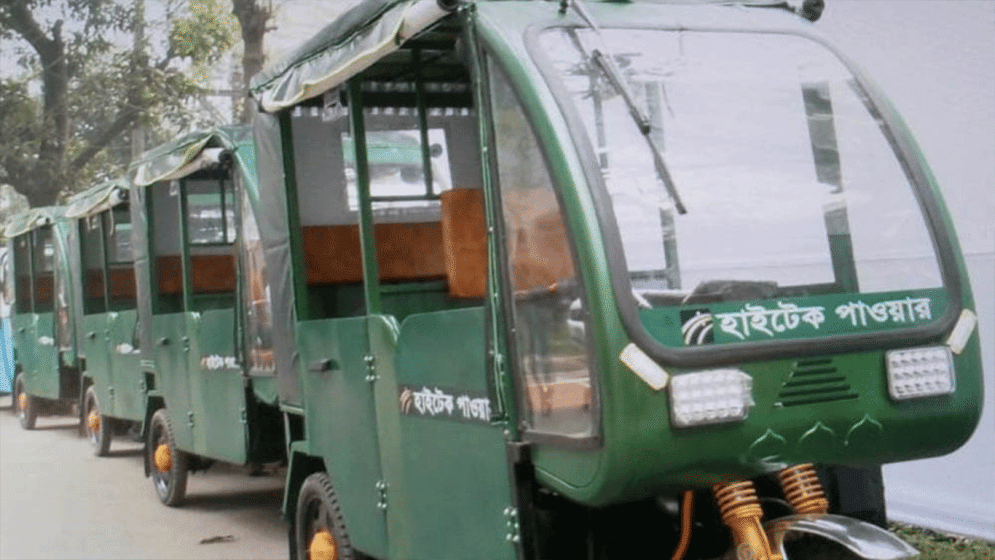
Photo: Collected
For the first time in Dhaka, a pilot programme of eco-friendly, battery-powered e-rickshaws developed by the Bangladesh University of Engineering and Technology (BUET) has been officially launched.
The three-wheeled, low-speed e-rickshaws are
designed to offer a safer and more sustainable urban transport solution.
The programme was inaugurated on Saturday morning
through two separate events—one in Aftabnagar under the Dhaka North City
Corporation (DNCC) and the other in Jigatala under the Dhaka South City
Corporation (DSCC).
At around 9:30am, the Aftabnagar programme allowed
experimental operation of e-rickshaws on designated roads connecting the Badda–Rampura
road to Aftabnagar.
Later, at 11:00am in Jigatala, permission was
granted for the initial operation of newly designed e-rickshaws in the
Dhanmondi area and converted e-rickshaws—transformed from battery- or
pedal-powered rickshaws—in the Motijheel area under DSCC.
Several senior government officials attended the
inauguration ceremonies, including Adviser for Local Government, Rural
Development and Cooperatives Adilur Rahman Khan; Adviser for Road Transport and
Bridges Muhammad Fouzul Kabir Khan; Special Assistant to the Chief Adviser
Sheikh Moinuddin; Special Assistant for Defence and National Solidarity
Development Lt Gen (retd) Abdul Hafiz; Special Assistant for Posts, Telecommunications
and ICT Faiz Ahmad Taiyeb; DNCC Administrator Mohammad Azaz; and DSCC
Administrator Md Mahmudul Hasan.
Speaking at the event, Adilur Rahman Khan said that
introducing e-rickshaws in Dhaka requires scientifically tested designs,
structures, braking systems, and battery safety.
“Through this pilot programme, we are evaluating
these standards on real roads,” he said.
He added that the core objective of the initiative
is to regulate unlicensed battery-powered rickshaws and easy bikes and
establish a disciplined urban transport system.
Road Transport and Bridges Adviser Muhammad Fouzul
Kabir Khan said road accidents are caused more by disorder and violation of
rules than by a lack of roads.
“To ensure discipline and safe travel, this
BUET-designed e-rickshaw has been introduced on a pilot basis. It will soon be
expanded across Dhaka,” he said.
Special Assistant to the Chief Adviser Sheikh
Moinuddin described e-rickshaws as an integral part of a planned urban
transport system, noting that sustainable mobility in Dhaka is possible only
through the integration of technology, design, and management.
Lt Gen (retd) Abdul Hafiz emphasised safety in urban
transport, saying the e-rickshaw’s structural stability, controlled speed, and
safety features would play a significant role in reducing accidents.
Faiz Ahmad Taiyeb highlighted the importance of
technology-driven transport systems in building modern cities, adding that
geo-fencing and digital control mechanisms would allow the e-rickshaw to
function as a smart urban mobility model.
DNCC Administrator Mohammad Azaz said training and
licensing rickshaw drivers is a key priority.
“Only trained and licensed drivers will be allowed
to operate e-rickshaws in designated areas, ensuring passenger safety and road
discipline,” he said.
DSCC Administrator Md Mahmudul Hasan said that based
on the experience gained from the pilot phase, the programme would be expanded
citywide. He also noted that existing pedal rickshaws would gradually be given
the opportunity to be converted into modern and safer e-rickshaws.
The initiative aims to regulate illegally operated
battery-fitted pedal rickshaws and easy bikes in Dhaka. BUET developed a
standardized design for the e-rickshaws, which was later approved by the
ministry’s technical committee before launching the pilot programme.
Compared to conventional e-rickshaws, the new model
features an improved braking system, speed control mechanism, and environmentally
friendly lithium battery.
Powered by a 38-volt lithium battery, the e-rickshaw
can travel approximately 70 to 80 kilometres on a single charge.
During the pilot phase, the e-rickshaws will be
evaluated on braking performance, battery efficiency, speed control, passenger
comfort, vibration tolerance, and driver handling capability.
To ensure disciplined operation, authorities plan to
use geo-fencing technology, preventing e-rickshaws from operating outside
designated areas or on major roads.
The Dhaka Metropolitan Police will determine the
number of e-rickshaws allowed in each area.
Training and licensing have been made mandatory for
e-rickshaw drivers. So far, DNCC and DSCC have jointly trained and licensed
around 24,000 rickshaw drivers.
The inauguration programme was presided over by
Secretary of the Local Government Division Md Rezaul Maksud Jahedi.