



 For all latest news, follow the Daily Sun's Google News channel.


The government’s revenue is growing slower than expected, while expenditure pressures are mounting from government salaries and allowances, domestic and foreign debt repayments, fuel imports and subsidies for power and agriculture. Consequently, the gap between income and expenditure is widening.
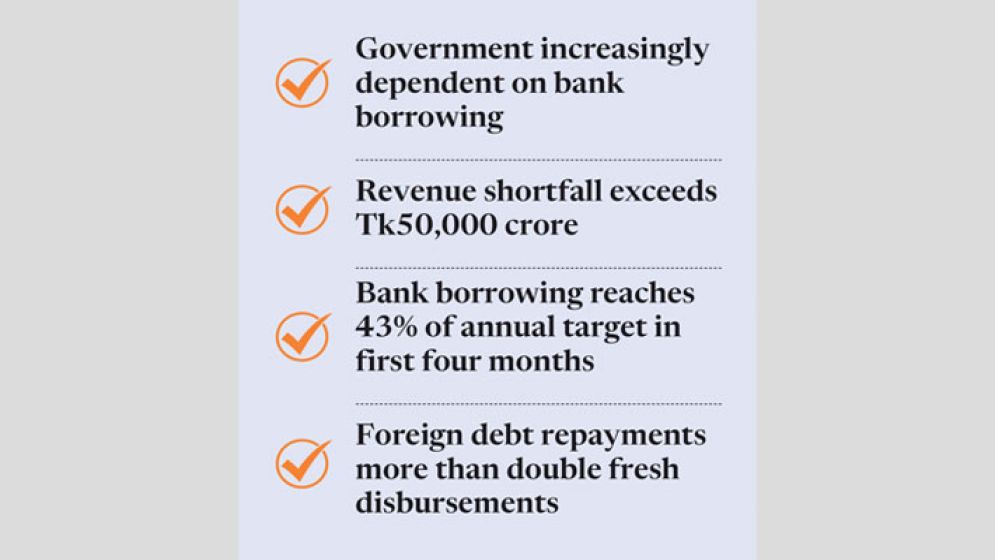
To finance the deficit, the government is increasingly relying on domestic bank borrowing while exploring foreign loans and alternative funding sources. The pressure is compounded by delays in development partners’ disbursements and repayments on existing loans exceeding fresh disbursements.
Against this backdrop, the Ministry of Finance has undertaken an eight-point reform initiative to boost revenue, improve debt management and control future financial risks, according to a recent Finance Division report.
The initiatives include expanding the revenue base, addressing banking sector weaknesses, securing low-interest foreign loans, diversifying financing sources, introducing an annual borrowing plan, prioritising high-return projects, controlling potential government liabilities and improving debt management coordination.
Zahid Hussain, former lead economist at the World Bank’s Dhaka office, told the Daily Sun, “The government currently lacks the financial capacity to undertake new projects, introduce a new pay scale or increase expenditure on subsidies and other areas. The government’s revenue-generating capacity is shrinking.
“Reforms are essential to increase revenue collection. There is no alternative to increasing domestic revenue. If the government continues to rely on borrowing, the burden will increase further in the future.”
Revenue shortfall and pressure on bank borrowing
Preliminary estimates of the National Board of Revenue (NBR) show that revenue collection remained below Tk1.28 lakh crore in July-October, against a target of approximately Tk1.78 lakh crore, leaving a shortfall of more than Tk50,000 crore in four months.
The government’s revenue target for the current fiscal year is Tk6.95 lakh crore, including Tk6.04 lakh crore through the NBR. Collection must accelerate significantly over the remaining eight months to avoid greater reliance on domestic and foreign borrowing to finance the deficit.
The government plans to expand the tax base, reduce unjustified tax exemptions and digitise VAT and income tax systems. However, officials believe these targets will be difficult to achieve without strengthening tax administration, preventing tax evasion and increasing the number of taxpayers.
Bank borrowing is increasingly becoming a major source of budget financing. According to Bangladesh Bank sources, the government’s net borrowing from the banking sector reached Tk47,800 crore in the first four months of FY2026-27, nearly 43% of its annual borrowing target of Tk1.12 lakh crore.
Continued borrowing could strain banks’ financing capacity and reduce credit availability for the private sector.
Foreign debt repayments exceed fresh disbursementsDelays in disbursements of loans and grants committed by development partners, coupled with rising principal and interest repayments on existing loans, are adding to the government’s financial pressure, according to the Economic Relations Division (ERD).
The Awami League government, ousted following the July mass uprising, borrowed heavily for large infrastructure projects. Repayments on these loans are now exceeding fresh borrowing, while many projects have generated limited benefits and relatively little revenue.
During July-September, the first three months of the current fiscal year, the government received $660 million in project loans but repaid $1.35 billion against previous loans—more than twice the amount received.
The government now wants to prioritise concessional, long-term and low-interest foreign loans while better coordinating borrowing and repayment plans.
Rising pressure from subsidies and salaries
Government salaries and allowances, implementation of a new pay structure, debt repayments and subsidies for power and energy are adding to budgetary pressure.
The Finance Division allocated Tk1,27,500 crore for interest payments alone in the current fiscal year. Repayment of loan principal requires substantial additional spending, leaving a significant portion of government revenue tied up in debt servicing.
The government also allocated Tk60,500 crore for subsidies in the power, LNG and agriculture sectors. Of this, Tk51,800 crore, or approximately 86%, had already been released within the first four and a half months of the fiscal year.
Eight-point reform initiative
The Finance Division’s report outlines eight areas of reform to ease the government’s financial pressures.
The government plans to expand the tax base, reduce unjustified tax exemptions and digitise VAT and income tax systems to improve revenue collection, transparency and administrative efficiency. Banking sector reforms, including recapitalising state-owned banks, will also be undertaken to prevent financial weaknesses from creating additional government liabilities.
It will prioritise concessional, low-interest foreign loans over expensive short-term borrowing and avoid financing the budget deficit through money printing. For the first time, it will publish an annual borrowing plan and formulate a medium-term debt management strategy detailing borrowing sources, amounts and maturities.
To diversify financing, the government plans to attract pension funds, insurance companies and foreign investors to government bonds. Besides Sukuk, green bonds and blue bonds, it is considering issuing Eurobonds, Samurai bonds and Panda bonds in international markets.
It also plans to ensure borrowed funds go to carefully evaluated projects offering high economic returns, prioritising the completion of ongoing projects to maximise benefits and reduce unnecessary expenditure.
Limits will be set on government guarantees, outstanding subsidy payments and potential liabilities of state-owned enterprises. The government will also publish statements detailing the financial risks arising from these liabilities.
For better debt management, a unified Debt Management Office will be established to coordinate borrowing, repayments and risk assessments. The government also plans to enact a Public Debt Act to strengthen the legal framework.
Zahid Hussain said, “These reforms were expected in sensitive areas such as revenue and expenditure to ensure sustainable public financial management.” He described the initiative as positive but said its success would depend on effective implementation.
He added, “Unless the government increased revenue collection, reduced unnecessary expenditure and ensured adequate economic returns from borrowed funds, dependence on borrowing to bridge the gap between income and expenditure would continue.”