


 For all latest news, follow the Daily Sun's Google News channel.


Pak pilot to be 1st foreigner to fly to China space station
Reuters, Jiuquan
Published: 25 Nov 2026, 12:00 AM
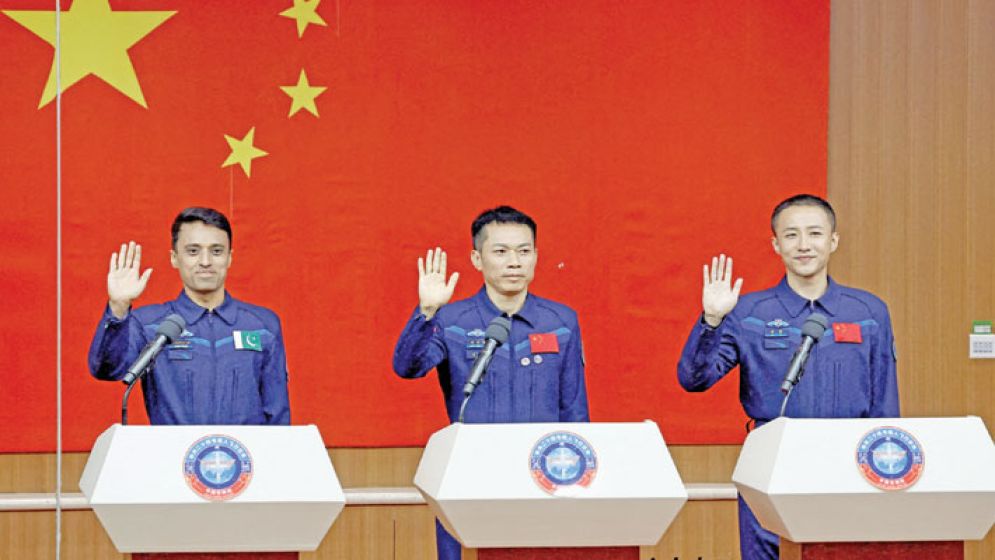
When the Shenzhou-24 space flight takes off on Wednesday for China's Tiangong space station, it will be a moment of pride not just for China, but also for Pakistan.
Zeeshan Ali, a 40-year-old pilot, is set to be the first Pakistani in orbit and the first foreign national to board the space station, as China makes new strides in space diplomacy.
Part of a three-man crew that includes Chinese commander Tang Hongbo and flight engineer Wu Yi, Ali will work as a payload specialist and is set to stay at the station for 5 to 10 days, conducting experiments.
The launch of the spacecraft, which will use a Long March-2F rocket, is scheduled for 8:18am (0018 GMT) from the Jiuquan Satellite Launch Centre in northwest China.
To prepare for the flight, Ali trained for seven months in Beijing, during which he underwent intensive Chinese-language classes, learning Chinese songs and reading Chinese poetry. He also practised calligraphy and played table tennis.
"I'm not flying for myself. I carry the name of Pakistan on my shoulder," Ali told reporters.
Space cooperation between China and Pakistan dates back to the early 1990s. China has launched Pakistani satellites and a Pakistani-built rover is also set to fly on a Chinese lunar mission around 2028.
"China has always been very good at using space for soft power outreach," said Victoria Samson, chief director of US-based Space Security and Stability at the Secure World Foundation.
"See how many satellites it builds and launches for other countries, and how it builds telescopes and tracking centres in the Global South — so this is just one more action of that same genre," she said.
While Ali's stay is much shorter than the usual six-month rotation for a Chinese astronaut, it is a big deal for Pakistan.
"It brings prestige, important science and technology know-how, and a level of deeper collaboration and diplomatic goodwill with China," said Blaine Curcio, founder of Hong Kong-based Orbital Gateway Consulting.
The mission underscores Beijing's vision to promote its Tiangong space station as a hub for international space cooperation as the NASA-led International Space Station (ISS) faces possible retirement by 2030.