




 For all latest news, follow the Daily Sun's Google News channel.


Mideast tensions mount as Saudi-Houthi conflict escalates
Dhaka condemns Houthi strike on Riyadh’s financial district
Agencies, Riyadh/ Sanaa/ Baghdad/ Dhaka
Published: 21 Nov 2026, 12:00 AM
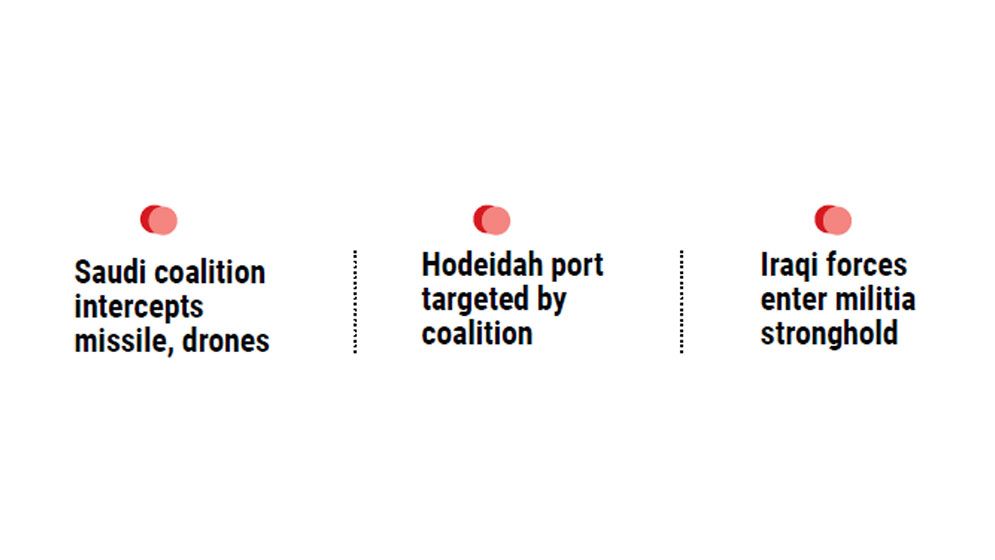
The widening Middle East crisis intensified on Friday as escalating Saudi-Houthi strikes threatened Red Sea ports and commercial airspace, while Iraqi forces entered Kataib Hezbollah’s Jurf al-Sakhar stronghold under a fragile compromise deal.
The Saudi coalition said that it had intercepted two drones and a ballistic missile fired toward the country’s southern region.
Coalition spokesperson Turki al-Malki said, early on the day, that "air defences intercepted and destroyed a ballistic missile launched by the Houthi terrorist militia toward the southern region."
Two Houthi drones fired at the kingdom’s southern region were also shot down, Al-Malki said in X posts.
The Houthis have launched in recent weeks strikes on a range of Saudi targets, including airports, energy infrastructure, military sites, and Riyadh’s financial district.
On Thursday, the Houthis damaged a skyscraper in the capital’s financial district—an area symbolising Crown Prince Mohammed bin Salman’s effort to transform the oil-rich kingdom.
Although authorities did not identify the building, photographs released by the civil defence agency appeared to show shattered glass and exterior damage to the tower housing the Public Investment Fund, which is Riyadh’s tallest building.
The coalition also said it targeted Red Sea port city Hodeidah and other sites around the country after the group warned of widespread reprisals.
“We targeted operational capabilities at Hodeidah port that were used in smuggling operations and the transport of weapons and ballistic missiles,” Turki al-Malki posted on X, adding that operations were “ongoing” in Sanaa, Saada, and Taiz governorates.
Earlier, it warned civilians to evacuate the major port of Hodeidah, following weeks of strikes by both sides.
Houthi claims of civilian deaths
Houthi authorities accused Saudi forces of attacking a civilian boat and killing 19 people after Yemen’s dormant civil war reignited.
Conflict flared up in July after years of relative calm, pitting the internationally recognised government, backed by Saudi Arabia, against the Iran-backed Houthis.
Houthi health ministry spokesman Anees Alasbahi condemned the “horrific massacre committed by the Saudi enemy planes, which targeted a civilian boat carrying more than 25 displaced persons... which resulted in the martyrdom of 19 civilians and left 4 others wounded.”
“Targeting civilians and displaced persons constitutes a full-fledged war crime and a flagrant violation of international humanitarian law and human rights,” Alasbahi added.
Among the dead were eight children and six women, according to the Houthis’ Almasirah television channel.
The boat was travelling from Ras al-Ara to Hays in the country’s south, Alasbahi said on X.
More than 1,600 people have been killed in the latest round of fighting and more than 300,000 displaced, according to the United Nations.
Houthi threats of retaliation against Saudi ports
Yemen’s Houthis threatened to hit Jeddah and other Saudi ports if the Saudi-led coalition strikes Hodeidah, after it issued an evacuation warning.
“The armed forces announce that the port of Jeddah and all enemy Saudi ports along the Red Sea coast will be targets for our forces if the enemy carries out its threats to shell the port of Hodeidah,” military spokesman Yahya Saree posted on X.
Saudi airspace under fresh threat
Yemen’s Houthis warned airlines that most Saudi airspace was “unsafe” after threatening to hit Jeddah and other Red Sea ports.
“The Yemeni Armed Forces warn all airlines that Saudi airspace is unsafe, as it will be the theater of our operations in the coming hours, except for the holy airspace over Mecca and Medina,” military spokesman Yahya Saree posted on X.
Iraq moves to curb militia power
Meanwhile in Iraq, Iraqi security forces deployed in Jurf al-Sakhar, a stronghold of the Kataib Hezbollah armed group, on Friday under a deal that seeks to limit the reach of Iran’s most powerful Shi’ite militia ally in the country without provoking a confrontation.
Prime Minister Ali al-Zaidi this week ordered security forces to move against the heavily armed Kataib Hezbollah, which officials accused of running an oil smuggling network siphoning state-owned oil worth hundreds of millions of dollars in Jurf al-Sakhar.
The hardline Kataib Hezbollah (Battalions of the Party of God), branded a terrorist group by the United States, has rejected the smuggling accusations, which have led to arrests that prompted fears of an armed response. The group is among those that have claimed attacks on US forces in Gulf states since the start of the US-Israeli war on Iran.
A convoy of vehicles flying Iraqi flags headed into Jurf al-Sakhar, and soldiers took up positions in the centre after senior security officials told a press conference that government forces would protect the town.
Members of the Kataib Hezbollah group stood near their group’s flags.
“From Jurf al-Sakhar, we begin asserting state authority across all of Iraq, confronting corruption and weapons beyond state control,” Zaidi told government troops who entered the town, speaking from a military operations centre in Baghdad.
“Our decision is firm: No weapons outside state authority, no weapons but Iraq’s, no decisions but Iraq’s, and no flag shall fly higher than the Iraqi flag.”
Under the arrangement, brokered by Shi’ite politicians, Kataib members were expected to withdraw to other parts of Iraq, a major oil producer and ally of both the US and Iran.
“God willing, things will be safe and secure with the presence of the security forces,” said resident Mohamed Ali.
Bangladesh condemns Houthis attack
Meanwhile, Bangladesh on Friday condemned Thursday’s Houthis attack on a tower in Riyadh’s King Abdullah Financial District, expressing solidarity with the Saudi government and people.
In a statement, the Ministry of Foreign Affairs described attacks on civilian and economic infrastructure as unacceptable, warning that such acts pose a serious threat to regional peace, security and stability.
Dhaka reaffirmed its support for Saudi Arabia and called for an immediate cessation of hostilities, saying such acts undermine efforts towards de-escalation.
The condemnation comes amid growing concerns over the security of civilian and economic infrastructure across the Middle East. Saudi Arabia is home to a large Bangladeshi expatriate community, making regional stability a particular concern for Dhaka.