



 For all latest news, follow the Daily Sun's Google News channel.


Bangladesh 16th most hit by extreme weather in 30yrs
Daily Sun Report, Dhaka
Published: 18 Nov 2026, 12:00 AM
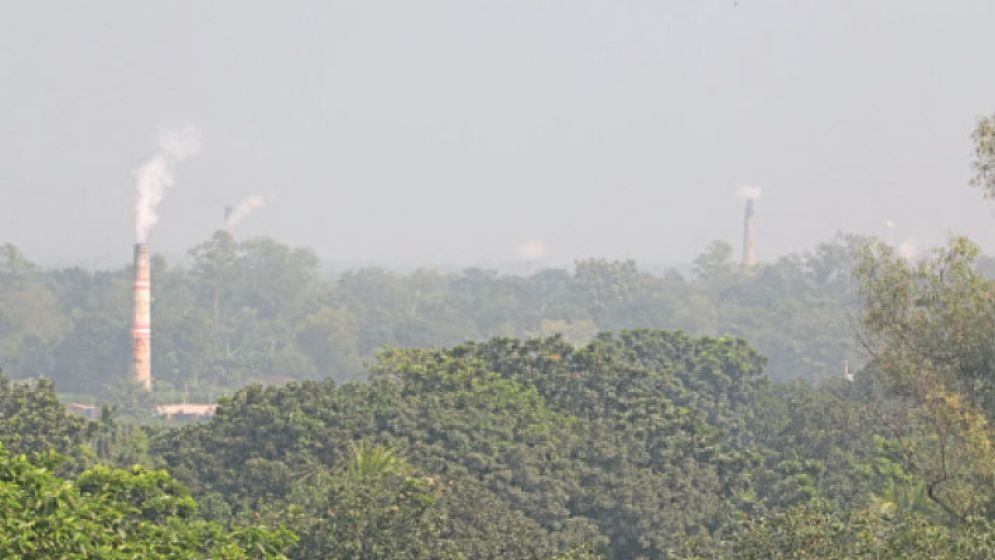
Smoke billows from a brick kiln chimney amid lush greenery in Dhamrai, Dhaka, on Tuesday, highlighting the environmental cost of brick production. The area has a large concentration of brick kilns, raising concerns over air and soil pollution. -Kamrul Islam Ratan
Bangladesh ranks 16th among the countries most affected by extreme weather over the past three decades, down from 13th in the previous edition, according to latest Germanwatch’s Climate Risk Index (CRI).
The index found that nearly 10,000 events worldwide between 1996 and 2025 killed more than 916,000 people and caused direct economic losses above $4.7 trillion.
The Berlin-based organisation released the report on Tuesday at the COP31 climate conference in Antalya, Türkiye. It covers 2025 and the 30-year period from 1996 to 2025. Bangladesh also ranked 13th in the 2024 index.
The index ranks countries on six indicators: total fatalities, fatalities per 100,000 people, total people affected, affected people per 100,000, absolute economic losses, and losses as a share of gross domestic product (GDP).
Bangladesh is one of seven lower-middle-income countries among the 20 most affected over the 30 years. The others are Haiti, Honduras, India, Myanmar, Nicaragua and Pakistan.
The report does not give a separate breakdown of deaths, people affected or economic losses for Bangladesh.
Global toll
The disasters of the past three decades affected around 5.5 billion people, including those displaced. The economic losses are almost equivalent to Germany’s current GDP.
Dominica, Myanmar and Honduras were the three most affected countries, followed by Libya, Haiti and Grenada. The Philippines ranked seventh, Nicaragua eighth, the Bahamas ninth and India tenth.

Laura Schäfer, one of the report’s authors, said the Bahamas was the only high-income country in the top 10. The other nine had been hit hard, often repeatedly, by tropical cyclones, with later storms destroying infrastructure that had already been rebuilt, she said.
The report identifies two patterns. Countries such as Dominica, Myanmar and Honduras have suffered exceptionally devastating disasters, while others, including the Philippines and India, face recurring events. Vera Künzel, another co-author, said climate change was raising risks for both groups.
“Disasters that were once considered exceptional are increasingly becoming continuous threats, creating a new normal,” she said.
Jamaica, Sri Lanka, Spain worst hit in 2025
A total of 367 extreme weather events were recorded in 2025, killing nearly 35,000 people, affecting more than 100 million and causing direct losses of over $158 billion. Jamaica, Sri Lanka and Spain were the most affected, followed by Thailand, the Philippines and Pakistan.
Hurricane Melissa, a Category 5 storm, killed 62 people in Jamaica and caused damage equivalent to almost half the country’s annual GDP. Cyclone Ditwah killed 823 people in Sri Lanka and affected more than 1.7 million, causing losses of $4.1 billion and the country’s worst floods in 20 years. Spain endured its hottest summer at the time, a heatwave, three storms and three wildfires in a single year, the report said.
Heatwaves deadliest
Heatwaves caused nearly 70 per cent of reported extreme weather deaths in 2025, more than 24,000 lives. Over the 30 years, they accounted for 40 per cent of reported fatalities. The report warned that heat-related deaths are substantially underreported, particularly in developing countries, because of weak data collection and monitoring.
Lisa Schultheiß, another co-author, said the index does not yet include the severe heatwaves of 2026 but already shows they have claimed the most lives of any extreme weather type. Unreported deaths in the Global South remain very high, she said.
Unequal burden
The report said lower-income countries that have contributed little to the climate crisis continue to bear some of its heaviest consequences, with limited finances and weaker disaster response capacity leaving them especially vulnerable.
David Eckstein, another co-author, said adaptation was among the most cost-effective investments in human security and prosperity.
“The costs of inaction are considerably higher than those of transition, and the limits of adaptation are increasingly evident,” he said, urging countries to use COP31 to speed the shift from fossil fuels and mobilise finance.
The report calls for more investment in adaptation, disaster risk reduction and early warning systems, alongside faster emissions cuts. It urges major emitters and large fossil fuel producers to increase financial support for vulnerable countries, particularly for unavoidable loss and damage.
Germanwatch said adaptation should be treated as an investment, not an expense, but cannot replace emissions reductions.
Recommended Stories