



 For all latest news, follow the Daily Sun's Google News channel.


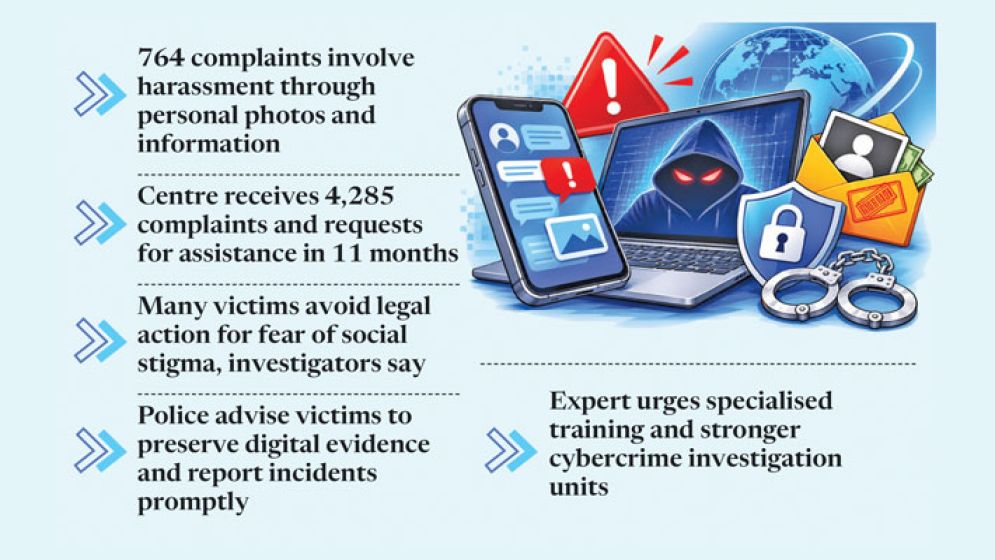
Online harassment involving the circulation of personal photos and information, along with blackmail, has emerged as the most common form of cybercrime reported to a specialist cyber unit of Dhaka police, with more than 4,000 people seeking its assistance in the past 11 months.
Cybercrime investigators told the Daily Sun that many victims do not pursue their complaints, allowing offenders to escape legal action.
The Cyber Support Centre, run by the Detective Branch of the Dhaka Metropolitan Police (DMP), opened on 20 November 2025. By 31 October this year, it had recorded 2,424 general diaries (GDs), the formal complaints lodged with police in Bangladesh. It also provided technical support and legal advice to another 1,861 people who did not file GDs, bringing the total number of people assisted to 4,285, according to its statistics.
The largest category of complaints, 764 or around 31%, involved harassment through the circulation of personal photos and information on social media.
Another 214 complaints, around 9%, concerned blackmail. Investigators said such cases typically involve threats to release private photos, videos or sensitive information to extract money, favours or compliance from victims.
The centre also recorded 52 complaints about job scams and 66 about fraud involving fake investment offers. Officials said criminals also use online loan offers to collect personal information.
Some officers handling the complaints said 80-85% of them involved offences that could lead to criminal cases, but victims often chose not to take legal action.
“When the same page, ID or number is linked to multiple sensitive incidents, police themselves become the plaintiff and file cases,” one investigator said.
The officers said their scope for action was limited when victims refused to file cases or offenders operated from abroad.
They said victims often faced public humiliation, mental stress and insecurity, with lasting consequences for their personal and family lives. Many kept blackmail incidents secret for fear of social stigma, emboldening offenders, they added.
Even police officials are not spared from such abuse. A female additional superintendent of police told the Daily Sun that she had regularly posted photos and videos of herself and her family on social media. Later, several hundred fake accounts using her pictures appeared, circulating defamatory images on Facebook.
She said she had taken action against some of those involved, but the abuse continued. She has since stopped posting photos and videos, although the fake accounts remain active.
The centre classifies cybercrime into nine broad categories: harassment through photos and information, blackmail, job fraud, loan and investment fraud, fraud involving the sale of goods and services, lost mobile phones, impersonation of individuals or organisations, gambling-related crime and hacked social media accounts.
A recent case illustrates how online fraudsters exploit people's trust. The father of a student who won a Class V scholarship from Monir School and College received a call on Monday from a man claiming to be a teacher at the institution. The Daily Sun is identifying the student as Saiman, which is not his real name.
The caller asked whether the father had accounts with any of three private banks, saying the scholarship money would be deposited into one of them. He then instructed the father to tap an option on his phone screen. The father said that after following the instruction, the caller gained control of his Gmail account.
Two other men subsequently called him. One claimed to be a teacher at Uttara High School and asked for his email address, while the other identified himself as an education officer.
Cybersecurity expert Arif Mainuddin of Decodes Lab Limited told the Daily Sun that cyber harassment and blackmail were increasing. He said law enforcement agencies should assess complaints based on the nature and severity of each offence before launching investigations.
He said investigators should also examine victims' previous relationships and interactions, as perpetrators in many cases were known to their victims.
He recommended that authorities make effective use of law enforcement request systems operated by platforms such as Facebook, Instagram and TikTok to obtain account-related information, including IP addresses and phone numbers, and identify suspects.
In less serious cases, victims can also report abusive content directly to social media platforms and seek its removal.
Mainuddin stressed the need to strengthen the cybercrime units of Bangladesh Police by recruiting skilled experts and providing specialised training to ensure faster and more effective investigations.
DMP Deputy Commissioner Khaleda Begum of the Detective-Cyber and Special Crime Division (North) urged victims not to panic.
She advised them to preserve conversations, links, screenshots, transaction details and other digital evidence and contact police promptly.
“People must also be careful,” she said. “They should not click on links sent by strangers or share personal information or OTPs [one-time passwords]. Public awareness and cooperation are as important as police action in curbing cybercrime.”
In parliament on Thursday, State Minister for Information and Broadcasting Yasser Khan Chowdhury said the government was working to tackle doctored images of women, defamation and blackmail through fake accounts, as well as online harassment of children.
He was replying to a question from Shirin Sultana, a reserved-seat MP.
The minister said awareness campaigns were under way.
BanglaFact, the fact-checking arm of the Press Institute Bangladesh, had identified 137 fake Facebook accounts, pages and groups using the name and photo of Prime Minister Tarique Rahman, he said.
It had also identified 19 websites imitating newspapers and television channels to spread propaganda and false information, along with more than 800 Facebook accounts and over 100 accounts on X spreading misleading or false claims.
BanglaFact had published 1,172 fact-checks, 552 of them since the current government took office, the minister added.