



 For all latest news, follow the Daily Sun's Google News channel.


71% of listed firms face audit objections
Missing disclosures, questionable accounts and audit warnings raise concerns over the reliability of information available to investors

More than seven in 10 listed companies have discrepancies or audit objections in their financial statements, raising serious questions about the reliability of information available to investors in the country’s capital market.
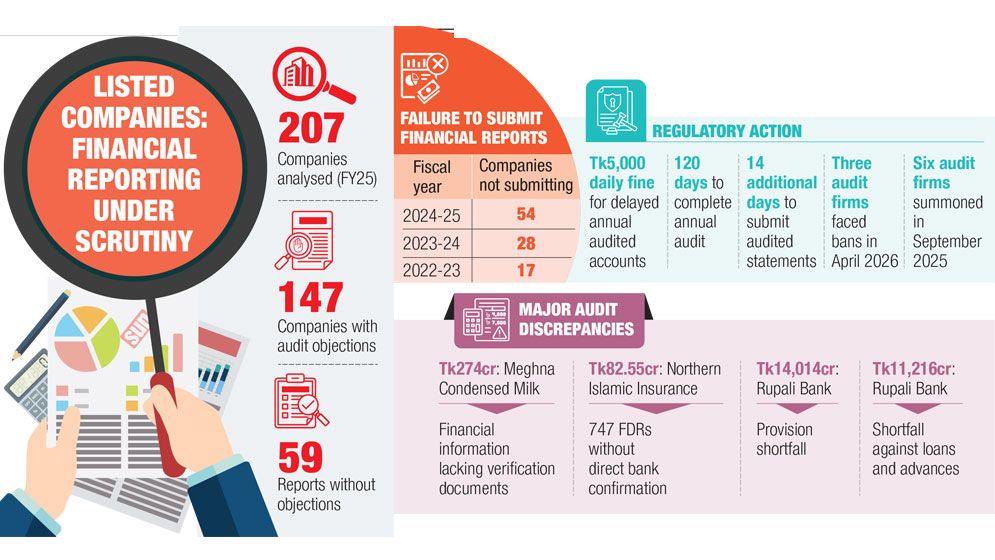
An analysis of Dhaka Stock Exchange (DSE) data shows that 147 of the 207 companies that submitted financial reports for the fiscal year 2024-25 (FY25), ending in June, had audit objections.
Auditors also raised concerns about the ability of some companies to continue their operations. Only 59 companies submitted reports without any objections.
Financial statements are a crucial source of information for investors, providing details of a company’s earnings, profitability, liabilities, cash flow and ability to remain in business.
Market stakeholders warn that inaccurate or incomplete disclosures can mislead investors, particularly those making long-term investment decisions, and expose them to substantial losses.
Auditors flag serious discrepancies
Audit objections have become a recurring concern in the financial statements of several listed companies.
During the audit of Meghna Condensed Milk Industries’ 2025 financial statements, auditors could not obtain the necessary documents and evidence to verify financial information involving nearly Tk274 crore.
They also found inadequate supporting documents for fixed assets, inventories, advances and receivables.
The auditors consequently issued an adverse opinion and highlighted uncertainty over the company’s ability to continue its operations.
In its FY25 financial statements, National Feed Mills reported raw material purchases of Tk7.83 crore, against nearly Tk10.09 crore in its VAT returns.
Auditors said the discrepancy indicated possible understatement of purchases and overstatement of profits.
They also identified inconsistencies in loan interest and financial expenses, along with inadequate documentation to verify inventory values. The auditors therefore issued a qualified opinion.
When contacted, the company’s acting company secretary, Md Zahidul Islam, declined to comment immediately and requested that he be contacted later.
In another case, auditors examining Northern Islamic Insurance’s 2025 accounts could not obtain direct bank confirmation for 747 fixed deposit receipts (FDRs) worth Tk82.55 crore out of the company’s total fixed deposits of Tk95.93 crore.
Rupali Bank’s 2025 audited financial statements, meanwhile, revealed a provision shortfall of more than Tk14,014 crore, including over Tk11,216 crore against loans and advances. According to the auditors, failure to recognise the shortfall affected the bank’s reported profits, liabilities and shareholders’ equity.
Dozens of companies fail to submit reports
Failure to submit financial statements on time is another major concern.
DSE data show that 54 companies did not submit financial reports for the FY25, representing a non-submission rate of around 20.7%.
The problem has persisted in previous years. Of 194 companies covered in the June-ended FY24, 28 failed to submit reports. For FY23, 17 of the 171 companies concerned did not submit their financial statements.
Ataullah Naim, president of Capital
Market Investors’ United National Unity, told Daily Sun that investors were being deprived of updated information on companies’ earnings, profits, debt and financial capacity because of the failure to publish reports.
This makes it difficult to determine a company’s actual value, he said, adding that rising share prices do not necessarily indicate sound financial health.
Even when a company’s production continues, the absence of financial statements leaves investors unable to assess its earnings, cash flow and capacity to repay debts.
Saiful Islam, president of the DSE Brokers Association of Bangladesh (DBA), said financial statements were among the most important safeguards for ordinary investors. Prolonged failure to publish reports deprives them of essential information.
Imposing fines alone would not be enough to prevent such irregularities, he said, stressing the need for stronger surveillance and effective action by the stock exchange.
Regulatory provisions allow action against defaulters
Under Bangladesh Securities and Exchange Commission (BSEC) rules, listed companies must prepare, audit and submit financial statements to the regulator within prescribed deadlines.
The DSE Listing Regulations, 2015, require companies to complete the audit of their annual financial statements within 120 days of the end of the financial year and submit the audited statements to the BSEC and the stock exchange within the following 14 days. Separate deadlines apply to quarterly reports.
Companies that miss the deadlines may face fines and other regulatory action. A BSEC directive issued on 1 July 2026 introduced a daily fine of Tk5,000 for delays in submitting annual audited accounts.
Section 11 of the Securities and Exchange Ordinance, 1969, also requires issuers of listed securities to submit annual reports and prescribed statements. Section 9 provides for the cancellation of listings under specific conditions and suspension of trading in the public interest.
BSEC moves against audit firms
The securities regulator has also begun taking punitive action against auditors and audit firms accused of failing to detect or disclose irregularities in financial statements.
In separate orders issued in April 2026, the BSEC took action against three audit firms and their concerned auditors over serious deficiencies in the audits of Ring Shine Textiles and Far East Islamic Life Insurance.
Ata Khan & Company and Shiraz Khan Basak & Company were declared ineligible for three years to conduct audits for companies on the BSEC panel over their failure to properly identify or disclose discrepancies in Ring Shine Textiles’ assets, profits and other key accounts for 2018, 2019 and 2020.
Mahfel Huq & Company also received a three-year ban over its audit of Ring Shine Textiles and a separate one-year ban in connection with the Far East Islamic Life Insurance audit.
The Commission found that unqualified opinions had been issued on financial statements in some cases without obtaining adequate and appropriate audit evidence.
Earlier, in September 2025, the BSEC summoned six audit firms for hearings over allegations that they had failed to disclose serious irregularities in the financial statements of four listed companies. The firms were subsequently barred from audit work for up to five years.
BSEC spokesperson Abul Kalam said the regulator had taken up the issue following numerous instances of fraud in the publication of financial statements.
The Commission is now scrutinising companies’ financial reports through designated audit firms and taking action whenever discrepancies are found, he said.
Share prices rise despite poor disclosures
The sharp rise in the share prices of some companies, despite prolonged failures to publish financial statements and suspended production, has further highlighted weaknesses in the market.
Tung Hai Knitting and Dyeing’s share price rose from Tk3.60 to Tk5.50 in one week in August 2026, a jump of nearly 53%. The company’s factory is closed, and it has not published any new financial statements since 2023.
According to DSE data, the company’s net liabilities stood at Tk6.35 per share at the end of March 2023.
New Line Clothings’ share price also climbed nearly 33% in just five trading days in August 2026, reaching Tk7.30.
A DSE inspection team found the company’s factory and head office closed on 12 August. The company also failed to respond to the stock exchange’s queries about the unusual price movement. Its shares had previously surged 29% in one week in February 2025, despite the company not publishing financial results since April 2022.
Emerald Oil Industries has shown a similar pattern. The company has not published any financial statements since January 2023, while its factory has remained closed since January 2024.
After the company announced preparations to resume production, its share price hit the maximum daily limit of 9.62%. It later issued a notice on its website saying production would not resume.
Separately, a report based on DSE data identified 37 listed companies in 2026 whose auditors had expressed doubts about their ability to continue operating. Despite these concerns, most of the companies have seen their share prices rise in the market, often without any apparent fundamental justification.