


 For all latest news, follow the Daily Sun's Google News channel.


Bangladesh has 20yrs to reap demographic dividend: WB
Daily Sun Report, Dhaka
Published: 04 Nov 2026, 12:00 AM
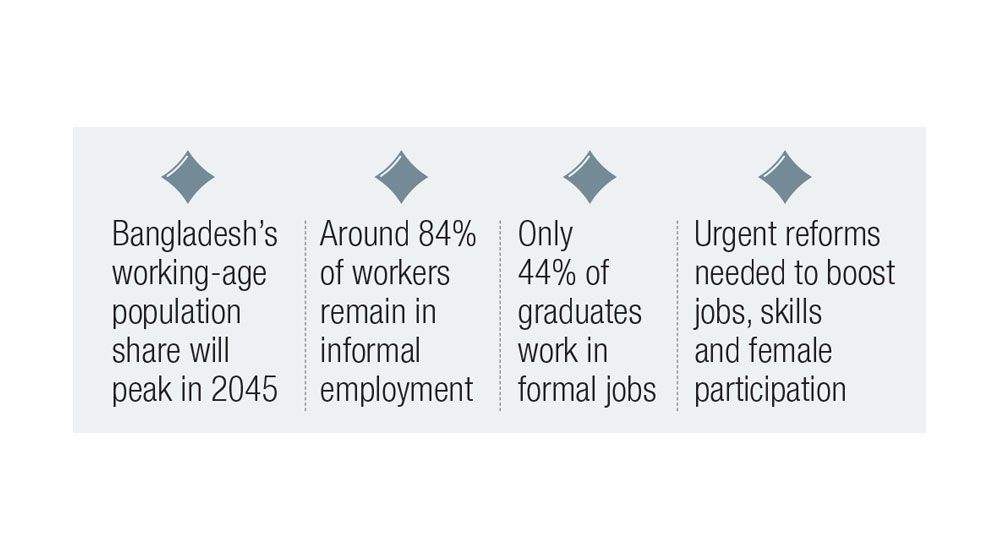
Bangladesh has around two decades to benefit from its large working-age population before its share peaks in 2045, but urgent reforms are needed to turn this advantage into economic gains, the World Bank has warned.
A new World Bank report, Demographic Change in South Asia: From Tailwinds to Headwinds for Development, released on Tuesday, says Bangladesh must create more and better jobs, improve skills, boost women's workforce participation and strengthen healthcare and pension systems to prepare for ageing.
South Asia has 1.17 billion working-age people, but their numbers are expected to peak and start declining in less than a decade. The region is projected to become an aged economy by 2049, when 14% of its population will be aged 65 or older. Bangladesh is expected to reach this stage in 2051.
Since 2000, the rising share of prime working-age adults has contributed 0.4% to South Asia's annual GDP growth and boosted labour productivity by 1.1% annually. However, demographic changes' annual contribution to regional GDP growth is projected to fall to 0.1% by 2050.
“South Asian economies are ageing faster and earlier in their development journeys,” said Johannes Zutt, World Bank vice-president for South Asia, urging countries to create better jobs, strengthen infrastructure and prepare for ageing while maximising their working-age populations.
Bangladesh has yet to turn its favourable age structure into employment and productivity gains. Key challenges include limited formal job creation, low female workforce participation and human capital gaps.
Around 84% of the country's workers, or 58 million people, are employed informally. Even 44% of graduates work in the informal sector. Formal firms are creating jobs slowly, while small firms have recently shed workers on average, the report says.
Jean Pesme, World Bank division director for Bangladesh and Bhutan, stressed the need to help businesses create better jobs, equip young people with market-relevant skills, remove barriers to women's employment and strengthen healthcare and old-age income security. Financing the ageing transition will also require stronger domestic resource mobilisation.
The report warns that South Asian healthcare, long-term care and pension systems are ill-equipped for longer-living populations who are not necessarily healthier. Only 17% of the region's working-age population contributes to pension schemes, while just 10% of older people receive benefits—the lowest coverage globally. To sustain the youth dividend, the World Bank recommends creating productive jobs, expanding finance for micro, small and medium-sized enterprises, streamlining regulations, improving healthcare, education and skills, and removing barriers to women's employment.
It also calls for stronger healthcare, long-term care and pension systems, alongside increased savings and investment, to secure a second demographic dividend by enabling healthier older people to continue contributing to the economy.