


 For all latest news, follow the Daily Sun's Google News channel.


Climate risks may displace 7.5% of Bangladeshis by 2050: ADB
Daily Sun Report, Dhaka
Published: 22 Oct 2026, 12:00 AM
Rising sea levels, water scarcity and declining agricultural productivity could force millions of people in Bangladesh to leave their homes by 2050, highlighting the growing threat of climate change to livelihoods and human settlements, according to a new report by the Asian Development Bank (ADB).
Around 7.5% of Bangladesh's population could become internal climate migrants by 2050 as the combined effects of these climate-related pressures intensify, said the Asia-Pacific Climate Report 2026: Coastal Risks on the Rise-Actions for a Resilient Future, released on Wednesday.
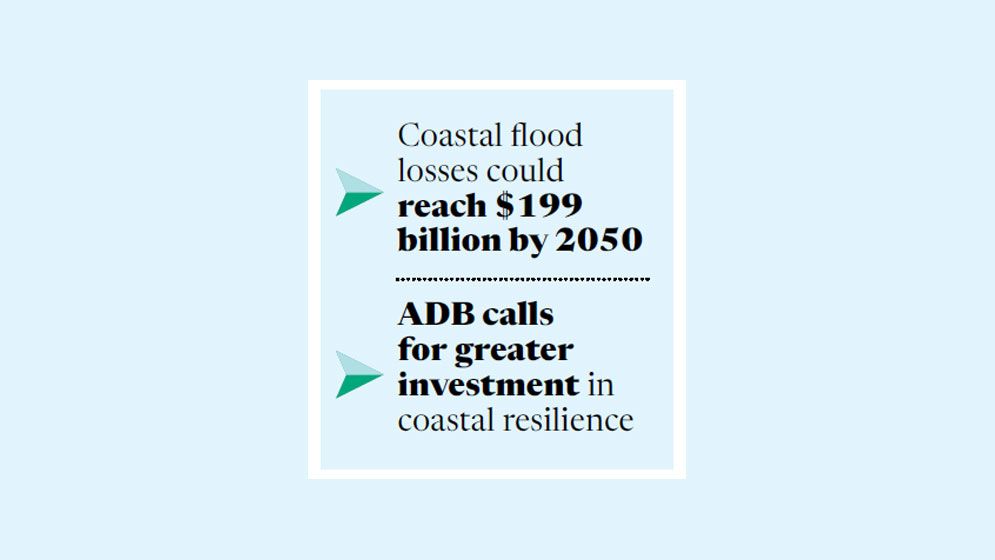
The report examines growing coastal climate risks across Asia and the Pacific and calls for greater investment in adaptation and resilience.
Bangladesh, Myanmar and India face a particularly difficult situation, as households exposed to the highest coastal flood risks often have fewer resources to prepare for, cope with and recover from disasters.
This combination of climate vulnerability and economic deprivation leaves poorer communities at greater risk of displacement and prolonged hardship, the report said.
The report noted that the coastlines of Asia and the Pacific generate around $7 trillion in annual economic output, supporting millions of livelihoods through trade, tourism and other economic activities. However, rising sea levels and intensifying climate hazards increasingly threaten these areas.
Without adequate adaptation measures, annual coastal flood damage across the region could rise more than sixfold by 2050 and nearly twentyfold by 2100.
Based on estimates covering 30 coastal economies, annual losses could reach $172 billion to $199 billion by 2050, up from around $27 billion at present. By 2100, the figure could climb to $520 billion to $739 billion.
The report estimated that annual investment of $9 billion to $19 billion in coastal protection could help keep flood damage near current levels. Such investment could prevent $178 billion to $360 billion in flood damage each year.
“Coasts are the overlooked engine-room of Asia and the Pacific's growth but are retreating in the face of rising seas and escalating hazards,” said Yevgeniy Zhukov, director general of ADB's Climate Change and Sustainable Development Department.
He called for long-term, adaptive and risk-informed solutions to protect people and keep economies running.
More than 400 million people in the region live within 10 kilometres of the sea, making coastal resilience a major development priority.
The report warned that coastal flooding could also cause significant economic disruption. In major cities such as Bangkok, Jakarta, Kolkata and Mumbai, floods that historically occurred once every 100 years could become annual events by the end of the century.
Disruptions to ports could put an estimated $40 billion to $45 billion at risk each year across the region.
To address these challenges, the ADB recommended integrating adaptive planning into development decisions, strengthening institutions and governance, mobilising finance, and ensuring sustained implementation.
International adaptation finance for coastal economies in Asia and the Pacific rose from around $5 billion in 2015 to an average of $11.4 billion a year in 2022-23. However, the report said a substantial financing gap remains.
Public finance will continue to play a central role in building coastal resilience, but governments also need to mobilise private and concessional funding to support long-term adaptation projects.
The report said timely investment in coastal protection and climate resilience would be essential to reduce future economic losses and protect vulnerable communities from the growing impacts of climate change.