



 For all latest news, follow the Daily Sun's Google News channel.


A dinar for Tk395, a taka for 730 Lebanese pounds
The size of a currency unit says more about history and policy than about the strength of the economy behind it
Daily Sun Report, Dhaka
Published: 17 Oct 2026, 12:00 AM
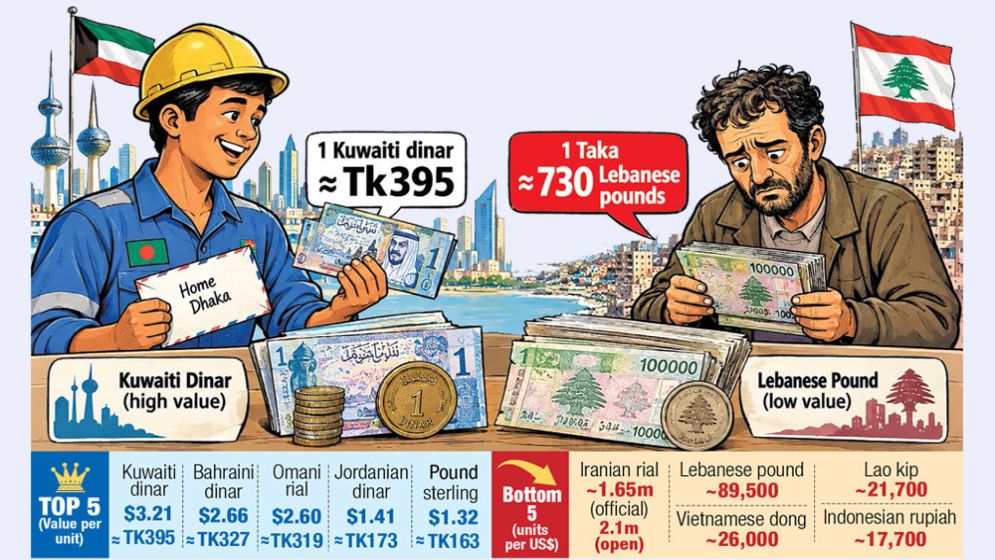
A Bangladeshi worker in Kuwait who sends home a single dinar is sending roughly Tk395. One Kuwaiti dinar fetched about US$3.21 in mid-October, and with the dollar at around Tk123 in early October, the sum comes out close to Tk400. Turn it round and a Tk1,000 note, worth about US$8.14, buys only two and a half dinars.
Now go the other way. At around 89,500 Lebanese pounds to the dollar, one taka is worth about 730 of them, and a Tk1,000 note comes to roughly 728,000.
Those two sums sit at the ends of a long list.
Why the dinar is so dear
Kuwait leads the world's currencies by value per unit. Bahrain, Oman, Jordan and the British pound complete the top five.
The Gibraltar pound, which trades at par with sterling, shares fifth place. The Cayman Islands dollar and the Swiss franc sit just behind, both at about US$1.20.
Oil money and small populations explain part of the Gulf story. The rest is policy. Bahrain, Oman and Jordan peg their currencies to the dollar, and Kuwait manages its dinar against a basket. The Kuwaiti dinar is also divided into 1,000 fils instead of the usual 100. Sterling is the odd one out in this company, because it floats freely and owes its place to a long monetary history rather than to a peg or to oil.
Value per unit, in other words, is largely a matter of how a currency was cut at birth. Jordan has a fairly modest economy, yet its dinar is worth more than a dollar, because the rate was fixed that way and kept there. The dollar is worth less than every currency in the table, but it sits on one side of most currency trades and makes up the bulk of the world's reserves.
The currencies Bangladeshis handle most often sit lower down.
In mid-October the euro was worth about US$1.12, or around Tk137. The Swiss franc came to roughly US$1.20, or about Tk148. The Chinese yuan cost around Tk18, and the Japanese yen less than a taka, about 78 poisha, since a dollar buys roughly 158 yen.
For Bangladesh the top of this table is more than trivia. The Gulf is where millions of our workers earn their living, so the dinar, the rial and the Bahraini dinar show up in household budgets from Sylhet to Noakhali.
At the bottom of the table
At the other end, five currencies need the most units to match a dollar.
Iran's figures are the shakiest, because the rial has been moving fast this year. The central bank's official rate stood at about 1.65 million to the dollar on 15 September, while the open market was above 2.1 million in early September. Sanctions, inflation and conflict did most of the damage.
Lebanon's fall is the starkest. The pound was held at 1,507.5 to the dollar from 1997 until October 2019, and has since lost more than 98 per cent of its value after a banking collapse.
Vietnam, Laos and Indonesia are different stories. The dong is guided lower by the central bank to support exports, so its weakness reflects policy rather than crisis. Vietnam's largest note, the 500,000 dong, is worth under US$20. Laos has struggled with debt and inflation, while Indonesia still carries the scars of the 1997 Asian financial crisis, though the rupiah is comparatively stable. Next in line come Uzbekistan's som at about 12,200 to the dollar and Guinea's franc at about 8,800.
Published rankings differ, mainly over whether Iran is counted at its official or its open-market rate. They also differ over how to treat currencies that have been redenominated, such as Sierra Leone's.
A big number per dollar can mean a currency in collapse, as in Lebanon. It can also mean a stable currency that never lost its zeroes, as in Vietnam. Only the economy behind it tells you which.
Where the taka stands
The taka sits in the middle. The dollar cost Tk122.91 on 2 October. Over the past year it has ranged from a low of Tk121.67 on 7 October 2025 to a high of Tk123.81 on 6 August 2026, and it now costs about one per cent more than it did a year ago. That is a gentle slide by the standards of the table above.
A softer taka makes each dollar or dinar sent home worth a little more, which families with a relative abroad notice quickly. It also makes imported fuel, fertiliser and machinery dearer, which everyone else notices.
What the numbers really tell us
Whether a currency unit is large or small is mostly an accident of history. What matters is what it buys and whether people trust it. In Lebanon, many shopkeepers think in dollars because the pound cannot be trusted to hold a price. In Kuwait the dinar is trusted at home and buys a good deal, but few would call it more powerful than the dollar.
(This report is based on information sourced from the internet)