



 For all latest news, follow the Daily Sun's Google News channel.


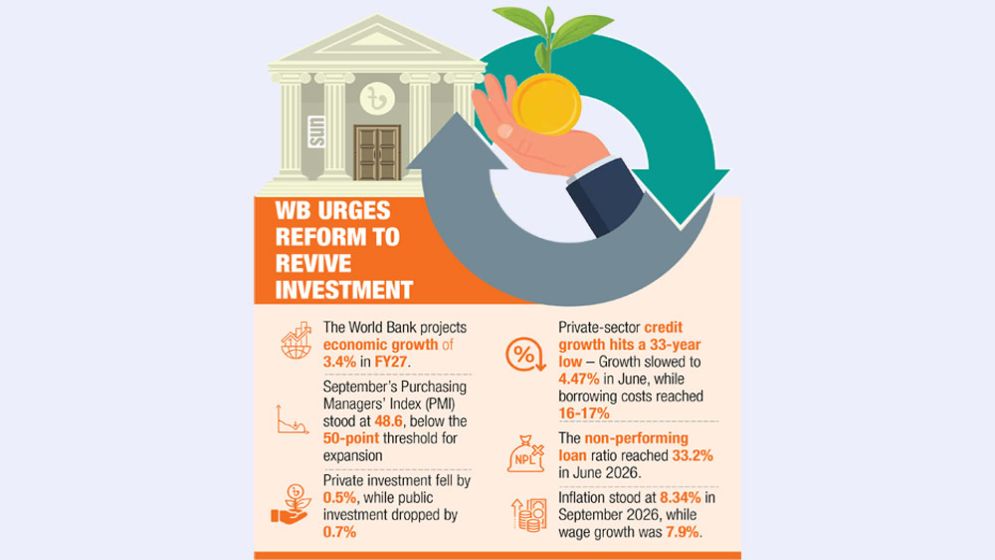
Bangladesh’s private sector is facing mounting pressure as business activity contracts, investment weakens and private-sector credit growth falls to a 33-year low, raising concerns over industrial production, employment and economic growth.
The World Bank has warned that the country’s GDP growth could slow to 3.4% in FY27, citing weaknesses in the banking sector, energy shortages, high inflation and inadequate revenue mobilisation. It has called for urgent reforms in these areas to restore economic stability and revive private investment.
The warning comes as the headline Purchasing Managers’ Index (PMI) fell 1.3 points to 48.6 in September from 49.9 in August, marking a second consecutive month of contraction, according to a report by the Metropolitan Chamber of Commerce and Industry, Dhaka (MCCI), and Policy Exchange Bangladesh (PEB).
Manufacturing suffered the sharpest deterioration, while construction and services also contracted. Economists and business leaders say high borrowing costs, unreliable energy supplies, banking-sector weaknesses and policy uncertainty are discouraging businesses from investing and expanding operations.
“Bangladesh’s economic dynamism remains under pressure, as weakness in manufacturing, construction and services weighed on overall performance,” said M Masrur Reaz, chairman and chief executive of PEB.
How to reverse the private sector slump
The World Bank has prioritised reforms in banking, energy and domestic revenue mobilisation to restore investor confidence, support businesses and create jobs.
It has urged completing bank asset-quality reviews, making bank owners and investors bear losses, and gradually withdrawing concessions to weak banks.
It has also urged boosting domestic gas production and renewables, expanding LNG infrastructure, and upgrading power networks. It has also stressed the need for transparent and competitive bidding in electricity procurement and project selection.
To raise revenue, it has recommended separating tax policy from administration, curbing evasion and reducing exemptions.
The reforms are vital amid weak investment, high production costs and financing constraints.
Manufacturing and investment under pressure
Manufacturing fell 2.6 points to 44.8 in September, with orders, output, purchases, inventories and imports contracting faster. Construction slipped to 48.5, with its index falling 3.8 points, while services contracted for a second month at 49.
Agriculture remained in expansion for a 13th month, despite falling to 55.2. A PMI below 50 signals contraction, while areading above 50 indicates expansion.
The World Bank said gas and electricity shortages were forcing factories to operate below capacity.
Industrial growth slowed to 2.86% in FY26, from 3.71% the previous year and 8.18% in FY23. Private and public investment fell by 0.5% and 0.7%, respectively.
According to the Bangladesh Bureau of Statistics, private investment stood at 21.53% of GDP in FY26, its lowest share in 14 years. A revised government estimate put it at 21.22%.
Imports of capital machinery, medical supplies, vehicles and heavy equipment fell 45.1% over four fiscal years.
Reaz warned that declining private investment threatened growth, stressing the need to boost demand, ensure reliable energy, ease financing and contain costs.
Credit constraints and banking weaknesses
Private-sector credit growth hit a 33-year low of 4.47% in June, below the 8% FY26 target, according to the Bangladesh Bank. High borrowing costs of 16-17%, weak demand and uncertainty have discouraged investment.
FBCCI Administrator Md Fazlul Hoque warned that slowing credit growth and falling imports of capital machinery and raw materials threatened industrial production.
He said lowering interest rates alone would not immediately revive investment because businesses lacked the confidence to take new risks. Simpler administrative procedures and more effective policy implementation were also needed to encourage entrepreneurs.
The World Bank warned that banking-sector weaknesses posed a major economic risk, with non-performing loans reaching 33.2% in June 2026 and unsecured liquidity support to weak banks hitting Tk76,000 crore.
It urged asset-quality reviews and action to address losses, saying repeated concessions and liquidity support delayed their resolution and undermined confidence.
Government credit growth exceeded 30%, with banks providing 81.5% of government financing in the first 11 months of FY26. The fiscal deficit reached 3.9% of GDP and interest payments 2.6%, raising concerns that borrowing could squeeze business credit, keep lending rates high and curb investment and jobs.
Dr Zahid Hussain, former lead economist at the World Bank’s Dhaka office, told the Daily Sun that the proposed public-sector pay structure would add around Tk1 lakh crore in expenditure over two years, but the financing plan remained unclear.
He said borrowing to finance a permanent increase in expenditure would raise interest costs and create further pressure on public finances. With limited scope to increase revenue in a sluggish economy, the government would need to find savings elsewhere, including through cuts in development expenditure.
Inflation and employment risks
Inflation reached 8.34% in September 2026, with food inflation at 7.22% and non-food inflation at 9.3%, according to BBS data. Wage growth slowed to 7.9%, squeezing real incomes and household spending.
The World Bank estimated that around 2.1 million more people fell below the poverty line in FY26 than in the previous fiscal year. The national poverty rate rose from 18.7% in 2022 to an estimated 22.5% in FY26 and could reach 22.8% in the current fiscal year.
Mustafa K Mujeri, executive director of the Institute for Inclusive Finance and Development and a former director general of the Bangladesh Institute of Development Studies, told the Daily Sun that major economic indicators showed the economy was not operating at its desired level of dynamism. Under the prevailing conditions, he said, businesses had legitimate reasons to consider fresh investment risky.
Fahmida Khatun, distinguished fellow at the Centre for Policy Dialogue, said domestic and global economic challenges had made new investment more difficult and hindered business expansion. High production costs were eroding competitiveness, while weak capital machinery imports were limiting opportunities to create jobs.
The World Bank forecast that around 630,000 net jobs could be created in FY27, but warned that this would not be enough to reduce poverty rapidly.
Recommended Stories