


 For all latest news, follow the Daily Sun's Google News channel.


Maitree Express: A six-hour journey that could bring Dhaka and Kolkata closer
Daily Sun Report, Dhaka
Published: 30 Sep 2026, 12:00 AM
For a patient, an elderly passenger, a family travelling with children or someone crossing the border for business, shopping or to visit relatives, every hour saved means less time spent inside a railway carriage and more time at the destination.
That is why the possible rerouting of the Maitree Express through the Padma Bridge-Benapole railway corridor could mean much more than a change in tracks.
It could fundamentally change the experience of travelling between Dhaka and Kolkata.
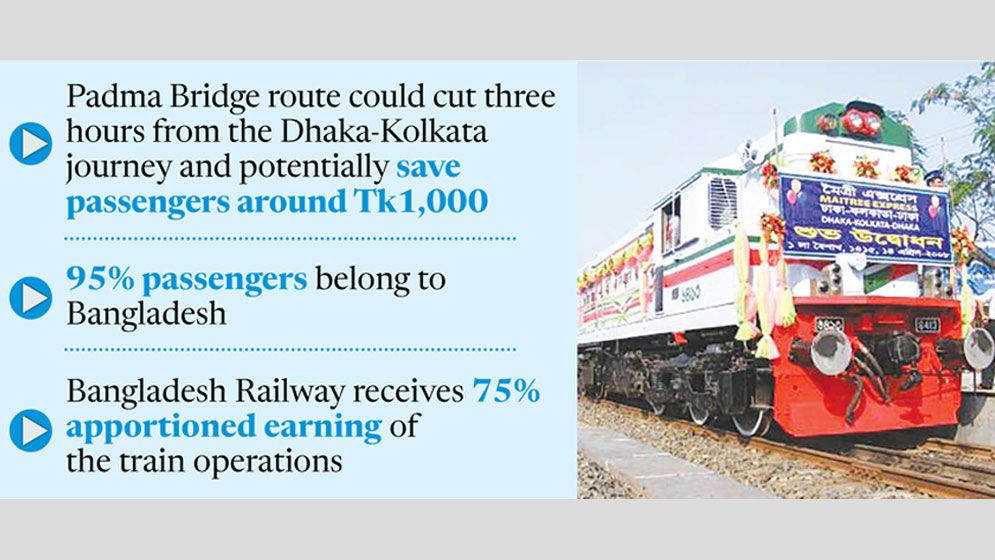
If the cross-border passenger train is shifted from its existing Jamuna Bridge-Darsana route to the Padma Bridge-Benapole route, the journey could potentially be shortened by around three hours, bringing travel time down to roughly six hours.
The shorter route could also reduce the fare by around Tk1,000, according to railway experts.
For a train that has already become a preferred mode of transport for thousands of Bangladeshis, those savings in time and money could make a significant difference.
The Maitree Express has always carried a little more meaning than an ordinary train. Its name means “friendship”, reflecting the historical and cultural ties between Bangladesh and India. But over the years, the symbolism has increasingly given way to something more tangible: a practical lifeline for ordinary passengers.
A train for ordinary people
Launched in April 2008 on the occasion of the Bengali New Year, the Maitree Express restored a passenger railway connection between Bangladesh and India that had been severed in 1965.
It was conceived as a symbol of renewed connectivity between two neighbouring countries. Yet its real importance has been defined by the people who board it.
Patients travelling to Kolkata for medical treatment, families visiting relatives, tourists, traders and businesspeople have all found the train a relatively affordable alternative to air travel.
And the passenger statistics tell a revealing story.
Railway figures show that 2,88,360 passengers travelled on the Maitree Express between 2022-23 and 19 July 2024. About 95 per cent of them were Bangladeshis.
The train generally operated at 80-85 per cent occupancy, while demand climbed above 95 per cent during major festivals such as Eid and Durga Puja.
In other words, the Maitree Express may have been born as a diplomatic gesture, but it became overwhelmingly a service used by Bangladeshis.
For many passengers, its appeal was simple. It offered a way to reach Kolkata without the cost, airport procedures and other complications associated with flying.
Then, suddenly, the journey stopped.
When the tracks went silent
The Maitree Express was suspended on 19 July 2024 amid security concerns. Since then, passengers on both sides of the border have been waiting for the service to return.
But its eventual resumption could come with a different route.
Before the suspension, the train travelled from Dhaka through Tangail, the Jamuna Bridge, Ishwardi and Darsana before entering India. The route covered about 392 kilometres.
The approved timetable allowed approximately 7 hours 45 minutes for the journey from Dhaka to Kolkata and 8 hours 25 minutes in the opposite direction.
In reality, however, the journey could take considerably longer.
Railway congestion, particularly along the Dhaka-Ishwardi-Darsana corridor, could push travel time to nine or even 10 hours.
On paper, that may look like a timetable problem. For passengers, it was a very real part of the journey.
A medical patient with an appointment in Kolkata could lose valuable time. An elderly traveller could face hours of additional discomfort. A family travelling with children could find the seemingly modest delay exhausting.
Then came the Padma Bridge railway connection.
A new route changes the map
The opening of the Padma Bridge rail link in December 2024 changed the geography of Bangladesh's railway network.
For the southwest, the bridge created a faster and more direct railway connection. Its effect became particularly visible on services running towards Benapole.
The journey from Kamalapur to Benapole, which previously took more than eight hours through the Jamuna Bridge corridor, has been substantially shortened via Padma Bridge. The Ruposhi Bangla Express, for instance, takes around 3 hours 4 minutes between Kamalapur and Benapole.
That raises an obvious question: why should the Maitree Express continue taking the longer northern route when a faster corridor is now available towards the western border?
Railway officials and people familiar with the matter believe routing the Maitree Express through Padma Bridge and Benapole could save around three hours.
The Dhaka-Kolkata journey could consequently come down to about six hours.
That would be more than a timetable adjustment. It would change the character of the service.
A train that currently requires most of a working day could become a realistic same-day travel option between the two cities.
Three hours saved and possibly Tk1,000 too
Time, however, is only part of the equation.
A shorter route could potentially reduce the passenger fare by around Tk1,000.
For a lone traveller, that is a useful saving. For a family of four or five, it becomes much more significant.
The combination of a shorter journey and lower fare could also make the Maitree Express more competitive with air travel.
That matters because the train's greatest advantage has never been speed. It has been accessibility.
The Maitree Express brings the border closer to ordinary passengers.
A railway service with an unusual revenue split
There is another side of the Maitree Express that receives less attention.
Under the arrangement for the cross-border passenger service, Bangladesh Railway receives 75 per cent of the apportioned earnings, while Indian Railways receives the remaining 25 per cent.
That gives the service an economic significance for Bangladesh beyond passenger convenience.
Before its suspension, the fare from Kolkata to Dhaka Cantonment was fixed at US$30 for an AC Seat and US$20 for an AC Chair Car, with no additional charge.
With 456 seats available on each train, high occupancy translates into substantial passenger traffic.
The rake consists of 10 coaches—four AC First Class coaches, four AC Chair Car coaches and two power cars. Three rakes were deployed to maintain the five-days-a-week service, with two supplied by Indian Railways and one by Bangladesh Railway.
The coaches were designed for long-distance comfort, with anti-telescopic structures, lightweight bodies, improved suspension and fire-safety systems.
Passengers could also carry up to 35 kilograms of accompanied luggage free of charge.
For people travelling across an international border, however, perhaps the most important convenience was not inside the coaches at all.
It was at immigration.
Crossing a border without feeling stuck there
The Maitree Express operates with an end-to-end immigration clearance system.
The arrangement helps minimise the lengthy border procedures that passengers on conventional cross-border journeys often have to endure, particularly around Gede and Darsana.
That matters enormously for people travelling for medical treatment, elderly passengers and families.
A train can be comfortable, affordable and fast, but if passengers spend hours waiting for immigration and customs clearance, much of that advantage disappears.
The Maitree Express was designed to reduce that friction.
It turns the international border from a prolonged interruption into a more manageable part of the journey.
The meaning of Maitree
The Maitree Express began as an emblem of friendship between Bangladesh and India. But its greatest achievement may be less diplomatic and more human.
It connected patients with hospitals, families with relatives, traders with markets and tourists with another city.
Its passenger profile also makes one fact particularly clear: this is a service in which Bangladeshis have overwhelmingly been the main users.
If the train resumes through the Padma Bridge-Benapole route, its future could look considerably different from its past.
The prospect of a roughly six-hour journey, combined with a potential Tk1,000 reduction in fare, could make the service substantially more attractive.
For a passenger leaving Dhaka in the morning and arriving in Kolkata around six hours later, the two cities would no longer feel quite so far apart.
The railway line would still cross an international border. The distance between the two cities would not disappear.
But the journey would become shorter, cheaper and easier.
And perhaps that is the most practical meaning of Maitree – not simply friendship written into the name of a train, but the everyday convenience of bringing two cities and the people who move between them a little closer.