



 For all latest news, follow the Daily Sun's Google News channel.


AFMC plans academic, infrastructure development
Daily Sun Report, Dhaka
Published: 23 Sep 2026, 12:00 AM
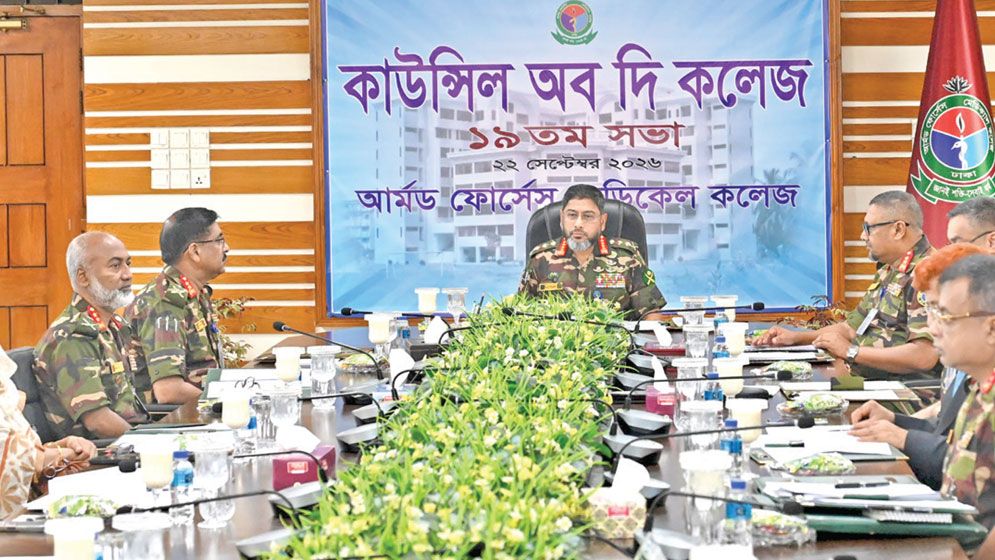
Chief of Army Staff and Armed Forces Medical College (AFMC) Chairman General Waker-Uz-Zaman chairs the 19th College Council meeting of AFMC at its campus on Tuesday.-ISPR Photo
The Armed Forces Medical College (AFMC) on Tuesday discussed a series of initiatives to expand its academic and infrastructure facilities, including a new academic building, women’s dormitory, training hospital and increased cadet intake.
The plans were discussed at the 19th College Council meeting of AFMC at its campus in Dhaka Cantonment, with Chief of Army Staff and College Council
Chairman General Waker-Uz-Zaman in the chair.
The meeting discussed and adopted a range of initiatives aimed at modernising medical education, enhancing academic excellence and aligning the institution’s standards with international benchmarks, according to a press release issued by the Inter-Services Public Relations (ISPR) Directorate.
The agenda included a review of recent professional examination results, academic development plans, budget and financial management, and admission of cadets to the 29th batch for the 2026-27 academic session.
The meeting also discussed construction of an extended academic building and a women’s dormitory, expansion of renewable energy use under the national rooftop solar programme, establishment of a dedicated training hospital and an increase in cadet intake to meet future requirements.
Senior officials from the Directorate General of Medical Services, AFMC and Bangladesh University of Professionals, along with representatives of the defence, finance, education and health ministries and the three services, attended the meeting.
AFMC began its academic journey on 20 June 1999 with 56 medical cadets under the affiliation of Dhaka University, the ISPR said.
Following the meeting, the Army chief visited AFMC’s Clinical Skills and Simulation Laboratory and laid the foundation stone at a designated site for relocating and expanding the facility into a more modern laboratory.
The initiatives are expected to strengthen the college’s education, training, research and infrastructure and contribute to developing skilled doctors for the armed forces and the country, the ISPR said.