


 For all latest news, follow the Daily Sun's Google News channel.


Mideast tension runs high
US faces arms shortfall
Agencies, Riyadh/Dubai
Published: 16 Sep 2026, 12:00 AM
Tensions centering on Iran war in the Middle East have heightened dangerously, bringing the region closer to a wider war, since Yemen’s Iran-aligned Houthis started launching attacks on Saudi Arabia recently.
Houthi rebels unleashed a new wave of strikes on Saudi Arabia and were digging into positions on the western coast of Yemen along the Red Sea, Yemeni officials said, as urgent deliberations took place in Riyadh over how to respond to their lightning advance.
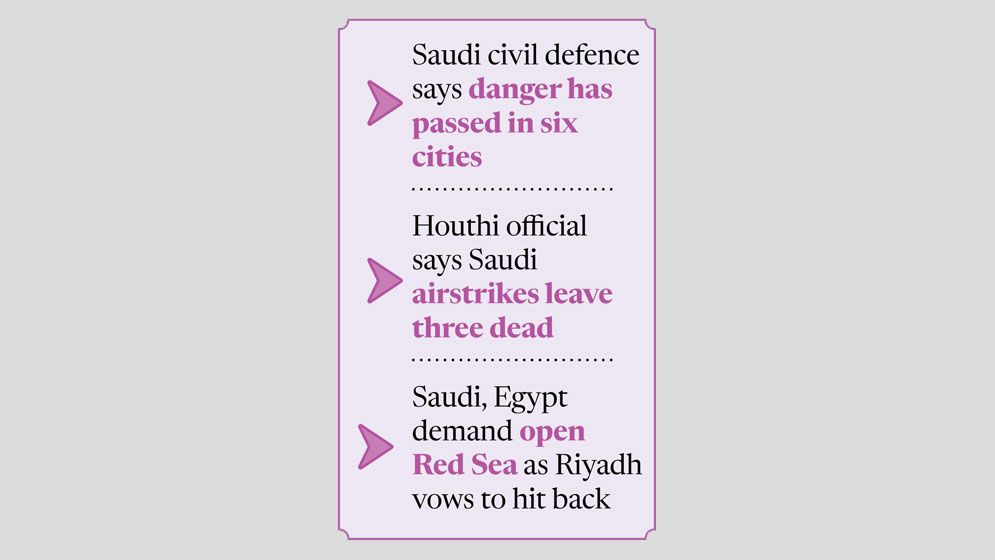
The Saudi Arabian Civil Defence sent an all clear on Tuesday after issuing alerts for potential danger in six cities including Yanbu, the kingdom's main Red Sea oil port, where millions of barrels a day are loaded.
Saudi Civil Defence said the danger had passed in Jeddah, Abha, Jazan, AlUla and Taif after the areas received emergency alerts amid an uptick in attacks by Yemen's Iran-aligned Houthis.
The Houthis have stepped up attacks on Saudi cities and energy infrastructure while advancing along Yemen's Red Sea coast towards the
Bab el-Mandeb Strait, a key shipping route.
A Houthi official said Tuesday that Saudi warplanes struck Yemen, killing three people, including two children, while Human Rights Watch accused the Houthi rebels of possible war crimes with their attacks on commercial vessels.
Saudi Arabia and Egypt's leaders called on Tuesday for free navigation in the Red Sea, after Riyadh vowed a firm response to attacks by Yemen's Houthis, who now control the southern entrance to the key waterway.
De facto Saudi leader Crown Prince Mohammed bin Salman met Egyptian President Abdel Fattah al-Sisi in Cairo on Tuesday, where the two discussed the latest crisis.
They called for "ensuring the freedom and security of maritime navigation" through the Hormuz and Bab al-Mandab, the Egyptian presidency said, adding that Sisi affirmed Egypt's support for measures taken by Saudi Arabia "to protect its security and stability".
On Tuesday, Qatar warned of dire consequences if Bab al-Mandab was closed, saying it would be "catastrophic for the entire world".
Oman said it was searching for two missing crew members who were aboard a tanker targeted in the Strait of Hormuz that was now being towed.
The Omani Maritime Security Centre said it was overseeing a towing operation for the Panama-flagged oil tanker ELGAIA to a port in Oman after a fire was extinguished in its engine room following an attack northeast of Musandam.
Flaring fighting between government forces and Iran-backed Houthis in Yemen has displaced more than 100,000 people inside the country, while thousands more have fled abroad, the United Nations said Tuesday.
Meanwhile, the Defense Department's inspector general revealed Monday that the United States was facing a shortfall in ammunition as a result of its costly war in Iran.
In a first-of-its-kind mandatory report to Congress, the inspector said that between Feb. 28 and June 30, Operation Epic Fury (OEF) had an estimated cost of $33.4 billion, with $22.3 billion of that spent on munitions alone.
"The munitions expenditure on OEF has resulted in strategic inventory shortfalls and revealed industrial base bottlenecks for munitions resupply," the report states.
It also lists American military assets lost in the war, including four F-15s destroyed, one F-35 damaged, seven KC-135 tanker aircraft damaged and up to 30 MQ-9 Reaper drones destroyed.
On the other hand, the global trading system is enduring its most sustained disruption in living memory amid challenges to trading rules that could batter living standards in a "geo-fragmented world", the WTO warned Tuesday.
The system is now in a decisive phase, the World Trade Organization said in its annual report, which "provides new evidence that a reversion to unilateral trade policy would impose large costs".