


 For all latest news, follow the Daily Sun's Google News channel.


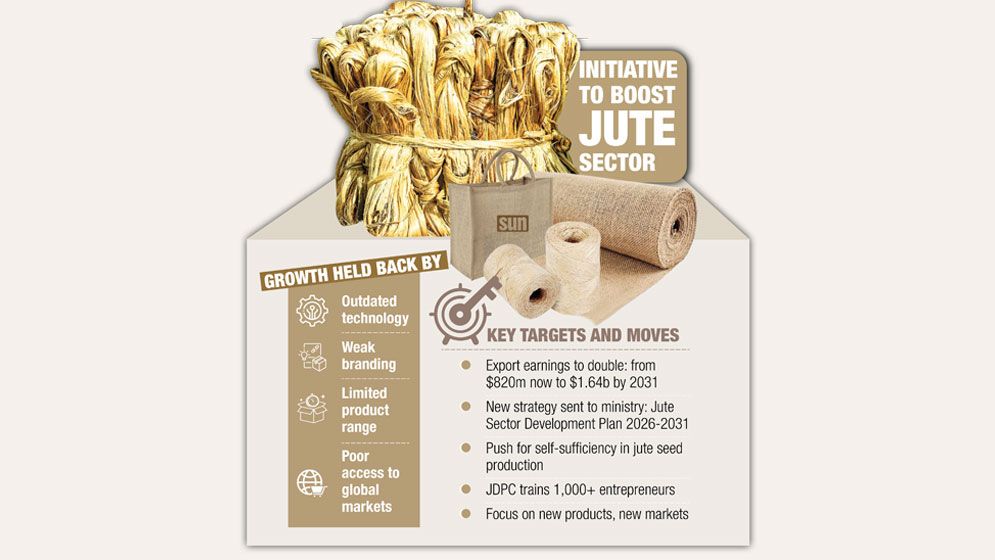
The government has drawn up a five-year plan to double jute export earnings, from around $820 million to $1.64 billion by 2031, according to a draft strategy now with the Ministry of Textile and Jute.
The Department of Jute has sent the “Bangladesh Jute Sector Development Strategy and Action Plan 2026-2031” to the ministry for approval.
It focuses on higher value addition, improved productivity, new products, market diversification and stronger international competitiveness.
Jute and jute-goods exports have fallen sharply in recent years despite rising global demand for sustainable, biodegradable alternatives to plastics and synthetic fibres.
Export earnings rose to $1.16 billion in FY21 but declined over the following four years to $820 million in FY25.
The draft attributes the fall to a limited range of value-added products, a narrow export market, international competition and anti-dumping duties imposed by India.
It also flags the closure of 73 of the country’s 266 jute mills, the absence of internationally accredited testing laboratories, and a large number of vacant posts at the Department of Jute as major challenges.
Bangladesh currently exports jute and jute products to 152 countries, but 63% of total exports are concentrated in three markets – Turkey, China and India.
The draft places emphasis on expanding into new markets and shifting exports towards high-value jute products rather than raw jute.
Director General of the Jute Department Syed Md Nurul Basir said, “We have recently sent a draft to the ministry. Now, the final decision will come from there. There is huge potential and also challenges to boost the sector.”
FBCCI Administrator Md Fazlul Hoque called the move an “encouraging development,” noting jute’s standing as one of the country’s oldest products.
“It is possible to double the benefits from this sector. Another major advantage is that the raw material is available locally and is entirely our own. We do not need to import raw materials from abroad; we have our own resources. So, the entire earning is ours, if we can diversify jute for exports,” he said.
Bangladesh Jute Spinners Association Chairman Tapash Pramanik welcomed the initiative, which places jute alongside apparel as a potential source of export earnings. But he added a note of caution, “In the past, we have seen many well-intentioned initiatives remain on paper without being implemented. We want to believe that this will not be the case this time with jute.”
Seed dependency a key challenge
Joint Secretary of the Textiles and Jute Ministry Md Jahid Hossain said achieving self-sufficiency in jute seed production is among the top priorities.
Department of Agricultural Extension and the Bangladesh Jute Research Institute are running joint projects and research to reduce that dependence, he said.
Research is also under way to develop high-yielding jute varieties that mature faster. Jute typically takes 90-120 days to harvest; with many farmers growing three to four crops a year on the same land, demand for shorter-duration, high-yielding varieties is rising.
Jahid Hossain said Bangladesh produced between 1.5 million and 2 million tonnes of jute in 1972–73, compared with 1.5 million to 1.8 million tonnes today – output sustained on less land, driven by higher productivity and wider use of high-yielding varieties.
JDPC trains over 1,000 entrepreneurs
Bangladesh earned around $900 million from jute and jute-product exports in the 2025-26 fiscal year, but continues to trail India and China in finished, high-value jute products. Exports have traditionally centred on raw jute and jute yarn; the focus is now shifting towards diversified, high-value goods.
The global market for jute bags presents a significant opportunity. Sector stakeholders put the global grocery bag market at $3 billion to $5 billion, of which Bangladesh holds a share of only around 0.5%. Despite being among the world’s leading jute producers, the country faces stiff competition from India, Pakistan, Türkiye and China.
Jahid Hossain, who also serves as Managing Director of the Jute Diversification Promotion Centre (JDPC), said the government is encouraging private entrepreneurs to produce diversified jute goods to reduce reliance on raw jute exports.
The JDPC, which has more than 1,300 registered entrepreneurs, provides training, design development support, access to domestic and international trade fairs, and help identifying new markets.
Jute sticks, once used mainly as fuel, are now being processed into charcoal, which – if converted into activated carbon – could serve water filtration and other industries, opening further export potential. The Ministry of Textiles and Jute is considering a project on this front.
As part of a wider push to boost domestic consumption alongside exports, the government has launched an initiative to produce jute schoolbags for primary students, with around 600,000 bags planned in the first phase. Fifty-nine JDPC-registered entrepreneurs are involved in production.