


 For all latest news, follow the Daily Sun's Google News channel.


INterview
‘Govt works tirelessly to reflect people’s hopes’
PM’s Adviser Mahdi Amin on six months in office

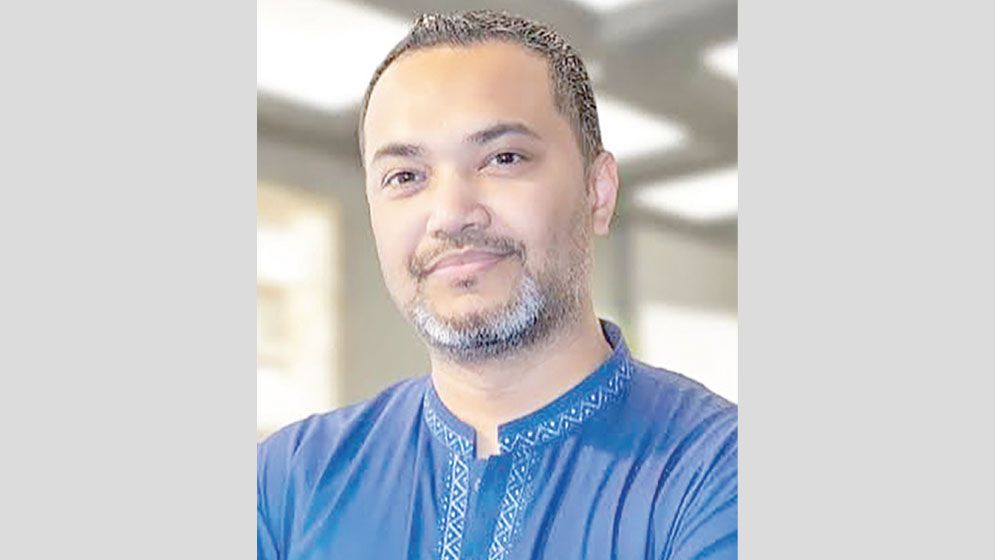
The BNP government has worked tirelessly over the past six months to reflect the hopes and aspirations of the people amid numerous challenges, and will continue to do so, Prime Minister’s Adviser and office spokesperson Mahdi Amin has said.
“We have seen already how this government has worked tirelessly over the past six months to reflect the hopes and aspirations of the people amid several challenges. And this government is continuing it for the future as well,” he told the Daily Sun in an interview.
Mahdi said the government, along with its ministries and agencies, would naturally assess its collective achievements over the 180 days, though it is the people, as holders of political power, who will ultimately judge its performance. The aim, he said, is to build on the first 180 days as a foundation over the remaining four and a half years of the government’s elected term.
“The first six months involved many inherent challenges, particularly the long process of recovering from the damaged state structure left behind by what we describe as 16 years of authoritarian rule,” he added.
Asked whether the government would evaluate the six-month performance of its cabinet members, Mahdi said the prime minister, like any head of government, routinely assesses the ministries and agencies under his authority.
“This is a normal process and it is not something specific to the 180 days. There will be an assessment after 180 days, followed by further assessments in the second, third, fourth and fifth years. It is therefore a continuous process.”
Where shortcomings emerge, he said, the government would learn from them and undertake more coordinated initiatives.
On opposition criticism, Mahdi said Bangladesh would always have different political parties, opinions and ideologies, but urged them to unite in the national interest. “I would urge the opposition political parties not to oppose everything simply because they are in opposition. Where the government is doing well, they should encourage it and stand beside it. They should rise above narrow partisan interests and prioritise the national interest.”
He added that while there should be no compromise on national unity, “where the government makes mistakes, it is entirely legitimate for the opposition to offer reasonable, fact-based criticism.”
Mahdi said the July uprising’s aspiration was for cordiality and cooperation among political parties, and that abusive behaviour or misinformation against respected public figures did not reflect its spirit. “We believe every democratic political party should pursue positive politics from its position.”
Economic and social measures
Listing the government’s achievements, Mahdi cited the waiver of agricultural loans and interest of up to Tk10,000 for farmers, along with the Family Card for women’s empowerment, the Farmer Card, and monthly honorariums for imams, muezzins, khatibs and religious leaders of other faiths. Nationwide canal excavation and tree-planting programmes were also under way, he said.
He pointed to business- and investment-friendly policies aimed at generating youth employment, adding that an employment exchange and expatriate card would be introduced soon. On education, he said reforms were under way to nurture “honest, qualified, skilled and responsible citizens,” with innovation grants and startup schemes being developed for students from Classes Six to Twelve.
In health, he said the government was working to extend services nationwide, including a plan to recruit around 100,000 healthcare workers, roughly 80,000 of them women.
Energy sector
Mahdi said the government was prioritising solar power and restructuring investment around renewable energy, with government institutions encouraged to shift away from traditional energy sources.
He claimed fuel prices in Bangladesh had remained controlled even as global oil prices rose amid the Middle East conflict, with increases coming only later and supplies uninterrupted.
On the continuing gas crisis, he said relevant ministries were seeking a realistic, sustainable medium-term solution.
The prime minister had discussed with Malaysian authorities ways to rapidly increase gas supplies via Petronas, and had encouraged energy investors during visits to China and Malaysia. Representatives of major US energy firms had also visited recently to discuss resolving Bangladesh’s gas and electricity shortages, he said.
Law and order, diplomacy
Mahdi said Bangladesh’s international standing had changed markedly under an elected government over the past six months.
On law and order, he said investigations into long-pending cases, including the killings of Tanu and Sharif Osman Hadi, had progressed significantly, alongside swift action on cases of child rape and murder.
He said the judiciary was functioning independently, without government interference, while the trial of those accused in the mass killings continued under the International Crimes Tribunal.
He noted that the banned organisation had been formally prohibited through parliamentary procedure, and that more than a hundred ordinances had been converted into law during parliament’s first session.