


 For all latest news, follow the Daily Sun's Google News channel.


Dengue infections are rising rapidly in Chattogram just weeks after severe flooding hit the region, raising concerns of a larger outbreak in the coming months.
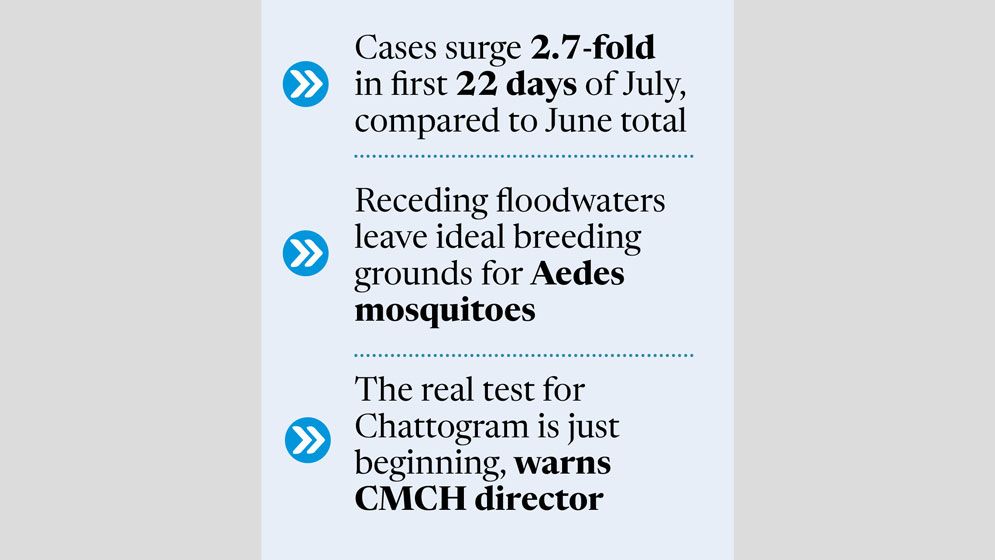
According to the Chattogram Civil Surgeon's Office, 68 dengue cases were recorded in January, 22 in February, 20 in March, 29 in April and 37 in May. The number then jumped to 122 in June. Then the number of cases rose to 329 in just the first 22 days of July – nearly 2.7 times the total recorded in the whole month of June.
Public health experts warn that stagnant water left behind by the recent floods has created ideal breeding grounds for Aedes mosquitoes, increasing the risk of further transmission in August and September.
Health officials say the number could exceed 400 by the end of the month if the current trend continues.
"Recent floods and stagnant clean water during the monsoon have increased Aedes mosquito breeding,
leading to a rapid rise in dengue infections," said Chattogram Civil Surgeon Dr Jahangir Alam.
"People must keep their homes and surroundings clean and ensure that water does not remain stagnant for more than three days. Government hospitals have also strengthened their preparedness to handle a growing number of patients," he added.
More cases in upazilas than the city
Traditionally considered an urban disease, dengue is now affecting more people in upazilas than the metropolitan city.
Of the 627 cases reported this year, 247 were detected in Chattogram city, while 252 were reported from different upazilas. Another 128 patients came from other districts and were diagnosed while receiving treatment at Chattogram hospitals.
Sitakunda recorded the highest number of cases among the upazilas with 62 patients, followed by 23 in Raozan, 21 in Lohagara, 18 in Mirsharai, 17 in Patiya, 16 in Banshkhali and 14 in Satkania.
Public health experts say dengue is no longer confined to cities and is increasingly spreading to rural and coastal areas, making disease control more challenging.
"Unrestricted movement of people, climate change and poor waste management are among the main reasons for the spread of dengue from urban areas to rural communities," said Dr Altaf Hossain, health and family planning officer of Sitakunda upazila.
However, Civil Surgeon Dr Jahangir Alam said the higher number of cases in upazilas may not fully reflect the actual situation.
"Many patients admitted to hospitals have permanent addresses in upazilas but currently live in the city. As a result, upazila figures appear slightly higher in the statistics," he observed.
Flood aftermath raises concerns
Large parts of Chattogram, Cox's Bazar, and the three hill districts were inundated during the recent floods. In many areas, waterlogging still persists.
Experts say after floodwaters recede, stagnant water in tree holes, discarded containers, damaged infrastructure and other natural breeding sites create favourable conditions for Aedes mosquitoes.
"If preventive measures are not strengthened now, the situation could worsen significantly in August and September," said a senior entomologist of the Directorate General of Health Services, requesting anonymity.
Chattogram City Corporation's Deputy Chief Conservancy Officer Pranab Kumar Sharma said larvicide and mosquito control operations have been ongoing since May.
"We have carried out mosquito control drives, cleaning campaigns and public awareness activities to prevent dengue and chikungunya after the floods," he said.
Greater public awareness in the city could be one of the reasons why more cases are now being reported from upazilas, Sharma added.