


 For all latest news, follow the Daily Sun's Google News channel.


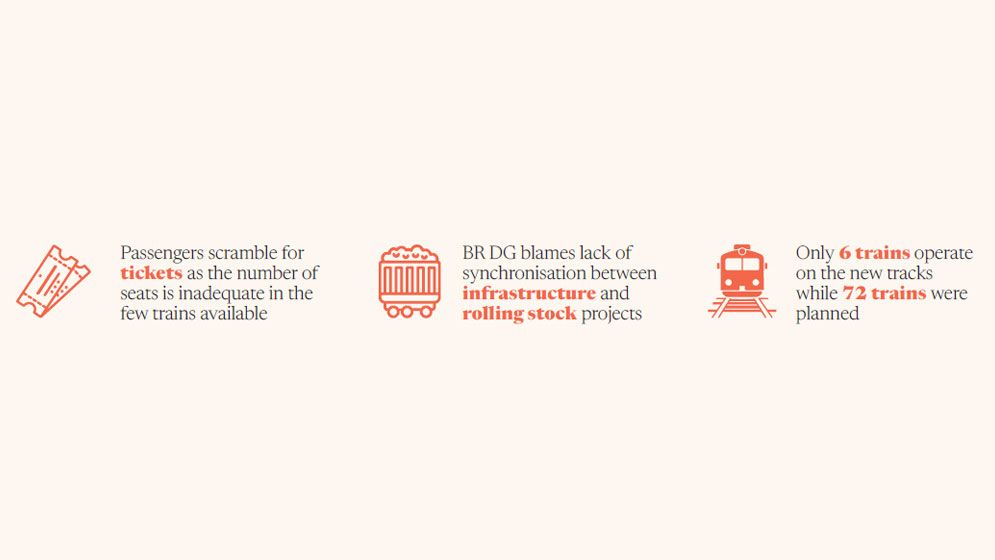
The Bangladesh Railway (BR) has failed to fully reap the benefits from around 340 kilometres of new tracks, set up with over Tk55,000 crore of public money with a dream of faster travel time for trains with larger passenger capacity and increased routes for Southwest-bound people.
In spite of huge demand for tickets from millions of people, the Dhaka-Jashore route via Padma Bridge, one of the major routes in the country, remains unutilised to a large extent, while Khulna-Mongla lines serve with one commuter train.
The BR officials said that the new tracks could not be used fully either for transporting goods or for passengers due to severe crises of locomotives and coaches as the Awami League government put emphasis only on expansion of the tracks and routes and plundering public money.
During the religious and other festivals like the two Eids, passengers struggle for tickets of the long route trains, but the railway data said that in the newly constructed 173 km rail line of the Dhaka-Bhanga-Jashore route, installed at a cost of Tk39,247 crore, now serves only seven intercity trains.
The trains on the route, which has reduced travel distance and time by more than half, are Jahanabad Express, Ruposhi Bangla, Sundarban, Benapole, Nakshikatha and Modhumoti Express and Benapole Express and a commuter train.
Speaking on condition of anonymity, a top official of the BR said, “The route has reduced distance from Dhaka to Khulna from 583 km to 209 km. But we could not introduce more trains on the route. Now only six trains operate in a day while it was planned to operate 72 trains on the route.”
He said, “From the Padma-Jashore project only 100 coaches were purchased but the coaches were not utilised on the route. They are mostly used in other routes.”
Under a project implemented between 2010 and 2025, the BR invested Tk4,225 crore for the construction of 63.821 km of new line with many components including eight station buildings and two foot bridges, but now it serves only one commuter train.
In the 101 km Dohazari-Cox’s Bazar route, which was constructed at Tk11,335 crore, only two intercity and two local trains operate there. Meanwhile, no train operates on the 26.35 km Ishwardi Rooppur route, which was constructed at a cost of Tk335.97 crore.
Talking to the Daily Sun on 15 May, BR Director General Afzal Hossain blamed non-synchronisation of the rolling stock projects, involving the design, procurement, manufacturing, testing and maintenance of railway vehicles, including locomotives, passenger coaches and freight wagons, with the projects for track expansion.
He said, “When the Padma Bridge-Jashore rail track project was taken, we should have taken other projects to purchase locomotives and coaches. We have taken a project and under the project, through which we are getting 200 broad gauge coaches from India at a cost of Tk1,205 crore. In June, we will receive the first consignment. Then we can arrange two trains for the Dhaka-Padma-Jashore route.”
Afzal also said, “We have a serious shortage of metre gauge locomotives and we have one project underway, and we are going to get 30 locomotives in the near future. We cannot solely blame the Bangladesh Railway authorities for the failure because there is an issue of project and fund approval.”
Replying to a question, he said, “We could operate 40 trains in the Dhaka-Jashore route via Padma Bridge, but we have a shortage of coaches. We imported 100 coaches from China for the route, but we have to use some coaches for the Panchagarh Express and other trains.”
He said, “The Ishwardi-Rooppur rail route was constructed to transport raw materials of the first nuclear power plant at Rooppur but somehow the process got delayed. We may arrange a passenger train for the route if we get locomotives and coaches. Besides, we have a plan to increase the number of trains on the Dhaka-Cox’s Bazar and Chattogram to Cox’s Bazar routes if we get locomotives and coaches.”
Former president of Bangladesh Institute of Planners Adil Mohammed Khan said that, “Passengers are suffering greatly for tickets but we cannot increase the number of trains despite having opportunities. We cannot increase rolling stocks. We have money for infrastructure. Don't we have money for rolling stocks? We had.”
He said a vested quarter might have hindered the proper development of the project and demanded a thorough investigation into the BR’s inefficiency.