





 For all latest news, follow the Daily Sun's Google News channel.


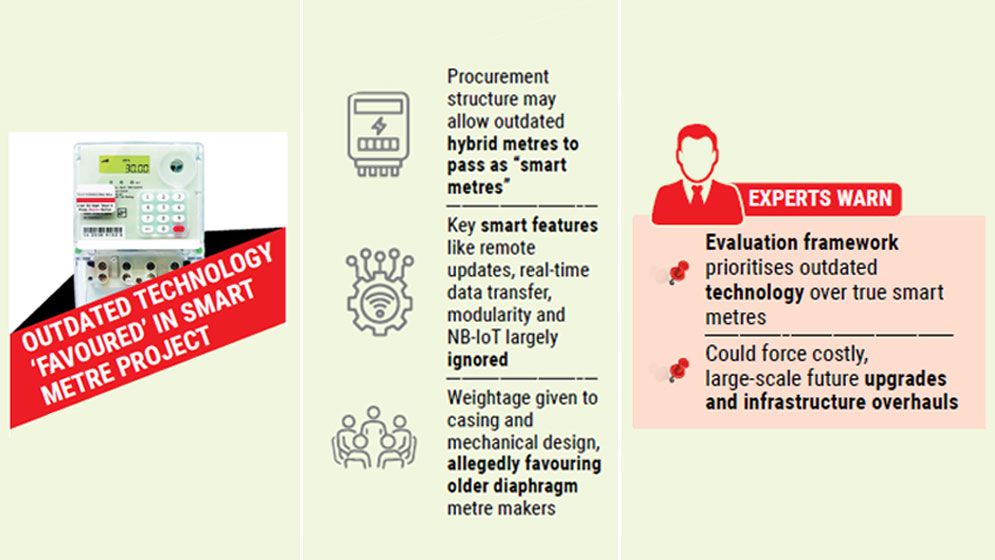
The Pashchimanchal Gas Company Limited (PGCL), the state-run supplier of natural gas in the country’s northwestern region, is facing allegations that its smart prepaid metre project may result in the procurement of outdated technology under the guise of modern “smart” systems.
According to tender documents and officials familiar with the process, PGCL on 9 March floated an open tender to supply and install 128,000 gas metres across four districts. While the tender specifies modern IoT-based smart metres – devices equipped with sensors, software and communication technology – the evaluation criteria have reportedly been structured in a way that allows older hybrid metres to score highest.
The project also aims to enable remote software updates, daily data transmission to central servers, real-time usage monitoring through mobile apps, digital payments, and future upgrades through modular components.
However, older hybrid metres – equipped with mechanical diaphragm measurement systems and mechanical indexes – still require manual reading of gas consumption. These systems are more prone to errors and manipulation.
Despite the emphasis on smart features in the tender description, critics point out that no explicit weight has been assigned to core IoT functionalities in the technical evaluation. Of the 55% allocated for technical performance, nearly 40% is reportedly tied to the material of the metre casing alone, with stainless steel receiving the highest marks. Another 15% is linked to the presence of a mechanical index—without which bidders risk scoring zero.
Meanwhile, features central to modern smart metres, such as remote updates, daily server communication, modularity, and low-power NB-IoT connectivity, have been largely overlooked.
As a result, stakeholders say the evaluation process disproportionately rewards external casing and legacy mechanical designs rather than advanced digital capabilities, potentially favouring manufacturers of older diaphragm metres. Some observers believe that a syndicate long associated with influencing smart metre tenders in the electricity sector may now be applying similar tactics in the gas sector.
The project is being implemented with financial support from the World Bank, following loan agreements signed with the World Bank and the Asian Development Bank (ADB) in November 2023.
Responding to the allegations, Engineer Debdip Barua, deputy director and project director of PGCL’s “Installation of Smart Prepaid Gas Metres, SCADA & GIS” project, said the tender was prepared in consultation with the World Bank’s technical team.
When asked why casing had been given such importance despite a three-year warranty and up to seven years of maintenance support specified in the tender, Debdip Barua said, “We prepared this tender notice in accordance with the guidelines from Petrobangla and our concerned ministry. Even the technical team of the World Bank is also aware of these specifications.”
He acknowledged that some bidders had raised concerns, adding, “We are aware that some bidders are confused about certain points in this tender notice. We will clarify all their queries within a few days.”
Public dissatisfaction with prepaid gas metres is already evident, with complaints over service charges, token-related complications and operational inconveniences.
Sources at Titas Gas Transmission and Distribution PLC say that 25%-30% of prepaid metres remain unused in warehouses due to communication problems.
Prof Dr BM Mainul Hossain, director at the Institute of Information Technology at Dhaka University, questioned the emphasis on metre casing in a project described as “smart.”
“It is not clear why PGCL gave so much weightage to metre casing,” he said. “If they really want to install smart gas metres, they should emphasise communication systems, digital display, universal network compatibility and interoperability features.”
He also stressed the need to improve customer support. “They should focus on better customer service and an effective grievance redress mechanism, as many subscribers may face difficulties using and maintaining smart metres.”
Bangladesh’s experience with prepaid metres has been mixed. Since 2011, Titas Gas has installed around 420,000 conventional prepaid metres with JICA funding, many of which have drawn customer complaints.
A much larger smart metre rollout is planned for Titas service areas starting in the second half of 2026. Backed by the World Bank and ADB, the project will cover Dhaka North and South, Narayanganj and Gazipur, installing around 1.6 million metres.
Analysts warn that if PGCL proceeds with its current evaluation approach, similar issues could spill over into the Titas project.