



 For all latest news, follow the Daily Sun's Google News channel.


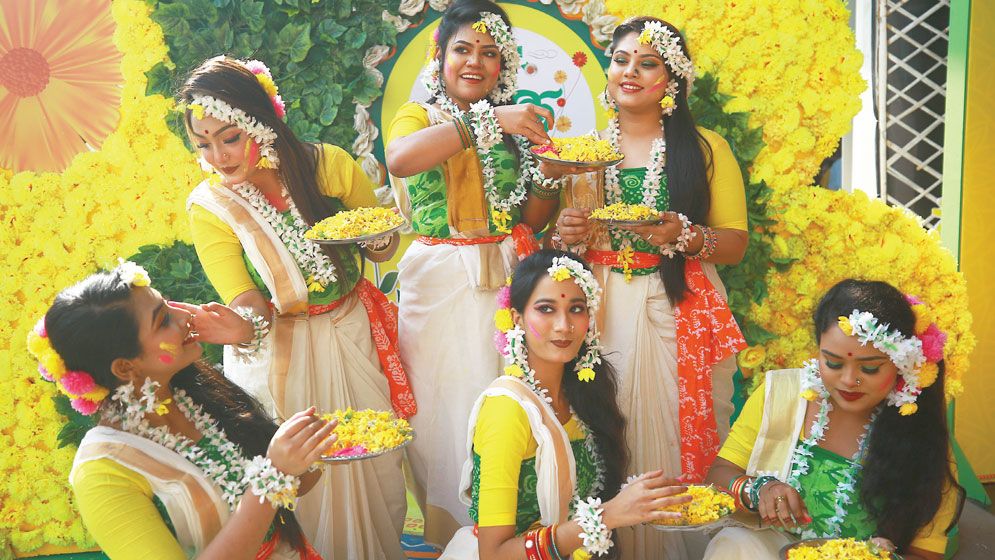
To celebrate the beginning of the Bangla month of Falgun, a group of classical dancers perform on the premises of the Liberation War Museum in Agargaon, Dhaka, on Saturday. Jatiya Basanta Utsab Udjapon Parishad (National Spring Festival Celebration Council) organises the event. -DAILY SUN PHOTO
The arrival of spring on Pahela Falgun, coinciding with World Valentine’s Day, has brought not only colour and celebration but also a subtle message of renewal and rebuilding in post-election Bangladesh, as people across the country welcomed the king of seasons with hope in their hearts.
The fiery red of shimul and palash, the sweet fragrance of mango buds, and the familiar call of the cuckoo have heralded the end of winter. With nature shedding its dryness, both the landscape and human emotions appear refreshed.
This year, however, spring has arrived in a markedly different political and social reality, giving its symbolism a depth beyond mere festivity.
Spring traditionally signifies love and rebirth, and this dual celebration has amplified that meaning.
Young people, dressed in yellow and vibrant attire, filled campuses, parks and public spaces, celebrating love while unconsciously embracing a wider longing for warmth, connection and continuity after a long period of uncertainty.
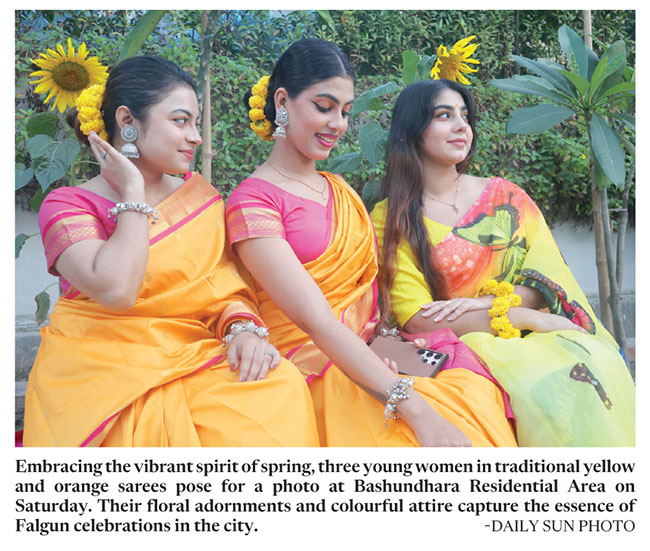
At Dhaka University, the spirit of Falgun was visible in the bright sarees, floral adornments, and lively gatherings around the Faculty of Fine Arts, TSC, Suhrawardy Udyan and surrounding areas.
Similar scenes unfolded at Ramna Park, Hatirjheel and Rabindra Sarobar, while towns and campuses outside the capital also saw crowds immersed in spring colours.
Yet this year’s Basanta Utsav carried a quieter undertone. In the aftermath of the 13th National Parliament election, the absence of the traditional Ekushey Book Fair meant city dwellers missed the familiar blend of spring air and the scent of new books. Still, spring refused to be silenced.
The Jatiya Basanta Utsav Uthjapan Parishad organised Basanta Utsav 1432 as usual, though the venue shifted from Bakultala at the Faculty of Fine Arts to the open courtyard of the Liberation War Museum.
The day-long programme began with instrumental and vocal performances by students of Bengal Parampara Sangitalay, featuring music, dance, recitations, and performances by children, teenagers, and artists from small ethnic communities.
Presiding over the spring discussion, council president Architect Safiuddin Ahmed said the essence of spring lies in renewal. Vice-president Kajal Debnath and general secretary Manjar Chowdhury Sweet echoed the sentiment, highlighting spring as a reminder of cultural continuity amid changing realities.
Poets and artists have long captured this spirit. Rabindranath Tagore wrote of spring standing at the awakened door, while Subhash Mukherjee famously declared that spring exists even if flowers do not bloom. Their words resonated strongly this year, when celebration coexisted with reflection.
In the city, spring often remains confined to festivals and symbols. In villages, however, its royal presence is unmistakable – wildflowers by the roadside, shimul trees in full bloom, and gentle breezes across ponds.
That contrast itself seemed to underline the unspoken message of this season: renewal must be lived, not merely observed.
A couple celebrating at Dhaka University told Daily Sun that after the “festival of voting” earlier in the week, the arrival of spring and Valentine’s Day together felt like a promise of a fresh beginning. To them, spring appeared to be urging Bangladesh to rebuild, to become as vibrant as Falgun and as humane as love itself.
Beyond flowers and festivities, this spring seems to whisper a deeper call. It urges society to move past stagnation, to replace cold divisions with warmth, and to allow new hope to take root.
As the red glow of shimul and palash merges with human affection, the message becomes clear: spring has arrived not only in nature, but in the collective conscience as well.