



 For all latest news, follow the Daily Sun's Google News channel.


Bangladesh, Japan sign historic economic deal
Daily Sun Report, Dhaka
Published: 07 Feb 2026, 12:00 AM
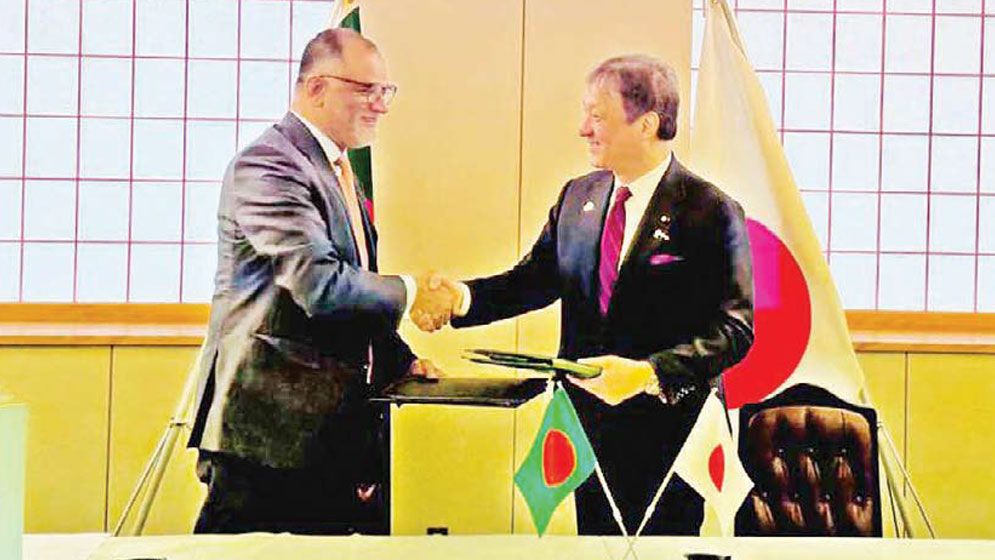
Bangladesh and Japan on Friday signed an Economic Partnership Agreement (EPA), marking the country’s first such comprehensive bilateral trade pact with a foreign state.
The agreement will allow 7,379 Bangladeshi products including ready-made garments to enter the Japanese market with full duty-free access, significantly expanding Bangladesh’s export opportunities.
In return, Bangladesh has agreed to gradually extend duty-free or preferential market access to 1,039 Japanese products.
The agreement was signed at the Japanese Ministry of Foreign Affairs in Tokyo by Bangladesh’s Commerce Adviser Sheikh Bashir Uddin and Japan’s State Minister for Foreign Affairs Iwao Horii on behalf of their respective governments.
Senior officials from both sides attended the signing ceremony, including Bangladesh’s Commerce Secretary Mahbubur Rahman, Bangladesh Ambassador to Japan Md Daud Ali, and Japan’s Ambassador to Bangladesh Saida Shinichi.
The EPA is the outcome of seven rounds of negotiations held in Dhaka and Tokyo, covering trade in goods and services, investment, and wider economic cooperation. Officials described the agreement as a significant milestone in strengthening the long-standing bilateral relationship between the two countries.
Speaking at the ceremony, Sheikh Bashir Uddin said the agreement reflected the deep friendship and mutual trust between Bangladesh and Japan.
“This agreement is not merely a trade document; it represents Bangladesh’s economic potential and our shared confidence in a prosperous future,” he said, expressing optimism that its effective implementation would usher in a new phase of mutual growth.
A key provision of the EPA is the inclusion of “single-stage transformation” rules for the garment sector, allowing Bangladeshi apparel exporters to ship products to Japan without complex origin requirements related to raw materials. Officials say this will enhance the competitiveness of Bangladesh’s garment exports in the Japanese market.
The agreement also opens new avenues for Bangladeshi professionals in Japan. Under the services component, skilled workers from Bangladesh will be able to work in around 120 service sub-sectors across 16 broad categories, including information technology, engineering, education, caregiving and nursing, creating new employment opportunities.
Bangladesh has also agreed to open 98 service sub-sectors under 12 categories to Japanese participation, further deepening bilateral economic integration.
Beyond trade, the EPA is expected to boost Japanese foreign direct investment (FDI) in Bangladesh, particularly in manufacturing, infrastructure, energy and logistics. Analysts believe increased Japanese investment, combined with advanced technology transfer, could improve productivity, product quality and overall competitiveness across Bangladesh’s industrial sectors.
Officials highlighted the agreement’s potential to support small and medium-sized enterprises (SMEs), enhance workforce skills and promote inclusive economic growth.
The government expects the EPA to play a key role in Bangladesh’s socio-economic development by supporting sustainable industrialisation and deeper integration into global value chains.
The signing comes as Bangladesh seeks to diversify its export markets and strengthen strategic economic partnerships amid shifting global trade dynamics.