


 For all latest news, follow the Daily Sun's Google News channel.


Baishakhi adda at Kaler Kantho
Firm resolve to resist evil forces threatening free culture and thought
Daily Sun Report, Dhaka
Published: 16 Apr 2026, 10:45 AM
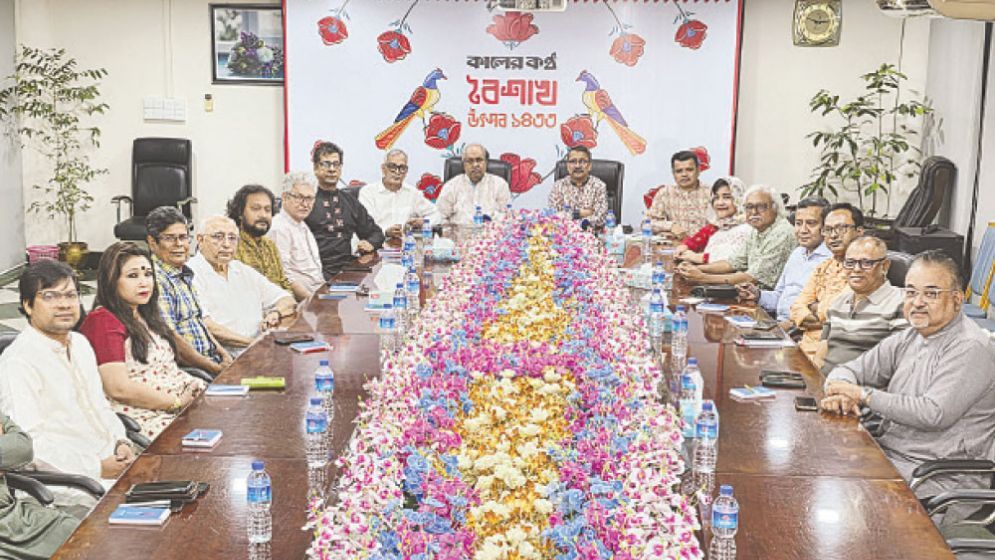
Distinguished guests engage in a lively Baishakhi adda organised by Kaler Kantho at its head office in Bashundhara Residential Area on 15 April 2026. Photo: Collected
Baishakh represents a collective expression of free culture and democratic thought, transcending all religions, castes, and classes. Repeated attempts have been made to suppress its practice and expression. Through the narrow lens of communalism, and under the guise of distorted culture and religious extremism, efforts have consistently sought to hold it hostage and push society backwards. However, shedding all stagnation, this year’s Baishakh has reawakened the Bengali spirit in its true form, marked by the exuberance of a free and unrestrained soul.
Reflecting on how this year’s Baishakh was celebrated after emerging from a suffocating environment, a Baishakhi adda (informal gathering) was organised by Kaler Kantho yesterday. Held at the newspaper’s office, the event was attended by distinguished journalists, columnists, politicians, intellectuals, academics, lawyers, and professionals from various fields. They spoke candidly about the joy of celebrating Baishakh freely, like liberated birds. At one stage, the lively discussion evolved into an informal national dialogue.
The programme was inaugurated with opening remarks by Kaler Kantho Editor and poet Hasan Hafiz, followed by a welcome address from Executive Editor Haider Ali, and was moderated by Head of News Faruk Mehedy. The discussion went beyond reminiscing about the festival, encompassing the current political reality, cultural crisis, the spirit of the Liberation War, freedom of expression, mob violence, extremism, press freedom, and democratic values.
At the outset, speakers emphasised that Pahela Baishakh is not merely a festival; it is a symbol of Bengali secularism, a meeting ground for people of all faiths and backgrounds, and a cultural bridge.
Recalling Baishakh celebrations, former Member of Parliament Syeda Asifa Ashrafi Papia said, “Whether it is the Benazir issue or the President’s interview, Kaler Kantho has repeatedly brought forward bold and important matters. It has published fact-based reports even against those in power.”
Journalist and columnist Mahbub Kamal stated, “The period under Dr Mohammad Yunus’s leadership was a calculated assault on Bangladesh’s cultural identity.” He alleged that there had been attempts to “reset” the Liberation War and cultural heritage. “Mob culture, vandalism, extremism—everything was part of a strategy to weaken a nation,” he said, adding that while religion is a matter of personal belief, culture defines a nation’s identity. He further claimed that attempts were made to alter this culture in the name of Islamisation.
Journalist M A Aziz noted that while Baishakh in rural Bengal once meant fairs, folk theatre, ballads, and games, such traditions have declined, though the festival has re-emerged in new forms in urban life. He said, “Kaler Kantho is now far more discussed and influential, having earned readers’ trust through bold investigative reporting.” However, he also expressed concern over press freedom, saying, “Journalists do not enjoy the same level of independence as before. An environment free from political and corporate influence is necessary.”
Senior journalist Mostafa Firoz remarked, “I have never seen a ruler as untrustworthy as Yunus. He destroyed the potential of a new political force.”
Political analyst Golam Maula Rony said, “During Dr Yunus’s time, the joy of Baishakh was accompanied by mob justice, communalism, and a culture of fear.”
Journalist Manjurul Alam Panna described the 18-month period under Dr Yunus as “suffocating,” adding that he and his family personally lived under fear and pressure.
Eminent media personality Abdun Noor Tushar, in sharp criticism, said, “Dr Yunus has proven that even an uncivilised person can receive the Nobel Peace Prize.” He alleged that the chief instigator of mob justice was the Chief Adviser himself, under whose patronage violence occurred.
Professor Dr Rezwana Karim Snigdha of Jahangirnagar University observed that a toxic competition to gain importance through abusive language is emerging, pushing the younger generation towards a dangerous future. She also warned that the “balancing politics” surrounding the Mongol Shobhajatra is troubling.
Former secretary Abu Alam Md Shahid Khan said, “Bangladesh’s greatest problem is not overt politics, but covert politics.” He referred to Dr Yunus as a “half Nobel laureate” and claimed that the past 18 months had been governed by disguised forces.
Senior lawyer Mohsin Rashid said, “I have called Dr Yunus a fraud from the very beginning. His government was one of hooligans.” Regarding the current administration, he added, “Its vision is still unclear.”
Journalist Mahbub Aziz said, “People of all views, paths, and religions must stand together, as they do in the Baishakhi procession.”
Senior journalist Masud Kamal remarked, “If the current government continues the mistakes of the previous one, how can this period be called better? In many ways, the present system still appears to be an extension of Yunus’s tenure.”
Journalist Anis Alamgir said, “The greatest irony is being labelled differently at different times. Some call me a journalist of the Awami League, others of the opposite camp. Yet I simply speak the truth.” He added that in many respects, the current government still seems like a continuation of Yunus’s rule.
Political analyst Advocate Abu Hena Razzaki said, “Baishakh is not just a festival; it is a platform for national unity, where people of all religions and backgrounds come together under one roof.”
Throughout the discussion, speakers highly praised Kaler Kantho for its bold journalism, pro-Liberation War stance, and support for freedom of expression. They said the newspaper’s role in defying intimidation from those in power sets a unique example in Bangladesh’s media landscape.
In his closing remarks, Editor Hasan Hafiz said, “More difficult times may lie ahead. We have remained steadfast in our professionalism. The historical significance of 17 April and 7 March cannot be denied; history cannot be altered. Kaler Kantho will never compromise on the Liberation War. Together, we will continue to resist religious extremism and communalism.”
Executive Editor Haider Ali thanked the guests for participating, saying, “You have freed society from a suffocating situation through the courage of your pen and voice. To me, each of you is a freedom fighter. Your enlightened presence inspires our future. Kaler Kantho has always stood for democratic values, and our journey towards building a secular Bangladesh will continue.”
Concluding the event, moderator and Head of News Faruk Mehedy said, “This Baishakhi adda is not merely the end of a celebration, but the beginning of a new struggle. Every word you have shared guides our professional path. Neither fear nor pressure from those in power should deter us from speaking the truth. Our multimedia and print platforms will continue to work towards that goal. Shedding all stagnation, we aim to build a progressive future.”