


 For all latest news, follow the Daily Sun's Google News channel.


Mideast turmoil prompts Dhakato rethink domestic coal
Govt weighs open-pit mining and profit-sharing in coal shift
Daily Sun Report, Dhaka
Published: 13 Oct 2026, 12:00 AM
Amid compounding global energy uncertainty driven by the Middle East conflict, Bangladesh is reassessing its unexploited domestic coal reserves to safeguard national energy security and curb soaring import bills.
Faced with expensive Liquefied Natural Gas (LNG) imports and dwindling domestic gas reserves, the government is examining the feasibility of extracting coal from several northern deposits.
Phulbari has emerged as the primary focus, with both open-pit and underground mining methods under review, according to official sources.
To overcome long-standing local resistance and environmental opposition, policymakers are considering a novel profit-sharing framework for landowners.
Under the proposed model, affected families would receive direct lease payments and a percentage of mining profits, alongside structured provisions for resettlement, employment, housing, and infrastructure. However, land acquisition, community displacement, groundwater depletion, and agricultural damage remain formidable hurdles.
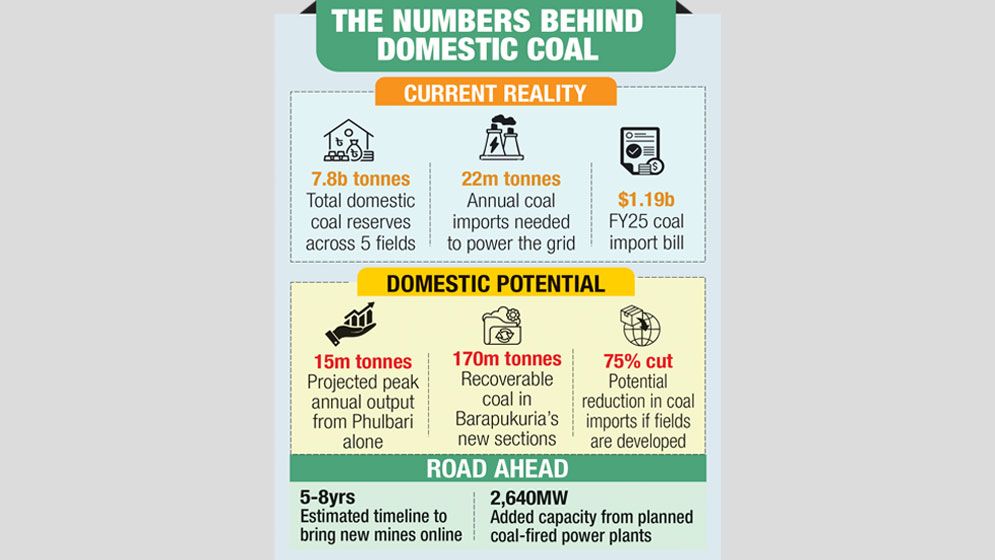
Bangladesh currently relies on imports for nearly 95% of its coal requirements, consuming roughly 22 million tonnes annually to fuel its power stations.
In the 2024-25 fiscal year, coal imports cost an estimated $1.19 billion.
Although the country possesses five identified coalfields containing an estimated 7.8 billion tonnes, commercial extraction remains restricted to a single underground operation at Barapukuria in Dinajpur.
On 4 October, officials briefed the Prime Minister’s Office on the operational status and prospects of the Barapukuria, Phulbari, and Dighipara deposits, and were directed to evaluate the Jamalganj field.
Speaking to Daily Sun, a senior official from the Energy and Mineral Resources Division confirmed that multi-stakeholder consultations regarding Phulbari were under way.
"A plan is being considered to share profits with the owners of land leased for the mine," the official said, adding that a final framework would follow further talks.
Petrobangla Director (Operations and Mines) Engr Md Shoyeb noted that the government is aiming to scale up domestic gas production concurrently with coal extraction. "The Phulbari coalfield in Dinajpur has been given special importance, whilst all aspects of extraction feasibility are being systematically evaluated," he stated.
Phulbari’s untapped potential
Phulbari holds an estimated 572 million tonnes of high-quality bituminous coal, of which approximately 475 million tonnes are recoverable. At peak output, the field could yield 15 million tonnes annually.
However, the human cost is substantial. Petrobangla estimates that roughly 40,000 residents inhabit nearly 10,000 acres across the proposed 48-square-kilometre site. The proposed profit-sharing arrangement – covering Phulbari, Parbatipur, Birampur, and Nawabganj – aims to offer long-term financial stakes and eventual land restoration upon lease expiry to secure public consent.
UK-based GCM Resources Plc, operating through its subsidiary Asia Energy Corporation (Bangladesh) Pvt Ltd, previously conducted feasibility studies and proposed a mine-mouth 1,000MW power plant.
The project stalled following fierce local protests over displacement, environmental degradation, and inadequate compensation. Officials hope the new profit-sharing model will offer a more acceptable path forward.
If Phulbari delivers its projected 15 million tonnes annually, combined with six million tonnes from northern Barapukuria and three million tonnes from Dighipara, domestic production could reach 24 million tonnes a year – potentially replacing up to 75% of current coal imports. Nonetheless, officials concede that developing new mines will take five to eight years, offering no immediate respite from the immediate energy crunch.
Open-pit proposal for Barapukuria
In tandem with Phulbari, the government is assessing open-pit extraction for the northern and southern extensions of Barapukuria.
According to the Barapukuria Coal Mining Company Limited (BCMCL), these two sections hold around 170 million tonnes of recoverable coal, capable of sustaining an annual production of six million tonnes for up to 30 years. Underground operations at Barapukuria have yielded only 15 million tonnes since 2005.
Following a meeting chaired by the prime minister on 13 August, Power, Energy and Mineral Resources Minister Iqbal Hasan Mahmud reviewed a progress presentation on 23 September. Petrobangla has since formally requested policy approval from the ministry.
Previous environmental assessments, including a 2014 study by the Institute of Water Modelling and subsequent reviews in 2018 and 2019, indicated that water pumping and barrier systems could mitigate hydrogeological risks, but urged comprehensive impact studies. Displacement remains a critical issue, with open-pit operations expected to require the relocation of 18,000 to 20,000 people.
Calls for independent scrutiny
Energy experts urge caution, advocating an impartial review before committing to large-scale extraction.
Professor M Tamim, noted energy experts and vice-chancellor of Independent University, Bangladesh, stressed that an independent third party must objectively evaluate technical and environmental risks.
"If the risks are manageable, we can move forward. If they are prohibitive, the project should be abandoned," he remarked, emphasizing that safety must override commercial interest regardless of the developer.
Geologist Professor Badrul Imam favoured underground mining over open-cast methods to safeguard agricultural land and regional aquifers.
Both experts called for transparent compensation, structured resettlement, and a multi-stakeholder oversight committee including local community representatives.
Expanding coal-fired generation
Despite global decarbonisation pressures, Bangladesh has granted policy approval for two new coal-fired power plants totaling 2,640MW at Matarbari in Cox’s Bazar and Payra in Patuakhali, with an estimated investment exceeding $3 billion.
Bangladesh Power Development Board Chairman Engineer Md Rezaul Karim defended the move, describing coal power as a reliable baseload option amidst volatile global fuel markets. Existing coal plants account for over 7,000MW of grid capacity, largely dependent on Indonesian imports.
With Middle Eastern geopolitical tensions threatening maritime supply routes, several Asian nations, including India, Japan, South Korea, Thailand, and the Philippines, have similarly expanded or restored coal-fired output.
For Bangladesh, balancing energy security against long-term environmental and social impacts remains a delicate, high-stakes equilibrium.
Read More