


 For all latest news, follow the Daily Sun's Google News channel.


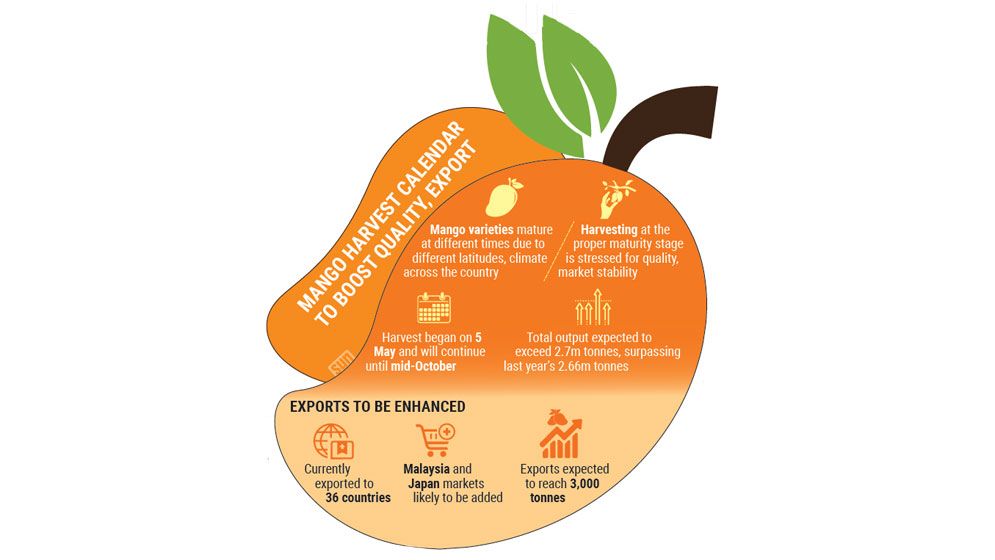
With expectations of a bumper mango harvest this season, the Department of Agricultural Extension (DAE) has finalised and started implementing a harvesting calendar across the country to ensure quality production and boost exports.
Mohammad Arifur Rahman, director of the DAE’s exportable mango production project, told the Daily Sun that if seasonal storms do not cause significant damage, the country could see both a record harvest and a new high in mango exports this year.
Total output is expected to exceed 2.7 million tonnes, surpassing last year’s target of 2.66 million tonnes, if conditions remain supportive, he said.
Mango, one of Bangladesh’s key commercial fruits, is now cultivated in 23 districts, with exports steadily increasing since 2015. So far, Bangladeshi mangoes have been exported to 36 countries, reflecting growing international demand.
“This year, new markets including Malaysia and Japan are likely to be added, with exports expected to reach 3,000 tonnes,” said Arifur Rahman.
Different harvest times to ensure quality
Arifur Rahman said mango harvesting has already begun on 5 May and will continue until mid-October in major producing districts, including Chapainawabganj, Rajshahi, Satkhira and Dinajpur.
To sustain export quality and market stability, the importance of harvesting mangoes at the proper stage of maturity is stressed, he added.
Due to differences in latitude and climate, the same mango variety matures at different times across districts. In Bangladesh, mangoes in southern districts like Satkhira and in hilly regions tend to ripen earlier because of their lower latitude.
The harvest calendar was finalised by reviewing and updating the data on exportable mango collection timelines. The initiative, jointly launched by the district administration and DAE, aims to ensure timely harvesting and proper market management.
In Satkhira, harvesting of mango varieties such as Gopalbhog, Gobindobhog, Baishakhi, and other local types began on 5 May, while the late variety Gourmati will start being harvested from 14 August.
In Khagrachhari, harvesting of Amrapali will start on 18 June, Bari-4 on 20 June, and Banana mango on 8 June.
In Chuadanga, harvesting of Gopalbhog and Gobindobhog will start on 15 May, Himsagar and Khirsapat on 27 May, Langra on 10 June, Amrapali on 20 June and Bari-4 on 22 June.
In Jashore, harvesting of Gopalbhog and Gobindobhog will start on 15 May, Himsagar and Khirsapat on 28 May, Langra on 10 June, Amrapali on 21 June and Bari-4 on 23 June.
In Meherpur, harvesting of Gopalbhog and Gobindobhog will start on 16 May, Himsagar and Khirsapat on 28 May, Langra on 11 June, Amrapali on 22 June, Fazli on 23 June and Bari-4 on 24 June.
In Kushtia, harvesting of Gopalbhog and Gobindobhog will start on 20 May, Himsagar and Khirsapat on 29 May, Langra on 11 June, Amrapali on 22 June, Fazli on 24 June and Bari-4 on 26 June.
In Natore, harvesting of Gopalbhog and Gobindobhog will start on 25 May, Himsagar and Khirsapat on 30 May, Langra on 12 June, Lakhanvog on 16 June, Amrapali on 25 June, Fazli on 26 June, Bari-4 on 5 July and Banana mango on 16 June.
In Rajshahi, harvesting of Gopalbhog and Gobindobhog will start on 25 May, Himsagar and Khirsapat on 30 May, Langra on 12 June, Lakhanvog on 16 June, Amrapali on 25 June, Fazli on 26 June, Bari-4 on 5 July, Banana mango on 18 June and Gourmati on 31 July.
In Chapainawabganj, harvesting of Gopalbhog and Gobindobhog will start on 26 May, Himsagar and Khirsapat on 4 June, Langra on 14 June, Lakhanvog on 18 June, Amrapali on 27 June, Fazli on 30 June, Bari-4 on 6 July, Harivanga on 20 June, Banana mango on 22 June and Gourmati on 4 August.
In Naogaon, harvesting of Gopalbhog and Gobindobhog will start on 1 June, Himsagar and Khirsapat on 8 June, Langra on 17 June, Amrapali on 28 June, Fazli on 30 June, Bari-4 on 8 July, Harivanga on 22 June, Banana mango on 23 June and Gourmati on 8 August.
In Rangpur, harvesting of Gopalbhog and Gobindobhog will start on 30 May, Langra on 18 June, Amrapali on 30 June, Bari-4 on 15 July, Harivanga on 23 June, Banana mango on 24 June and Gourmati on 11 August.
In Dinajpur, harvesting of Gopalbhog and Gobindobhog will start on 2 June, Himsagar and Khirsapat on 18 June, Langra on 20 June, Amrapali on 1 July, Bari-4 on 20 July, Harivanga on 24 June, Banana mango on 28 June and Gourmati on 12 August.
In Thakurgaon, harvesting of Gopalbhog and Gobindobhog will start on 2 June, Amrapali on 4 July, Bari-4 on 20 July, Harivanga on 26 June, Banana mango on 30 June and Gourmati on 14 August.
DAE data shows that Bangladesh exported a record 2,194 tonnes of mangoes to 29 countries last year. This season, exporters are aiming higher, with projections of at least 3,000 tonnes. There is also emerging potential to expand into new markets such as Malaysia and Japan.
According to DAE guidelines, mangoes should only be picked when fully matured, as immature fruits fail to ripen properly and lack sweetness. Naturally matured mangoes show slight yellowing near the stem and have a specific gravity of 1.01-1.02, meaning they sink in water – an indicator used to assess readiness.
For export purposes, however, mangoes are harvested earlier at around 80-85% maturity to maintain quality during transportation and storage.
Agro-economist Dr Jahangir Alam told the Daily Sun that when immature mangoes are picked, their nutritional value is not fully developed and they often taste bland.
Some dishonest traders harvest mangoes prematurely and sell them in the market as ripe fruit to gain extra profit, which leads to consumer deception, he added.
Bumper harvest expected
Md Rafiqul Islam, a mango farmer from Nachole in Rajshahi, said that mango production may exceed the previous year’s production.
“I have a 400-bigha orchard of mangoes in the area, and I am expecting a good production amid following good agricultural practices,” he said.
Under the DAE’s “Exportable Mango Production Project,” mango cultivation has expanded to 204,000 hectares this year. Officials report no major disruptions to production so far.