


 For all latest news, follow the Daily Sun's Google News channel.


The making of Osman Hadi’s mass popularity
Daily Sun Report, Dhaka
Published: 20 Dec 2025, 12:00 AM
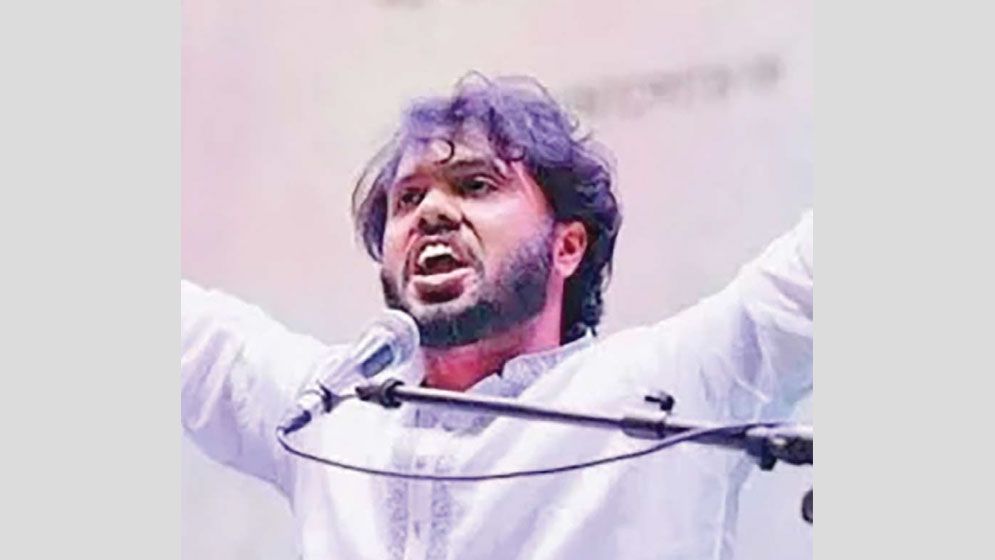
Sharif Osman Bin Hadi
Since Sharif Osman Bin Hadi, spokesperson of the Inqilab Moncho, was shot on 12 December in the capital’s Purana Paltan area by whom police suspect to be former leader of the banned Chhatra League, he has become a household name across the country. In death, he has become immortal.
Undoubtedly, he was an icon of last year’s July uprising, thanks to his passionate opposition to the ousted autocrat Sheikh Hasina.
Riding on this momentum, he continued speaking out against fascism, sharing his vision of building a just Bangladesh for all citizens through political programmes, television talk shows, and social media appearances.
Yet the question remains: how did this 32-year-old secure a place in people’s hearts? What made him stand out amid millions of protesters?
Hailing from Nalchity in Jhalakathi, Hadi came from a lower-middle-class family. After enrolling in Dhaka University’s Political Science Department, he earned a living through tuition and by teaching at the English coaching centre Saifur’s, just to survive in the megacity. After completing his education, he went on to teach at a private university.
It would have been natural for him to focus solely on securing his own future and supporting his family, rather than becoming entangled in turbulent political developments. But he chose a different path. He wrote poetry and published books, before coming to the conclusion that only politics could take him closer to his larger goal.
He was exceptional in his approach to politics as well.
Despite knowing that joining a popular political party could increase his chances of winning votes, he remained independent. He chose to contest a constituency where influential and seasoned politicians were already in the fray.
Hadi lacked the financial resources to fund election campaigns with large, colourful posters, banners, and placards. On the day he was attacked, he posted on social media that he felt no pressure to remove publicity materials. Nor had he had thousands of activists who demonstrated his strength by organising long motorcycle processions, with hundreds of bikers chanting slogans in his name.
Instead of wealth, he relied on innovative ideas and an unwavering self-belief that he could persuade voters to trust him.
For example, Hadi set up whiteboards across his constituency so that ordinary people could share their expectations directly with him.
He also made the effort to go door to door, speaking with voters individually.
Without fixating on outcomes, he trusted that people would eventually choose new politics, leaving behind old stereotypes.
In appearance, dress, mannerisms, and speech, Hadi was like any other young Bangladeshi man.
But his courage, firmness, and uncompromising attitude, combined with his clarity and ability to understand people’s minds and articulate that understanding, made citizens feel that he was one of them.
This is what made him an icon to many – and a target for his opponents, desperate to reject the emergence of new politics.
Bangladesh has embraced an uprising at the cost of blood, yet the interim government it chose to run the country and support young politicians like Hadi has become a byword for confusion. Having received at least 30 threats to his life via social media and phone calls, Osman Hadi filed a general diary with the Shahbagh police station.
How it was investigated, or what measures the government took to protect the leaders of the uprising, remains a mystery to the public – escalating frustrations and pushing the country into a state of deep uncertainty.