


 For all latest news, follow the Daily Sun's Google News channel.


Nabanna: A Festival of Bengal’s Soul
Dr M Abdul Momin
Published: 25 Nov 2025, 12:00 AM

Nabanna festival holds a special place among many customs of Bengali rural households. The word Nabanna means “new rice”. . It is a season-based festival. It is observed in late autumn, during the harvest of new Aman paddy. The festival is traditionally celebrated on the first day of the Bengali month of Agrahayan. The word “Agrahayan” means “first”, and “hayan” means “month”. From this, it is assumed that once upon a time, Agrahayan used to be considered the first month of the Bengali calendar year. This thousand-year-old festival remains one of the most non-communal, deeply traditional, and ancient celebrations bound to Bengal. The first day of Agrahayan once meant a wave of festivity in every rural household.
Families of farmers across the country have still continued to observe Nabanna in some way or other. In the Chittagong hill regions, the spirit of Nabanna comes alive with the harvest of new jhum crops. The indigenous communities celebrate Nabanna to mark the gathering of their principal harvests. The Santals celebrate the Sohrai festival during the winter months of Poush and Magh after bringing home their main crops. The Mro jhum cultivators celebrate Chamoainat, where they sacrifice chickens and organise a communal feast with rice from the new harvest. After collecting their crops, the Garo community observes Wangala, a festival filled with feasting, song, and dance to express gratitude for the abundance of fruits and crops. Among Muslim farmers, the Nabanna celebration begins on the first Friday of Agrahayan, while Hindu farmers observe it from the first day of Agrahayan according to their traditional calendar. Thus, people continue to celebrate their age-old festival of new crops in their own ways.
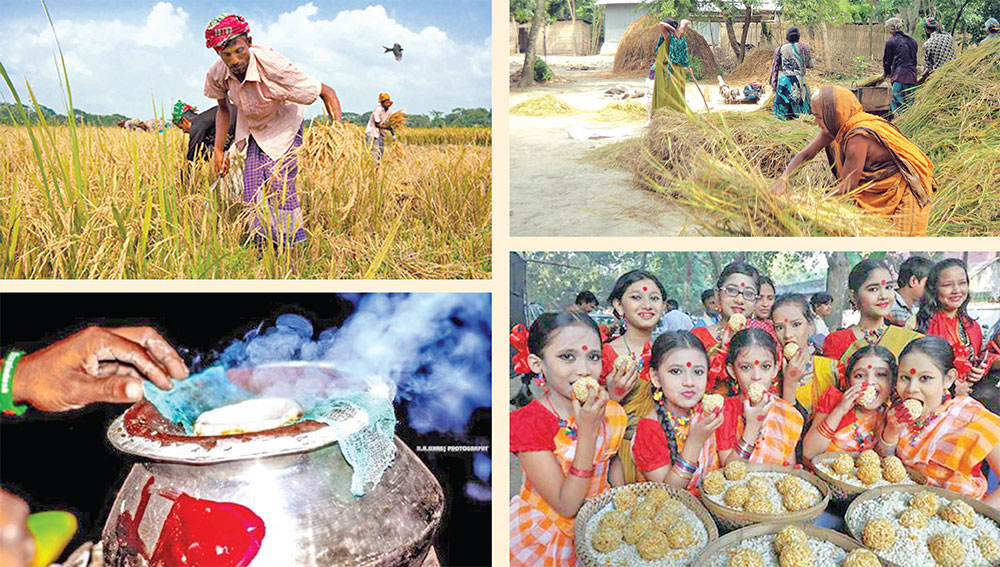
Bengali farmers and their families share the joy of Nabanna together. In some regions, daughters are invited to their parents’ homes during Nabanna, a custom known as naiyor. Sons-in-law and their families are also warmly invited. The entire household becomes festive with the celebration of Nabanna and the making of traditional cakes (pitha-puli). As Agrahayan arrives, the familiar refrain echoes across the countryside.
The landscape is shrouded in mist while farmers’ granaries fill with golden paddy, the timeless image of rural Bengal. The fields gleam with ripened crops; songs of husking rice float through the air; the rhythmic sound of the Dheki (traditional wooden rice pounder) enlivens courtyards. The atmosphere overflows with joy as families cook rice from the new harvest and prepare delicacies like pitha, kheer, and payesh. In Muslim communities, it is customary to offer shinni (a sweet offering) at mosques, while in Hindu households, various rituals and festive preparations take place. The most captivating feature of Nabanna is the heart of the celebration, the vibrant rural fair (grameen mela). These fairs host countless stalls offering an array of items: traditional sweets, pitha, sandesh, monda-mithai, clay utensils, toys, and dolls. Adding to the joy are Baul music performances, filling the fairgrounds with songs, dances, and the spirit of festivity surrounding Nabanna.
The Nabanna festival awakens a sense of unity among Bengalis. Agricultural fairs are organised at district and upazila levels, where outstanding farmers are recognised and awarded by local agricultural departments to encourage greater participation in farming. Various agricultural universities and institutions also observe Nabanna with colourful rallies, discussion sessions, and cultural programmes to remember this tradition. In recent years, urban areas too have embraced the Nabanna celebration. Under the slogan “Esho mili sobei Nabanner utsabe” (Let us all join the Nabanna festival), the event is celebrated annually in cities. At the Faculty of Fine Arts of Dhaka University in Shahbagh, the festival features vibrant processions, music, dance, recitation, Baul performances, indigenous cultural presentations, and exhibitions of traditional pitha (rice cakes). On the morning of the first day of Agrahayan, the capital awakens in a festive spirit as artists fill places like Ramna Batamul and Charukala premises with songs and joy.
In conclusion, it may be relevant to say that farmers’ new crop is not only a source of joy for their own families but also a blessing for the whole nation. Their yields of hard work contribute to the country’s food security. But farmers are often deprived of a fair price of their crops. Our National Poet Kazi Nazrul Islam spoke for protecting farmers’ rights. He demanded that farmers receive fair prices for their produce. May Nabanna bring pure joy, happiness, and prosperity to Bengali life. At the same time, may the dignity and rights of our hard-working farmers be safeguarded.
______________________________________
The writer is Senior Communication Officer, Bangladesh Rice Research Institute (BRRI), Gazipur. He can be reached at [email protected]