


 For all latest news, follow the Daily Sun's Google News channel.


New corridor to boost Bangladesh-Bhutan economic ties
Bhutanese PM stresses enhanced connectivity to unlock economic cooperation
Daily Sun Report, Dhaka
Published: 24 Nov 2025, 12:00 AM
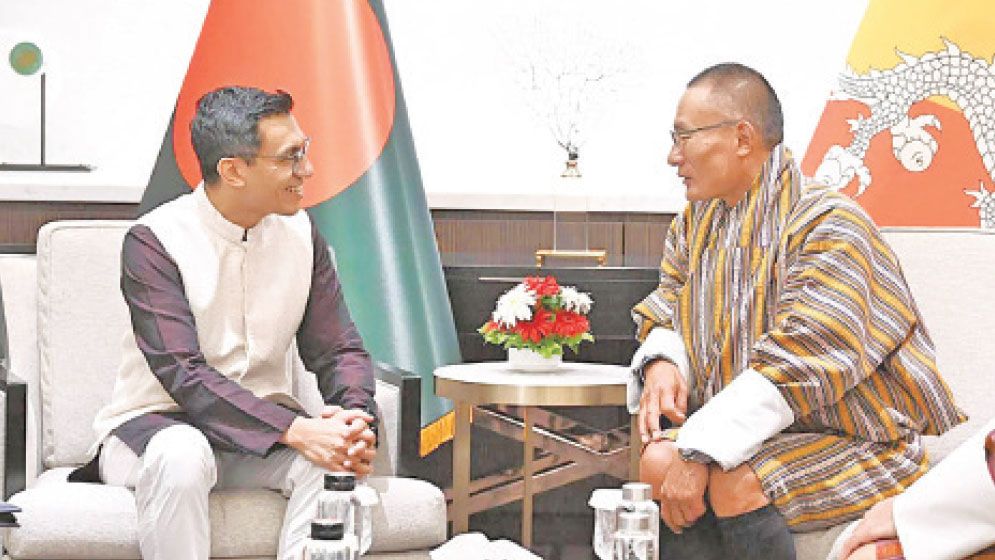
Bangladesh and Bhutan are set to advance a major cross-border development initiative – the Kurigram-Gelephu Economic Corridor – as both countries push to deepen economic ties and boost regional connectivity.
Anchored in a Government-to-Government (G2G) Special Economic Zone in Kurigram and linked to Bhutan’s planned Gelephu Mindfulness City, the corridor is expected to reshape investment flows and create new opportunities for trade and industrial collaboration.
During a high-level bilateral meeting in Dhaka yesterday, Bhutanese Prime Minister Dasho Tshering Tobgay stressed that enhanced connectivity is essential to unlocking the next phase of economic cooperation.
He described the Kurigram SEZ as a “pivotal, future-shaping project” aligned with Bhutan’s vision for sustainable and innovation-driven development.
A transformative partnership
The Kurigram SEZ, being fast-tracked by the Bangladesh Economic Zones Authority (BEZA) and the Bangladesh Investment Development Authority (BIDA), is designed to integrate directly with Gelephu Mindfulness City, Bhutan’s emerging administrative and economic hub.
“Kurigram and Gelephu can become complementary engines of a shared economic future,” said Ashik Chowdhury, executive chairman of BIDA and BEZA.
“Bangladesh offers scale, skilled labour and global market access. Bhutan brings sustainability, innovation and wellness. Together, we can create a new model of cross-border cooperation.”
Officials say the corridor will facilitate seamless movement of goods, foster industrial linkages and enable new value chains between the two neighbours.
Bhutan eyes Bangladesh’s financial sector
Prime Minister Tobgay also expressed interest in exploring investments in Bangladesh’s expanding banking and financial services industry.
He said Bhutan will soon send a high-level business delegation to assess potential opportunities.
Bangladesh highlighted recent reforms, including simplified repatriation procedures, tax modernisation and improved port efficiency, as part of its strategy to become a regional investment hub.
Strategic edge for Kurigram
BEZA officials noted Kurigram’s geographic advantage, with close proximity to Bhutan and direct access to the Sonahali and Roumari land ports and the Chilmari river port – routes that could significantly cut transport time and logistics costs for Bhutanese exporters.
So far, 133.92 acres have been acquired for the SEZ, with an additional 61.87 acres under acquisition.
BEZA is implementing five major economic zones, including the Mirersarai-based National Special Economic Zone, and has outlined a 10-year plan to develop four more zones – one dedicated to Bhutan in Kurigram.
Bangladesh’s G2G model has already gained global confidence, with the Japanese Economic Zone in Araihazar now operational and similar partnerships with China and others advancing.
Trade gaining momentum
Bilateral trade, while modest, is growing. In FY24, Bangladesh-Bhutan trade reached US$48.36 million, reflecting rising engagement and future potential.
The Bhutanese delegation included Ambassador Rinchen Kuentsyl and senior officials from the ministries of Health, Commerce and Industry.
Officials from BIDA, BEZA, the Ministry of Foreign Affairs and the Bangladesh Embassy in Thimphu represented Bangladesh.
As the two countries prepare to operationalise the Kurigram-Gelephu corridor, the initiative is increasingly seen as a model for cross-border development, bringing together sustainability, connectivity and shared prosperity.